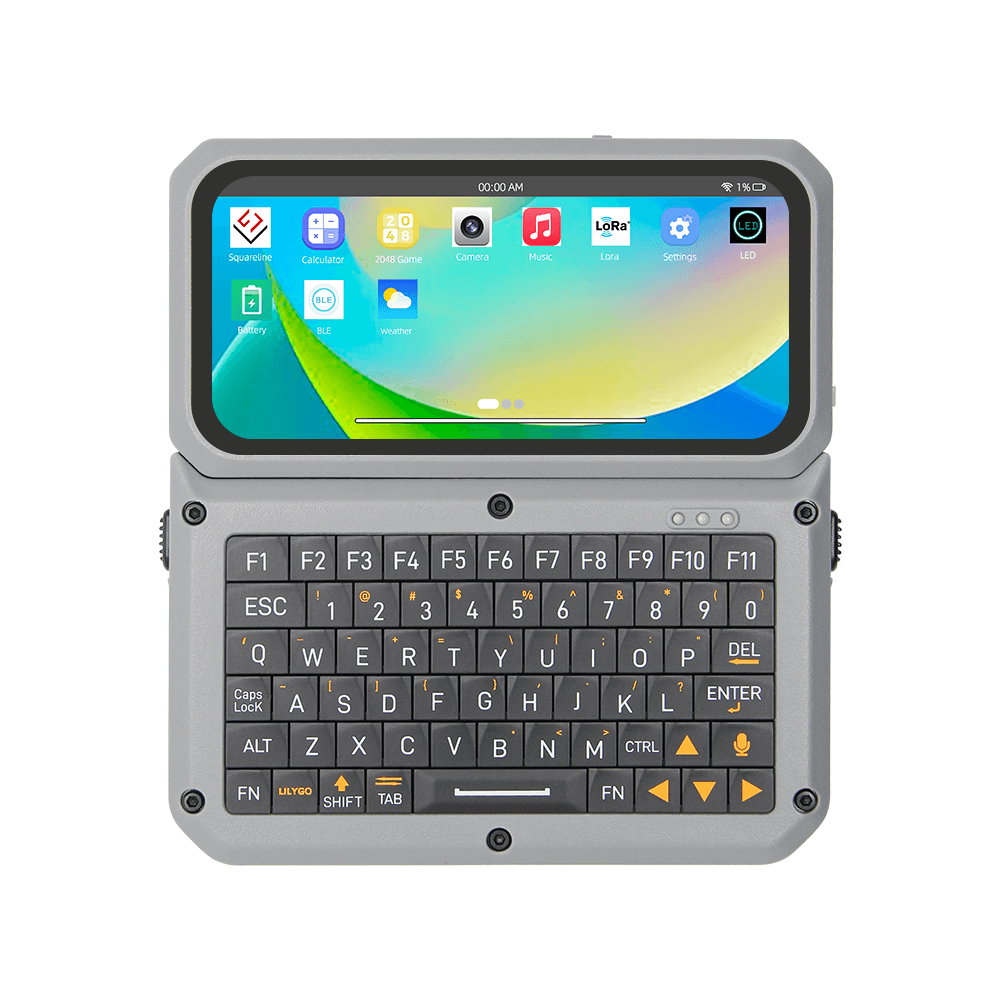
It looks like a smartphone, but everything inside points at developers. LILYGO's T-Display K230 Kit packs a RISC-V processor, a 4.1-inch AMOLED panel, LoRa radio and a detachable QWERTY keyboard into one small handheld. It builds on the existing T-Display K230 by adding the keyboard and a dedicated enclosure, with pricing that starts at 150.31 USD (about 23,900 yen). The target is anyone who wants to build a device that can still send text where there is no cellular coverage.
A RISC-V chip that carries its own AI block
The SoC is Kendryte's K230. It has two 64-bit RISC-V cores clocked at 1.6GHz and 800MHz respectively, an asymmetric pairing meant to split heavy workloads from lightweight always-on tasks.
What stands out is how much sits alongside those cores. There is a KPU for AI inference, a DPU for 3D work, a 2.5D GPU for drawing, and a VPU that handles H.264 and H.265. Image recognition and video decoding can therefore be pushed onto dedicated blocks instead of the general-purpose cores. Memory is 1GB of LPDDR4 (8Gb), and storage comes from a microSD slot on the side of the enclosure.
The 4.1-inch AMOLED that fills the front uses an RM69A10 driver at 568 x 1232 pixels. The camera is a 2MP GC2093 capable of 1080p capture, and the module rotates forward so it can face either outward or back at the user. HDMI output is also present, driving an external display at up to 1080p and 30fps.
Three ways to talk, including off-grid
Having three separate radios and ports is what gives this board its character.
Wi-Fi runs on an RTL8189 module covering 2.4GHz IEEE 802.11 b/g/n. Wired networking goes through an RC01812 controller to a full-size RJ45 port, so a device this small can accept a LAN cable. Selected configurations add an SX1262 LoRa transceiver covering the 868MHz, 915MHz and 923MHz bands, and a separate variant uses the LR2021 across 830 to 940MHz.
LoRa is slow, but it draws very little power and can reach several kilometers with a clear line of sight. Because it needs neither a base station nor an internet connection, it has found use in mountainous areas, at events and in disaster response. Add a physical keyboard and the device becomes a small radio you can type messages on directly. MMCX connectors on the enclosure allow an external antenna to be fitted.
Built to be opened up
The expansion side is thought through as well. Beyond the K230 there is a companion nRF52840 microcontroller with its own header, exposing GPIOs plus 3.3V, 5V and ground. A separate USB port is dedicated to nRF52840 debugging, and SWD signals are reachable through the expansion interface. A Qwiic connector is available for attaching I2C peripherals without wiring anything by hand.
Elsewhere there are two USB Type-C ports (one for 5V power, the other for USB OTG), a 3.5mm headphone jack, an onboard microphone and speaker driven by a MAX98357A amplifier, and an internal AHT20 sensor for monitoring temperature. The main unit measures 104 x 51 x 15.5mm without the keyboard, and power input is rated at 5V/500mA.
The keyboard detaches and offers a QWERTY layout with a number row, function keys, arrow controls, modifier keys and extra navigation buttons. On the software side, CanMV/RT-Smart firmware is published, and the GitHub repository notes that version 1.3 adds support for the LR2021, battery functions, the keyboard, GPS, LTE-M, a fan, the speaker and the AHT20 sensor. Sample code and build instructions live in the same place.
Priced piece by piece
The kit is not sold as a single bundle. The CoreSet with the SX1262 at 868MHz is 150.31 USD (about 23,900 yen), while the LR2021 Core Unit covering 830 to 940MHz is 153.01 USD (about 24,300 yen). Keyboards are separate: 113.25 USD (about 18,000 yen) with an nRF9151 module and 70.94 USD (about 11,300 yen) without it.
1 USD = 159 JPY (as of August 24, 2026)
Pairing the main unit with a keyboard lands somewhere around 35,000 yen, which is mini PC territory. But this is not a finished product. It is a base with the SoC support circuitry, radios and an input device already in place, and assembling an equivalent setup from a breadboard would cost considerably more effort.
Summary
The T-Display K230 Kit combines an AI-capable RISC-V SoC with an AMOLED panel, a camera, LoRa, wired Ethernet and a physical keyboard. The shape says smartphone, but the intent is off-grid messaging and edge AI experiments rather than phone calls. The presence of an nRF52840 expansion header and a Qwiic connector from the outset makes clear that this is meant to be extended, not simply used as-is. For anyone who prefers to build rather than buy, it is a genuinely interesting starting point.