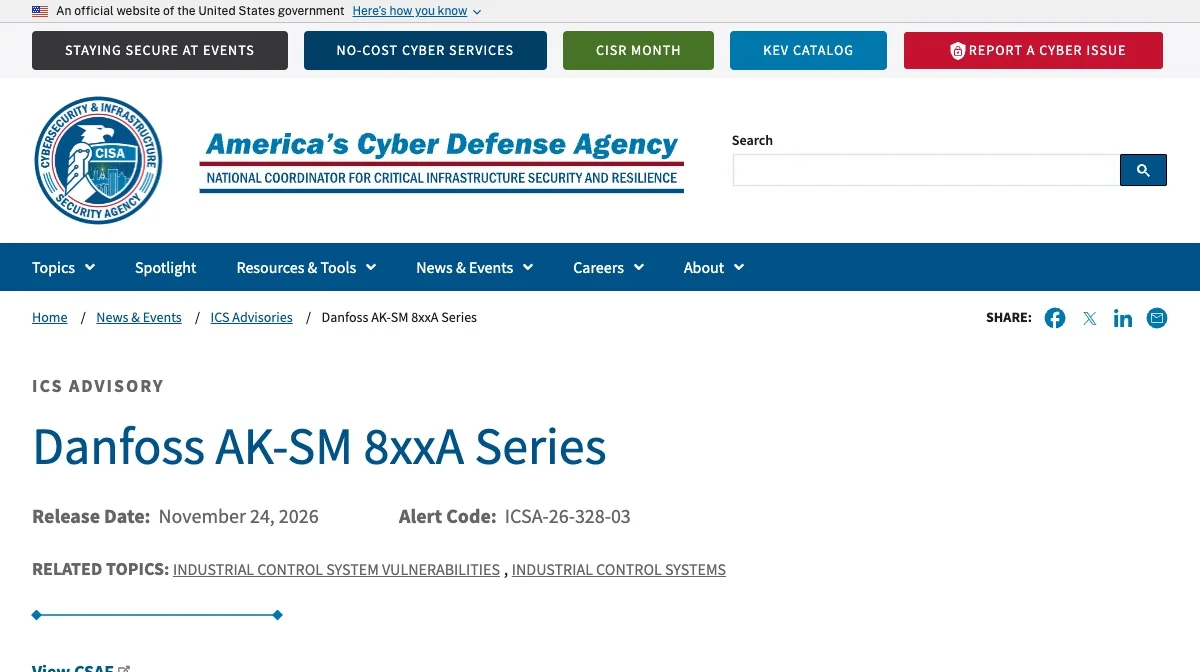
The U.S. Cybersecurity and Infrastructure Security Agency (CISA) published an industrial control systems advisory (ICSA-26-328-03) on November 24, 2026 (U.S. time), warning of a critical vulnerability in the AK-SM 8xxA series of controllers made by Denmark-based Danfoss. The flaw can be exploited remotely without authentication, and no fixed software version had been released as of this writing. Danfoss says the issue will be addressed in an upcoming software release, so operators need to protect their systems on their own until then.
Versions 5.4.0 and Earlier Are Affected, With a CVSS Score of 9.8
According to the advisory, AK-SM8xxA versions 5.4.0 and earlier are affected. The vulnerability is tracked as CVE-2026-129713 and carries a CVSS v3.1 base score of 9.8 and a CVSS v4.0 score of 9.3, both in the highest "Critical" category.
The flaw is a stack-based buffer overflow (CWE-121). It resides in an unauthenticated CGI handler, and a remote attacker can send specially crafted HTTP/S POST requests to corrupt memory. CISA says this can restart the web server and could potentially allow arbitrary code execution with web server privileges.
| Item | Details |
|---|---|
| Affected | Danfoss AK-SM8xxA, versions 5.4.0 and earlier |
| CVE | CVE-2026-129713 |
| CVSS v3.1 / v4.0 | 9.8 / 9.3 |
| Type | Stack-based buffer overflow (CWE-121) |
| Fixed version | Not yet available as of this writing (planned for 5.5.x) |
Fix Planned for Version 5.5.x, and Strict Mode Will No Longer Be Optional
According to Danfoss's statement included in the CISA advisory, the vulnerability will be fixed in an upcoming AK-SM 800A series software release (version 5.5.x). The advisory does not give a release date.
Danfoss also says future software releases will remove the ability for users to disable "Strict Mode." Strict Mode is an operating mode that tightens session handling, and the company is asking customers to run all affected devices in this mode as an interim measure.
Keeping Devices Off the Internet Is the Key Interim Step
Until a fix is available, Danfoss lists four mitigations. Do not expose devices directly to the internet or assign them public IP addresses. Use a VPN or another protected network architecture for remote access. Configure all affected devices to run in Strict Mode. And use strong, unique passwords for all user and administrative accounts.
CISA likewise recommends keeping control systems off the internet, placing them behind firewalls, and isolating them from business networks. It also cautions that when VPNs are used for remote access, the VPNs themselves must be kept up to date.
Used in Commercial Facilities Worldwide
The advisory lists the product's sector as "Commercial Facilities" and its deployment as "Worldwide." These devices manage store equipment such as refrigeration systems, so a shutdown or tampered settings could directly affect the quality control of goods.
CISA says that, as of this writing, no known public exploitation specifically targeting this vulnerability has been reported to it. The flaw was reported to CISA by an outside researcher. The advisory does not say how widely the product is used in Japan.
Our Take
The fact that a single crafted request, with no authentication, could lead to a restart or code execution is serious. The lack of a stated release date for the fix is also a headache for operators.
That said, an attacker needs a path to the web server, and the risk drops sharply in setups where the device cannot be reached directly from the internet. Danfoss's plan to make Strict Mode impossible to disable is also a step toward eliminating weak configurations at the root. Even so, store equipment is sometimes managed remotely by maintenance contractors, so operators should map out exactly where these devices can be reached from.
Summary
A critical vulnerability rated 9.8 that can be exploited without authentication has been found in Danfoss's AK-SM 8xxA series (versions 5.4.0 and earlier). It affects businesses and maintenance providers that use the product to manage refrigeration and other equipment. A fix is planned for version 5.5.x, and until then operators are urged to keep devices off the internet and run them in Strict Mode.