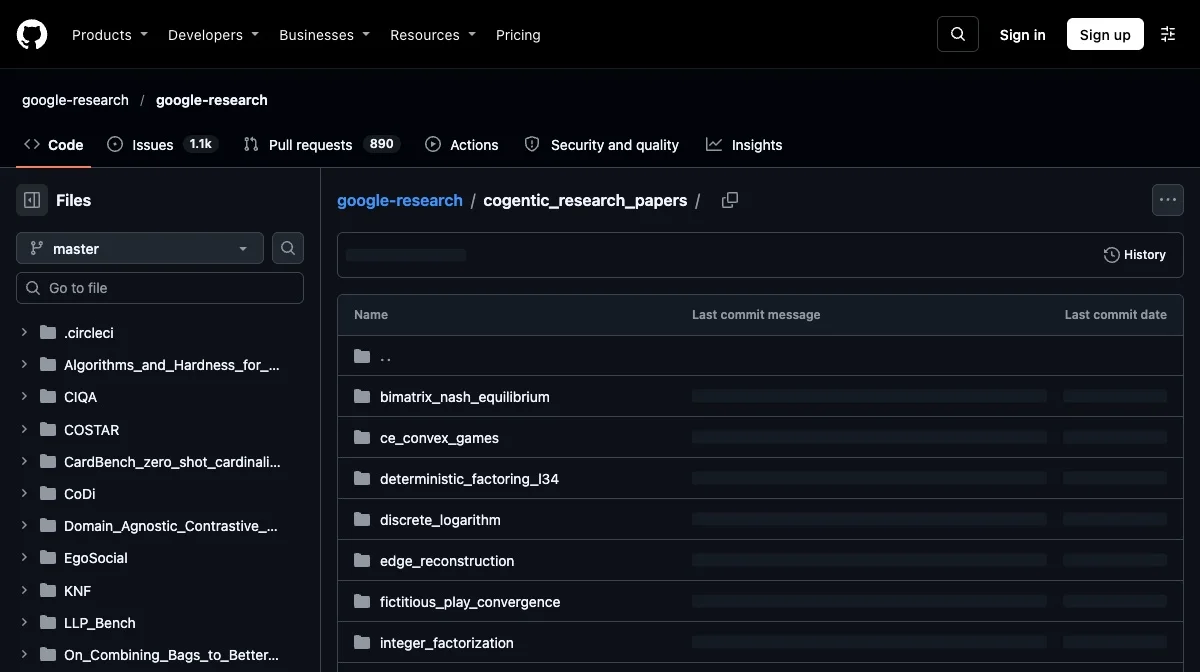
Researchers at Google Research and Google DeepMind on November 25, 2026, published six mathematics papers generated by Cogentic, a multi-agent AI system, in the cogenticresearchpapers directory of the google-research repository on GitHub. The description accompanying each paper states that "There was no human interaction other than the initial prompt for Cogentic to generate a full proof and formalization." The papers tackle open problems at the foundations of computer science, including integer factorization, discrete logarithms and game theory.
Six New Papers Bring the Total to 10
Alongside the six papers dated November 25, the directory lists one paper from October 30, one from November 18 and two from November 23, for a total of 10 as of this writing. Each paper has its own folder containing a PDF and a README.
The six papers added on November 25 are:
| Field | Paper title |
|---|---|
| Integer factorization | Unconditional Integer Factorization in Time L_N[1/3, O(1)] |
| Discrete logarithms | Discrete Logarithms in Finite Fields of Fixed Characteristic in Sub-Quasi-Polynomial Time |
| Game theory | An Exact Polynomial-Time Algorithm for 1/5-Approximate Nash Equilibria in Bimatrix Games |
| Integer factorization (deterministic) | Unconditional Deterministic Subexponential Integer Factoring and Quadratic Nonresidue Construction |
| Communication complexity | Breaking the Square-Root Barrier for the Log-Rank Conjecture |
| Graph theory | Unconditional Edge Reconstruction of Simple Graphs of Linear Density |
The authors are affiliated with Google Research and Google DeepMind, and one of them is also affiliated with Yale University. The README also carries the note "This is not an official Google product," so the release is not a Google product announcement.
Separate Agents Handle Proving and Verification
Cogentic is described in the paper "Cogentic: Multi-Agent Orchestration for Automated Proof Discovery," submitted to arXiv on September 30, 2026. According to the paper, an orchestrator assigns a population of independent provers to distinct proof directions, and specialized components then subject their output to adversarial verification. Confirmed results are stored in a persistent verified ledger that later rounds build on.
As for the underlying model, the arXiv paper says the team used either Gemini 3.1 Pro or an early version of Gemini 4 Argon. The READMEs for the new papers, by contrast, say Gemini 4 served as the base model. In the arXiv paper, the team reported new results on open problems in online learning, auction theory and mechanism design, each independently verified by domain experts.
An Unconditional Subexponential Factoring Algorithm
The factoring paper stands out. Its README describes an unconditional zero-error Las Vegas algorithm, one that does not rely on unproven assumptions, with a worst-case expected running time of L_N[1/3, 105]. Every prime factor in the output is certified deterministically using the Agrawal-Kayal-Saxena (AKS) primality test.
The Nash equilibrium paper deals with two-player bimatrix games. It presents MaximinKiteNE, a deterministic polynomial-time algorithm that outputs a strategy profile in which no player can gain more than 1/5 by deviating (its maximum unilateral regret). The README positions this as an improvement over the earlier 1/3 + δ bound (2023) and roughly 0.30954 + δ (2026).
Lean 4 Formalizations to Come Later; No Mention of Peer Review
The READMEs state that a complete formalization of each proof in Lean 4 (v4.35.0), using only Mathlib, has been completed and will be released in a companion submission. Proofs written in Lean, a proof assistant, can be checked mechanically by a computer. As of this writing, however, the formalization code is not included in the directory.
The READMEs do not say whether the papers have undergone peer review. For now, the results remain claims made by the authors.
Our Take
Producing six papers on the same day from a single initial prompt suggests that AI-driven research automation is moving from one-off results toward something closer to volume output. Once the Lean formalizations are released, experts should be able to confirm correctness without spending months on manual checking.
That said, the factoring result is unlikely to threaten cryptographic security in the near term. The widely used number field sieve is already believed to run at the same L_N[1/3] level in practice; the significance of this claim lies in guaranteeing that bound without assumptions. With a constant as large as 105, it does not show that keys of practical length can be broken quickly.
Still, claims of AI systems independently answering open questions in complexity theory are piling up. Judgment is best reserved until the formalizations are released and experts have checked the work.
Summary
Researchers at Google Research and Google DeepMind have released six math papers on GitHub that they say the AI system Cogentic wrote without human involvement. The work matters to researchers in integer factorization and discrete logarithms, which underpin cryptography, as well as game theory. Lean 4 formalizations of the proofs are slated for later release, and attention now turns to peer review and outside verification.