OpenAI and Cisco announced Shirudo on November 23, 2026 (US time), an open-source tool that protects running Linux systems from vulnerability exploits without waiting for patches to be applied or for systems to restart. Isovalent, the Cisco company behind the project's technology, published technical details in its own official announcement the same day. The name comes from the Japanese word for "shield."
eBPF "Shields" Protect Systems While They Keep Running
In its official announcement, OpenAI explains that Shirudo uses eBPF, a Linux technology that lets small programs run at specific points inside the operating system. For each vulnerability, a countermeasure program called a "shield" is created and loaded onto the running system to detect and block exploitation attempts. Services do not need to be stopped.
In other words, it is a tool for closing the gap until a patch is ready and applied. OpenAI says its goal is to make tested shields available alongside vulnerability disclosures.
In Cisco and Isovalent's official announcement, Isovalent explains that shields can be built not only from eBPF but also from application bytecode. The company showed an example of mitigating the Java vulnerability Java4Shell on Elasticsearch 9.5.5 with a Java bytecode shield. On its official blog, Cisco also states that Shirudo's agent-based approach has already written code that detects and blocks attempts to exploit recent PHP and Java4Shell vulnerabilities.
AI Agents Handle Everything From Investigation to Validation
Shirudo stands out because it is designed from the ground up to be operated by AI agents. OpenAI explains that it provides programmable controls for agents to investigate vulnerabilities, develop targeted shields, and validate their effectiveness. Isovalent cited OpenAI's coding agent Codex as an example of the agent-side control plane.
Even so, security teams decide what goes into production. OpenAI emphasizes that the design keeps deployment decisions in human hands.
The system builds on Tetragon, the eBPF-based security platform Isovalent has developed. Isovalent describes Shirudo as a rewrite of Tetragon designed for agents, adding that Tetragon has also served as the foundation for Cisco's Live Protect capability. Shirudo has no permanently running daemon and is operated through a one-shot command-line tool. On protected systems, an eBPF program loaded at boot acts as the control plane.
Signatures and TPMs Verify Every Shield Before It Loads
Injecting programs deep into a system raises the question of whether those programs can be trusted. Shirudo cryptographically signs shields and verifies them before loading. In addition, the eBPF verifier built into Linux checks that programs comply with its safety rules.
Shirudo also uses a TPM (Trusted Platform Module, a security chip found in PCs and other devices) to keep a verifiable record of which shields were loaded or removed. Isovalent states that shields are built on the operator's machine, packaged as signed .bee packages, and distributed through an OCI registry (a system for distributing container images and similar artifacts). Protected systems check the signatures using TPMs when they pull those packages.
| Item | Details |
|---|---|
| Announced by | OpenAI, Cisco (Isovalent) |
| Announcement date | November 23, 2026 (US time) |
| Platform | Linux |
| Core technology | eBPF |
| Distribution format | Signed .bee packages (via OCI registry) |
| License | BSD 2-Clause (BPF programs dual-licensed under BSD and GPL) |
Operators Can Try It in a VM or an Online Lab
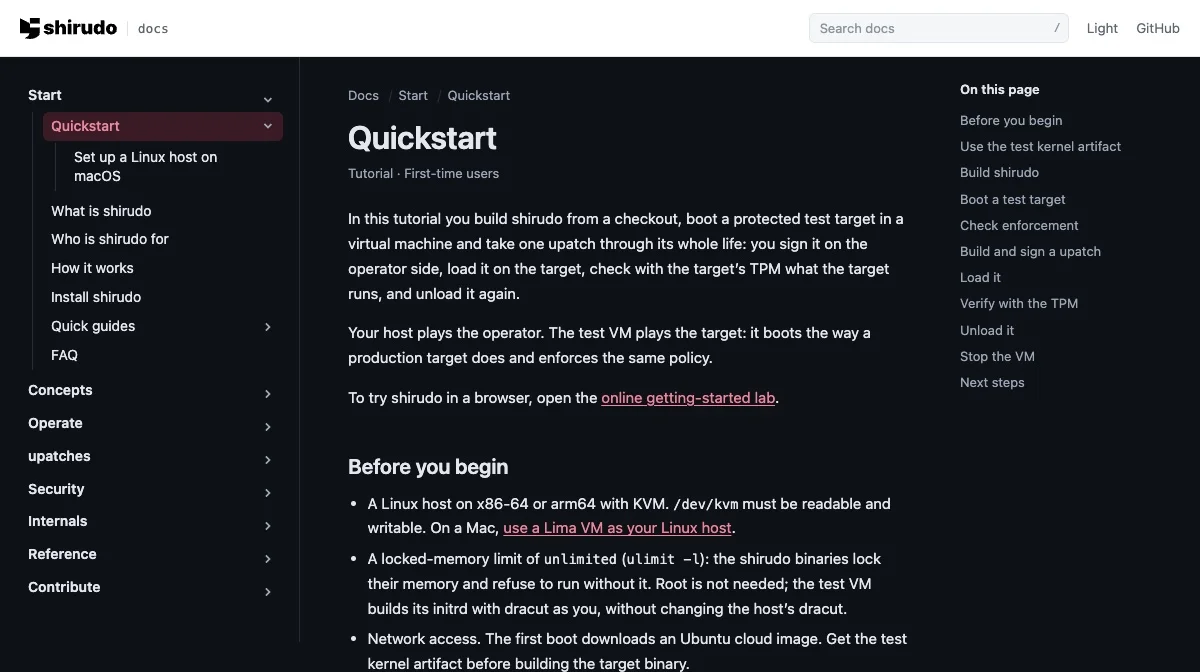
Shirudo's official documentation, which OpenAI's announcement links to, includes a guide for trying it in a virtual machine. It requires a Linux host on x86-64 or arm64 with KVM, and Mac users are directed to use a Lima virtual machine as the host. Those who do not want to set up their own environment can also try it in Isovalent's online lab.
OpenAI also says a webinar explaining Shirudo will be held on December 15. As of this writing, the companies have not announced commercial support or a paid edition.
Our Take
The time between a patch's release and its actual deployment is a persistent headache for many operations teams. It seems significant that a way to stop attacks without restarts has arrived as open source, complete with signature and TPM-based verification.
On the other hand, many organizations will likely be cautious about running AI-generated code so close to the core of the operating system. Operational concerns remain, such as how to verify the quality of shields and whether they might mistakenly block legitimate traffic. Still, the design keeps deployment decisions with humans, and starting by testing its effectiveness in a staging environment looks like a realistic approach.
Summary
OpenAI and Cisco have released Shirudo, an open-source tool that protects running Linux systems with eBPF shields. It is relevant to server operators who need time to apply patches, as well as to security teams. A webinar is scheduled for December 15, and the key question going forward is how consistently tested shields will ship alongside vulnerability disclosures.