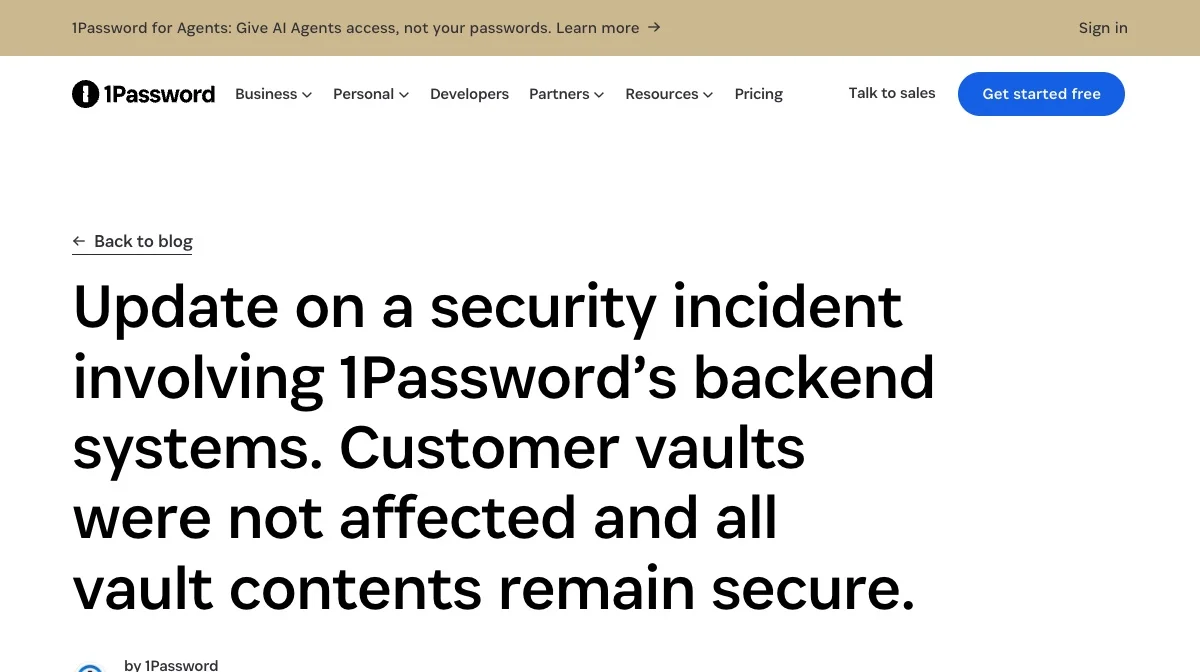
1Password, the company behind the password manager of the same name, announced in an official blog post on November 25, 2026, that an attacker had gained unauthorized access to its backend systems. The attacker abused an employee's corporate GitHub account and downloaded account records, including names and email addresses, for a subset of users. The company says customer vaults and their contents were never accessed.
It started with an employee's GitHub account, investigated from November 19
According to the company, it began investigating on November 19 after finding indications that an attacker had accessed an employee's corporate GitHub account. The attacker used that account to access source code and push malicious code to backend services. That code then downloaded administrative data about customers.
The attacker also copied source code from private repositories and gained access to the company's CI/CD system, the pipeline that automates software builds and delivery. 1Password acknowledged that the CI/CD system holds infrastructure-related secrets needed for its product to work, and said it has rotated all credentials that may have been exposed. As of this writing, the company has not disclosed how the employee's account was compromised.
Names, email addresses and other account records were taken
The stolen data consists of account records for "a subset of our users." The table below lists the items 1Password named and how the company characterizes each one.
| Item taken | 1Password's explanation |
|---|---|
| Names and email addresses | ― |
| Account and user identifiers, account creation and last sign-in times | ― |
| Public keys | Public by design, with no impact on user security |
| SRP (a protocol that verifies identity without sending the password itself) parameters | Cannot be used to access an account |
| Some tokens in invitation, provisioning and account recovery emails | A token alone cannot access an account |
| Metadata such as version and file numeric identifiers | Not secret information |
The company has not said how many users were affected. The tokens involved only a small number of users who were partway through an invitation or recovery process, and those users have been notified individually. 1Password has also lengthened the codes used for invitations and recovery from six numeric digits to ten alphanumeric characters.
Vaults, keys, apps and browser extensions were not affected
The company states that vault contents were at no time accessed by, or available to, the attacker. Items it lists as unaffected are vaults and the items in them, the keys that protect vaults, account recovery keys, and its apps and browser extensions. 1Password also notes that it does not store users' account passwords or Secret Keys.
The company says its services are working normally, with no impact on availability or product security. Its response included disabling the affected GitHub account, revoking the stolen token, removing access the attacker created, rotating internal credentials, and tightening GitHub, CI/CD and endpoint controls while adding new detections. It has also brought in independent cybersecurity experts to validate its containment and remediation. The company says it has found no internal evidence of account takeovers using the exposed tokens.
What users need is phishing awareness, not account changes
1Password says users do not need to update anything in their 1Password accounts. At the same time, it urges caution about unexpected emails, texts or calls that mention 1Password. The company says it will never contact users to ask for their account password or Secret Key.
Users who receive a suspicious message are asked to report it to 1Password support. The company also reminded users to keep their Secret Key and account password safe.
Our Take
The attacker got inside the company's systems yet never reached vault contents, and that appears to owe a great deal to a design in which 1Password does not store passwords or Secret Keys. Explaining the security impact of each stolen item one by one should also help users judge the situation for themselves.
However, because names and email addresses leaked together, attackers could send targeted phishing to people they know are 1Password users. The fact that a single employee account led all the way to the CI/CD system is also a serious lesson for software companies in general. That said, there is little users need to do right now. Never entering a password or Secret Key anywhere other than the official apps and website should greatly reduce the immediate risk.
Summary
1Password announced that an intrusion starting from an employee's GitHub account led to the theft of names, email addresses and other records for some users. The company says vaults, passwords and apps were not affected, and users do not need to change their account settings. 1Password says it will update its blog post if it finds anything that changes what it has said.