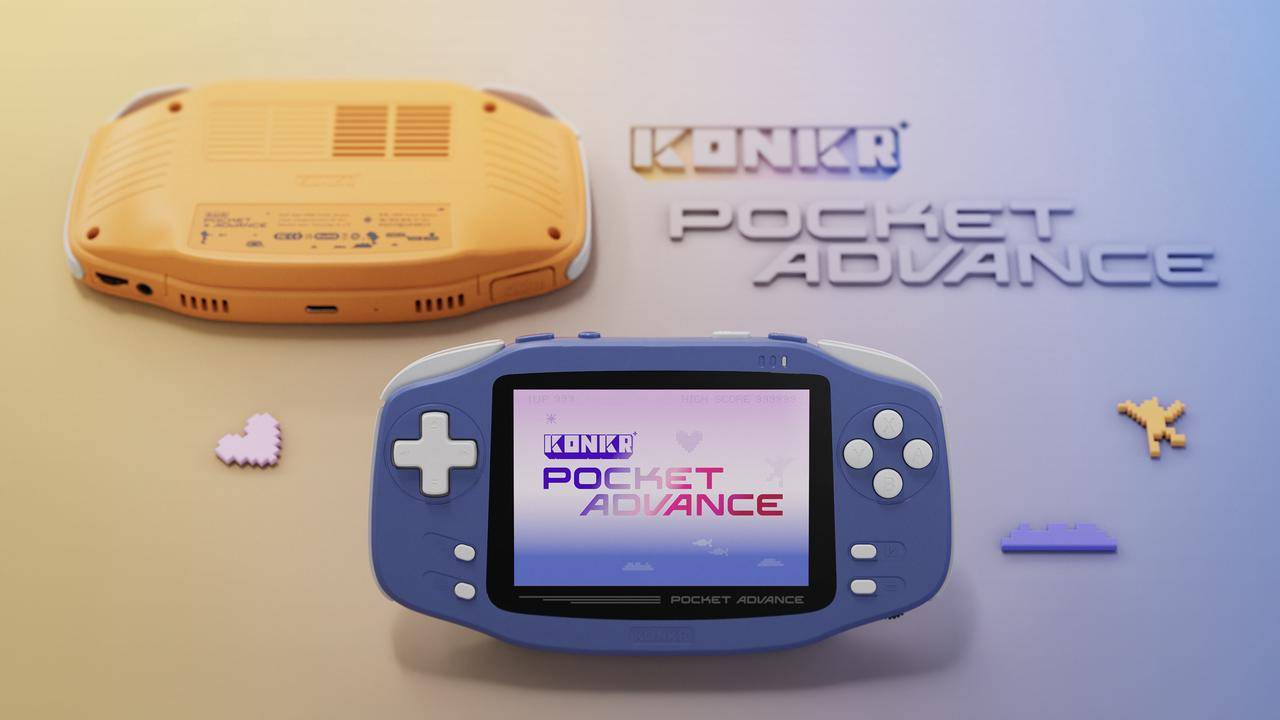
KONKR, a sub-brand of AYANEO, has shown the production unit of its horizontal Android handheld, the KONKR Pocket Advance. During a product sharing session streamed on July 31 by AYANEO CEO Arthur, the company disclosed a 3.5-inch 960 x 640 LCD, a 151.3 x 82.4 x 22 mm body, and a weight of roughly 224 grams. Two colors are planned: Navy Blue and Coral Orange. The processor, battery capacity, price, and release date remain unannounced.
A 151.3 x 82.4 x 22 mm body weighing about 224 grams
The Pocket Advance carries the layout of the golden-age landscape handheld straight into the present, with the screen at the center and buttons on either side. The outline is rounded, the body curves inward to match the natural grip of both hands, and an anti-slip texture runs across the surface. KONKR describes the result as a balance between retro sentiment and modern holding comfort.
The body measures 151.3 x 82.4 x 22 mm and weighs approximately 224 grams. KONKR positions it as a device that slips into a pocket, and the 151 mm width does sit close to the height of a typical smartphone. The 22 mm thickness sounds substantial by phone standards, but on a device you hold by its grips, that depth is what your fingers wrap around. Judging the ergonomics from the number alone would be a mistake.
Two colorways are planned. Navy Blue leans on a calm, classic blue, while Coral Orange takes a brighter warm tone. Both are tuned to evoke the palette of the pixel era.
3.5 inches at 960 x 640, scaling pixels 4x without breaking them
The display is a 3.5-inch LCD with a 3:2 aspect ratio and a 960 x 640 resolution. KONKR says the panel reproduces retro game graphics accurately through 4x point-to-point display technology.
That is the most meaningful detail in the announcement. The Game Boy Advance ran at 240 x 160 in a 3:2 frame, and 960 x 640 is exactly four times that in both directions, so each original pixel maps cleanly onto a 4 x 4 block. Non-integer scaling leaves pixels at uneven sizes, which blurs edges and produces stair-stepping. Stretching is the single factor that most often ruins emulated retro games, and matching the aspect ratio and resolution up front removes the problem entirely.
In other words, the panel spec is not a headline number. It is worked backward from the conditions under which period pixel art looks its best. The panel is an LCD rather than an OLED, but for this use case a clean pixel grid matters more.
Buttons expanded to ABXY plus L2 and R2, built from conductive rubber
The control layout follows the classic landscape arrangement while adding buttons. The D-pad and the ABXY buttons use conductive rubber, tuned for clear tactile feedback. Where the original Game Boy Advance offered A and B, this device provides four face buttons.
The shoulders combine large L1 and R1 buttons shaped to the fingertips with separate L2 and R2 buttons. L1 and R1 are enough for GBA software, but for titles from generations with more inputs, and for Android games in general, the extra pair makes a practical difference.
USB Type-C, micro SD, and AYANEO's Android software stack
Connectivity consists of a USB 2.0 Type-C port supporting data transfer and PD fast charging, plus a micro SD card slot for adding game content. Wireless support covers Wi-Fi 5 and Bluetooth 5.0. A 3.5 mm headphone jack and a volume wheel on the side also return.
On the software side, the handheld inherits AYANEO's in-house Android environment. AYASpace handles retro game management, AYAHome serves as the custom launcher, and AYASetting manages handheld-specific settings, so players are not left assembling emulators and files on their own. Sharing a foundation with existing AYANEO Android devices is a straightforward advantage for a sub-brand product.
Processor, battery, price, and release date still blank
Several fields remain unfilled. The processor, memory, storage, and battery capacity have not been disclosed. On a handheld, the chip determines how far up the console generations the device can comfortably reach, so the playable ceiling cannot be assessed until that information arrives.
KONKR has also said nothing about pricing or timing. AYANEO tends to release product details in stages, and this hands-on reveal is one step in a sequence that began with the design unveiling in mid-July. Whether the handheld will be sold officially in Japan is undecided.
Summary
The KONKR Pocket Advance is a landscape Android handheld whose 3.5-inch 3:2 LCD at 960 x 640 scales the Game Boy Advance's 240 x 160 by exactly four. A 151.3 x 82.4 x 22 mm body weighing about 224 grams houses four ABXY face buttons, separate L2 and R2 shoulders, USB Type-C, a micro SD slot, Wi-Fi 5, and Bluetooth 5.0, and it runs AYANEO's own Android software stack. What remains open is the processor, the battery capacity, the price, and the release date.