iRobot has shown Roomba Duo at IFA 2026, a floor cleaning system built around two robots of different sizes working as a pair. The larger unit carries a mechanical arm on its top deck that lifts an ultra-slim companion robot and lowers it into places the main unit cannot enter, such as the space under furniture. The main robot loosens grime with steam before scrubbing it away, while the companion handles gaps and edges. What appeared in Berlin is a prototype, and no price or launch date has been given.
A vacuum that carries another vacuum
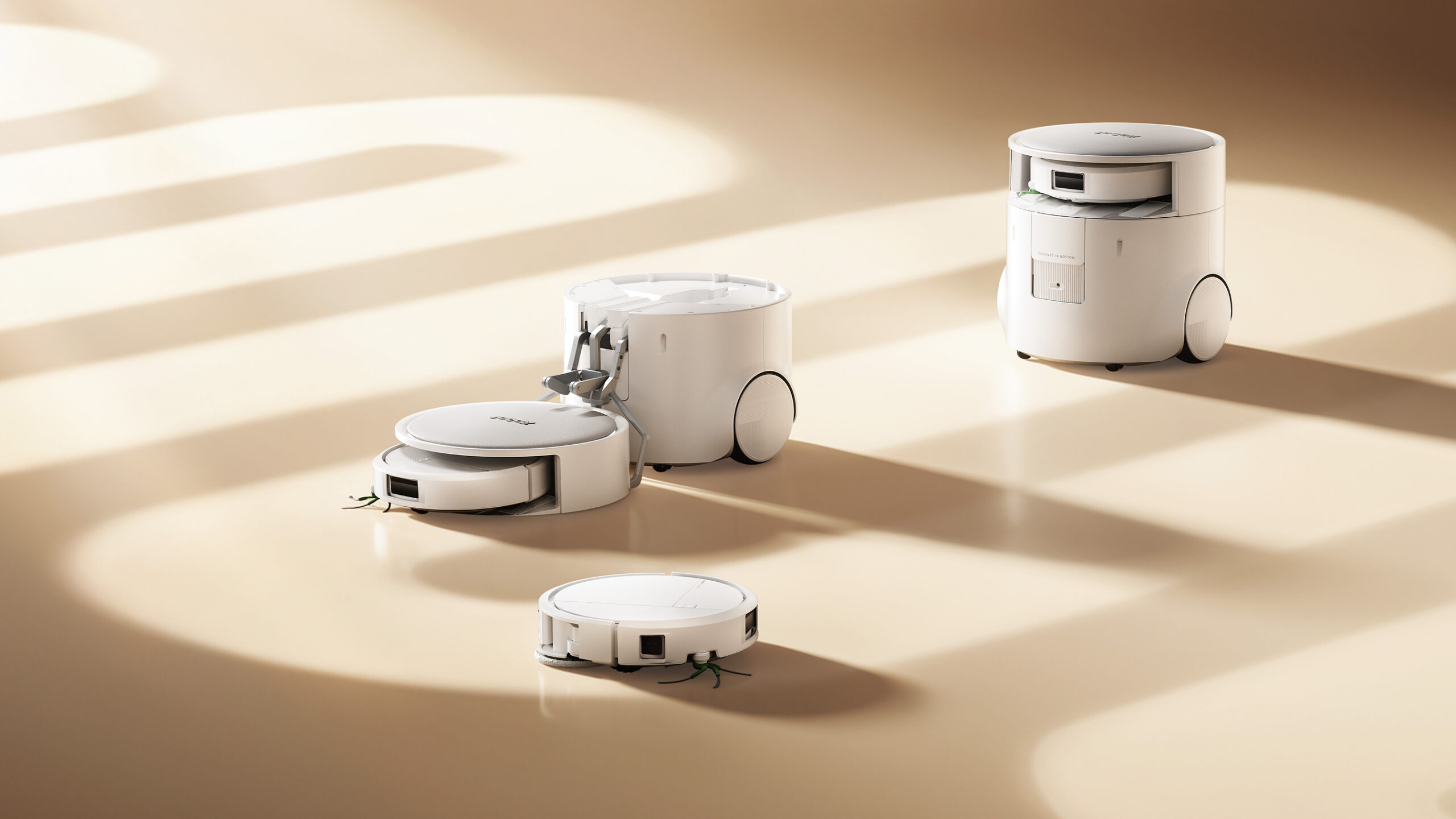
The most striking part of Roomba Duo is that one robot vacuum rides on another. The main unit has a mechanical arm on its top surface, and the end of that arm stays level as the arm moves. That design keeps the machine steady while it holds the weight of the second robot. When it reaches the target area, the arm lowers and releases the companion onto the floor.
The division of labor is clear. The main unit takes on large, open floors, handling suction and wet cleaning in a single pass. The companion covers what a taller machine physically cannot reach, including the space beneath furniture, the gaps between chair legs, and along walls. The two robots share the same home map through the Roomba Home App and communicate in real time to decide who cleans what.
Rather than asking a single robot to do everything, iRobot splits the job between two machines with different strengths and lets one carry the other. That, the company argues, is how you expand the area a single cleaning run can actually cover.
The main unit leans toward washing rather than vacuuming
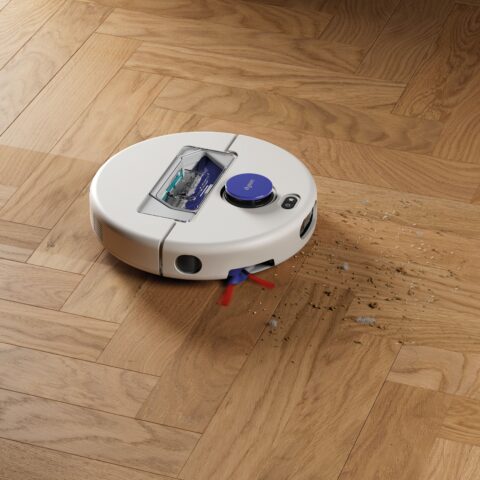
The main unit looks quite different from the usual disc-shaped robot vacuum. Its cylindrical body creates more internal volume, which houses a wet and dry washing module, a high-output motor, and a large battery. It is the opposite of a design that chases slimness.
Washing is handled by the PowerSpin Max roller mop, which measures 60mm in diameter. It presses against the floor with 46 newtons of force, roughly equivalent to 4.7 kilograms, while it spins. The goal is to apply pressure close to what you get scrubbing by hand.
The sequence matters too. A heater inside the machine first produces steam and spreads it evenly across the target area to loosen baked-on dirt, without exposing the floor to excessive heat. The roller then turns while continuously washing itself, picking up the loosened dirt and sticky messes such as pasta sauce and cooking grease. Finally, a hot-air drying component behind the roller dries the wet surface, so wooden floors are not left damp for long.
The machine rides on 17cm wheels driven by hub motors, which gives it more stability as it moves between rooms.
The companion is a robot that is already on sale
The companion robot demonstrated at the IFA booth is not a new design. It is the Roomba Plus 575 Combo, which launched earlier in 2026. At 8.35cm tall and 29.8cm wide, it slips between dining chairs and moves under low beds, sofas, and TV cabinets.
Corners are handled by a PerfectEdge mop pad that extends up to 31mm outward, combined with an extended edge sweeping side brush, so it works its way along walls, baseboards, and irregular edges automatically. Air-lift omni-wheels let it climb thresholds up to 3.5cm and carry on into the next room.
Reusing a shipping product as the companion is a sign that this concept is more than a drawing on paper.
Mapping and maintenance both live at the dock
Both robots use the same navigation stack, combining ClearView Pro dual-line LiDAR with PrecisionVision AI to identify and avoid household obstacles. The main unit adds top-mounted AI cameras that look out over rooms, furniture, and floor layouts from a higher vantage point. That helps build detailed maps across homes with many rooms and pick out larger stains or spots where debris tends to pile up.
Routine upkeep falls to the AutoWash dock. It centralizes the clean water supply and the wastewater tank, washes and dries the mops automatically, and empties collected dust into a large bag, aiming for months of hands-off use. The dock is shared by both robots and is described as self-navigating.
Hao Li, CEO of iRobot, has said that instead of asking one robot to do everything, building specialized robots that work together as a single intelligent system is what lays the groundwork for a home that takes care of itself.
A prototype on display, not yet a product
It is worth being clear that Roomba Duo was not announced as a retail product. It was displayed at IFA 2026 as a prototype, with no pricing, launch timing, or sales regions disclosed. There is no information on availability in Japan at this point.
The exhibit is at Booth 133 in Hall 9 of Messe Berlin, running from September 4 to 8. The booth also has iRobot's 2026 flagship Roomba Max 875 Combo, the Roomba Plus 675 Combo, and the Roomba Plus 575 Combo.
Robot vacuums have long forced a choice: give up autonomy to get real mopping power, or give up mopping power to get autonomy. Roomba Duo tries to escape that trade-off not by compromising within one machine but by splitting the work across two. Whether the arm mechanism that carries the companion can be made durable and affordable enough for mass production is what will decide the fate of the idea.
Summary
Roomba Duo is iRobot's first two-unit robot cleaner, pairing a main robot that washes floors with steam and a high-pressure roller with an ultra-slim companion that handles the space under furniture and along edges. An arm on the main unit's top deck lifts the companion and lowers it into tight spots, and the two work from a shared map and a shared AutoWash dock. The companion is the already-released Roomba Plus 575 Combo. For now it remains a prototype, with no price and no launch date.