
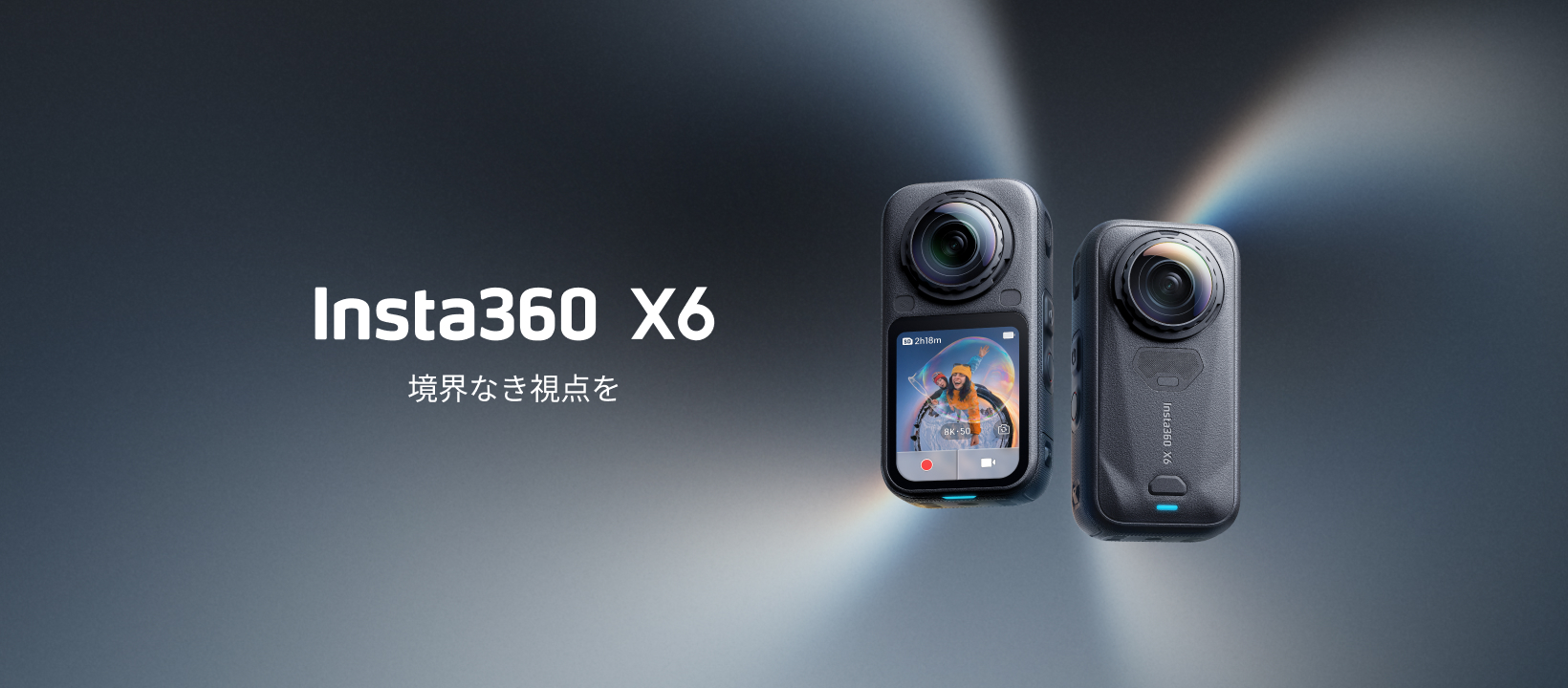
Insta360's new flagship 360 camera, the X6, went on sale in Japan on August 12, 2026, with the standard version priced at 118,000 yen. Larger dual sensors push the camera into 1-inch-equivalent 360 capture, and a single tap switches it between a 360 camera, a subject-tracking gimbal camera, and a conventional action camera. Low-light performance and battery life are the two areas where the jump from the X5 is easiest to feel.
Bigger sensors aimed squarely at the low-light problem
The X6 uses custom-designed dual Sony 1/1.1-inch square sensors, which amount to 1-inch-equivalent 360 imaging. Sensor area is 33 percent larger than on the X5, and the camera takes in 4 times more light per frame.
Because 360 cameras are structurally forced to use small lenses, noise in evening shots and heavy backlight has long been their weak point. This generation attacks that with sheer sensor area. Processing has been rebuilt around a triple AI chip layout: an 8-core 3.3GHz 4nm processor paired with two dedicated image processing chips. Insta360 says processing performance is up 500 percent over the X5, clock speed is 106 percent faster, and power draw is 35 percent lower.
A new low-light mode uses two ambient light sensors to suppress flicker, while AdaptiveTone 2.0 takes two exposures per frame to widen dynamic range. The X6 is also the first 360 camera to handle Dolby Vision natively in-camera. With 10-bit color and more than 1.07 billion colors, footage holds up straight out of the camera.
Switching between 360, gimbal, and action modes with one tap
The clearest statement of intent here is what Insta360 calls the 3-in-1 camera ecosystem. A 360 camera, a subject-tracking gimbal camera, and a single-lens action camera all live in one body, and you move between them by tapping the screen.
In 360 mode the camera records everything around it at native 8K30fps, so framing can be chosen after the fact, as many times as you like. InstaFrame 2.0 recognizes people, pets, and objects, keeps them in frame, and outputs a flat 4K video directly from the camera with no editing step. Add the new folding selfie stick remote kit and you can steer the framing with a joystick, which removes the need to carry a separate gimbal.
Switching to single mode turns the X6 into a straightforward action camera at up to 5K60fps, with a 170-degree ultra-wide field of view at 5K30fps and 4K120fps for slow motion. Those are numbers that hold their own against dedicated action cameras.
More than 100 accessories are supported, and the magnetic mount system is shared with the X5, X4 Air, and Ace series, so existing gear carries over. Motorcycle riders get a holographic speed dashboard overlay, an AI auto-loop dash mode, and automatic license plate blurring. Cyclists can overlay ride data from Garmin or Apple Watch. The Invisible Dive Case Pro takes the camera down to 60 meters.
Battery and lenses: the everyday details
The display is a 2.32-inch OLED that reaches 1200 nits and supports always-on operation. It stays readable in direct sunlight, and because the whole screen acts as a press-to-shoot surface, it works with gloves on.
The new 2600mAh Extreme battery records 140 minutes of 8K30fps 360 video on a single charge, 51 percent longer than the X5, and goes from 0 to 80 percent in 24 minutes. It is rated to operate down to minus 20 degrees Celsius. Heat during long 8K sessions is handled by Insta360's Star-Ridge cooling system and an insulated grip.
The Replaceable Lens 2.0 design deserves attention as well. Scratch resistance is 5 times higher than before, and replacement costs 60 percent less than the previous generation. Exposed lenses have always meant that a scratch equals a repair bill on a 360 camera, so making that repair cheap is a practical improvement. The body itself is waterproof to 20 meters (IP68), and 47GB of the 64GB internal storage is usable, so you can start shooting even without an SD card.
On audio, a wind-resistant 4-mic array covers all directions, and a dedicated Hidden Engine mic mode tuned for riders suppresses wind noise while keeping engine sound intact. Transfers run at up to 100MB/s over Wi-Fi 6.0 and up to 450MB/s over USB 3.0.
The edit is finished while the camera charges
The other pillar of the X6 is an AI foundation called PanoMind, trained on more than 10,000 hours of footage across over 30 scene types including travel, daily life, winter sports, motorcycling, and diving. What sets it apart is that it understands a full 360 scene rather than a flat frame.
While the X6 charges, the AI Director inside PanoMind builds a highlight reel from the clips on the camera and sends the finished result to the app. The analysis runs on the camera rather than in the cloud, and the feature can be turned off. For people who want more control, Auto Edit 2.0 handles framing, camera movement, cuts, music, and transitions in a single tap.
On the cloud side, Insta360+ Cloud offers up to 2TB, and shared links open as a full 360 view rather than a flattened video. Uploaded files can be worked on in Moments Pro, Insta360's cloud editing tool built on Google Gemini. A separate Spatial Capture feature generates a 3D Gaussian splatting model from your footage, letting you walk back through a location as a navigable 3D space.
Pricing and launch offers
The X6 has been available since August 12, 2026 through the Insta360 official store, Amazon, and authorized retailers. The standard version is 118,000 yen, and the Essential Kit, which bundles accessories, is 135,000 yen.
Buy and activate an X6 by September 30, 2026 and you get one year of Insta360+ Premium cloud storage (500GB) plus a three-pack Moments Pro trial at no extra cost. Activating an X5 or X4 Air in the same window earns one year of the 200GB Premium tier. Insta360 FlexiCare is available as an option and covers up to 4 replacements over 2 years. A free replacement policy applies to all early buyers for 90 days after launch, and a Trade-In program discounts the X6 against older gear.
Summary
The Insta360 X6 pairs 1-inch-equivalent dual sensors with a triple AI chip to shore up low-light performance, then folds 360, tracking gimbal, and action shooting into one device you switch with a tap. Shoot at 8K30fps and you can pick your angle later, and the camera assembles a highlight video while it charges. At 118,000 yen for the standard version this is not a casual purchase, but for anyone who has been carrying several cameras at once, consolidating down to one body is a reasonable trade.