

GMKtec showed its flagship mini PC, the EVO-X5 Pro, at IFA 2026. It pairs AMD's Ryzen AI Max+ PRO 495 with up to 192GB of unified memory, and the company says it can run large language models of up to 300 billion parameters without sending anything to the cloud. GMKtec frames the machine as an entry point to the agentic PC, a computer that does more than wait for instructions.
Memory capacity sets the ceiling
The headline number on the EVO-X5 Pro is 192GB. The system uses LPDDR5X-8533, and up to 160GB of that pool can be allocated to the integrated GPU as VRAM. Memory bandwidth is roughly 273GB/s.
No game will ever use 160GB of VRAM. That allocation matters for local inference, where the goal is to keep an entire model resident in memory. Even quantized models grow their memory footprint in step with parameter count, so the largest model you can run on a desktop is decided by how much memory you have. At 192GB, the number translates directly into model size.
A working unit was on the show floor. In a demo running Qwen3.8-Flash-Next, output tokens were reportedly generated well into double-digit rates per second, which is fast enough for interactive use.
The Ryzen AI Max+ PRO 495 underneath
At the center is AMD's new SoC, the Ryzen AI Max+ PRO 495. The CPU side has 16 Zen 5 cores and 32 threads, with boost clocks reaching 5.2GHz. The integrated GPU is a Radeon 8065S with 40 compute units and hardware ray tracing support.
The NPU is XDNA 2, rated at up to 55 TOPS. Because the CPU, GPU and NPU share the same memory pool, there is far less copying of data back and forth when a large model is in play. GMKtec's reason for choosing this SoC probably has more to do with that unified memory design than with raw compute.
Built for data that cannot leave the building
GMKtec lists government, healthcare and life sciences, finance, legal and compliance, and confidential research as target use cases. All of them share a constraint: sending the data to an external cloud service is difficult in the first place.
The feature set reflects that. The machine supports AMD DASH for OS-independent remote management and carries a separate wired LAN port for DASH. Security is handled by a dTPM 2.0 chip. GMKtec also says the system has been validated for continuous 24/7 operation. This is less a hobbyist desktop than a box meant to sit in a department and keep running.
Cooling combines a vapor chamber with a triple-fan setup, and three performance modes are available. During long inference runs, heat eats directly into throughput, so headroom here matters more than the spec sheet suggests.
Four systems can be chained over USB4
Connectivity includes two USB4 ports on the front and two USB4 Version 2.0 ports at the rear. There are two wired LAN jacks, one of which runs at 10Gbps, plus four USB Type-A ports, HDMI output and audio in and out.
The USB4 ports handle external GPU docks and 8K video output. They also allow up to four EVO-X5 Pro units to be chained into a cluster for distributed processing. Transfer speeds fall short of OCuLink, but the option leaves room for splitting a model that will not fit on a single machine.
No price, no release date yet
Pricing and availability have not been announced. The previous generation EVO-X3, built on the Ryzen AI Max+ 395 with up to 128GB of memory, starts at 3,799.99 USD (about 590,000 yen) on GMKtec's own store. With 192GB of memory and a newer SoC, the EVO-X5 Pro is unlikely to land below that.
※1 USD = 156 JPY (early September 2026)
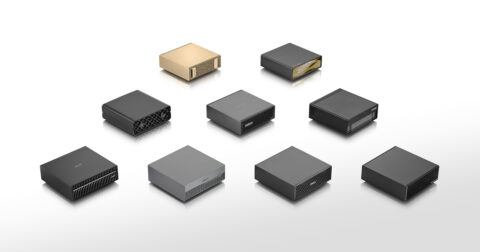
The EVO-X5 Pro was not alone at IFA 2026. Several other compact systems on the show floor led with local LLM execution, a sign that running large models on your own hardware is moving from experiment to product category.
Summary
The EVO-X5 Pro is a mini PC aimed at running 300 billion parameter models locally, using the Ryzen AI Max+ PRO 495 and 192GB of unified memory. It ships with enterprise-oriented features including DASH remote management, dTPM 2.0 and 24/7 validation, and supports four-unit clustering over USB4. Judgment has to wait until pricing appears, but organizations that cannot hand their data to a cloud provider have one more option on the table.