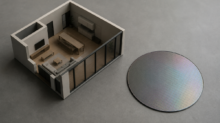
ASML and Taiwan Semiconductor Manufacturing Company (TSMC) have launched an industry-wide initiative to move EUV (extreme ultraviolet) photomasks from today's 6-inch format to 12 inches. The plan calls for a 12-inch mask pilot line by 2031 and lithography systems ready for advanced-node production by 2033. The goal is to lift the exposure field constraint that appeared when High NA EUV cut the printable area in half.
The Half-Field Problem
High NA EUV raises the numerical aperture from 0.33 to 0.55. Resolution improves, but the anamorphic optics needed to get there bring an awkward side effect. Because the demagnification differs between the horizontal and vertical axes, a 6-inch mask can only print up to 26 by 16.5 millimeters on the wafer. That is exactly half of the conventional 26 by 33 millimeter field.
Any die larger than that half field has to be exposed as two half-fields and joined at the seam. This technique, called stitching, has been demonstrated to work, but it pulls in design, OPC (optical proximity correction), the mask, and the scanner all at once. It also adds exposures, which cuts into tool productivity. Large AI chips are the most likely to run into this limit, which is what made the issue pressing.
A Bigger Mask Restores the Field
Moving to 12-inch masks tackles the problem from the material side rather than the optics side. A larger mask restores a conventional-sized exposure field even with anamorphic optics in place. Stitching becomes unnecessary, fewer exposures mean higher scanner productivity, and chipmaking costs come down. That is the case ASML and TSMC are making.
Christophe Fouquet, president and CEO of ASML, described the sequence as High NA EUV starting on today's 6-inch masks and then being supported by 12-inch masks that raise scanner productivity. TSMC Chairman and CEO Dr. C.C. Wei said that when the industry works together on complex problems, it unlocks possibilities no single company could reach alone.
That said, mask blanks, pellicles, inspection tools, and writers have all been built around the 6-inch format. This is not a matter of simply scaling everything up; the supply chain has to be rebuilt. The reason the two companies framed this as an industry initiative is that no single firm can move that ecosystem.
Pilot Line in 2031, Production in 2033
The roadmap has two markers. A 12-inch mask pilot line by 2031, and 12-inch-capable lithography systems ready for advanced-node volume production by 2033.
TSMC itself intends to use ASML's High NA technology in high-volume manufacturing for advanced nodes starting in 2030. In other words, the first few years run on 6-inch masks, with 12 inches joining later. TSMC expects the number of layers requiring High NA EUV to grow, driven mainly by the increasingly complex transistor architectures that AI workloads demand.
Intel Was Three Years Ahead
The idea of a large-format mask is not new. Intel Foundry has disclosed that it has been pushing a large-format mask effort on its own for more than three years. The company has also said it has processed more than 1 million wafers on High NA EUV, putting it ahead of the field in deployed volume. This initiative amounts to the rest of the industry catching up with that position.
The announcement is dated September 8, 2026. The day before, on September 7, the two companies gathered partners ahead of the SPIE BACUS Conference in Monterey, California. SAMSUNG has said it will join, and High NA EUV adopters and major mask suppliers have expressed interest in participating. In a market where a single vendor supplies the scanners, the surrounding standards are now being aligned as well.
Summary
High NA EUV traded exposure field for resolution and left the industry with stitching as the workaround. Twelve-inch masks address that structural constraint directly. A 2031 pilot line and 2033 production tooling sit far out on the investment horizon for advanced nodes, but that distance is a measure of how heavy a mask format change really is. TSMC starts High NA production in 2030, and 12-inch masks join a few years later. Whether that two-stage plan holds will shape the pace of scaling in the early 2030s.