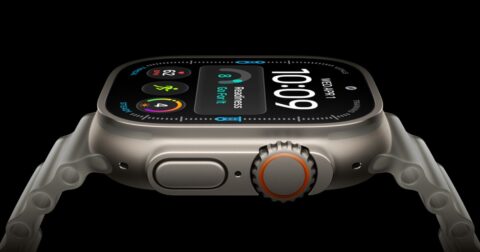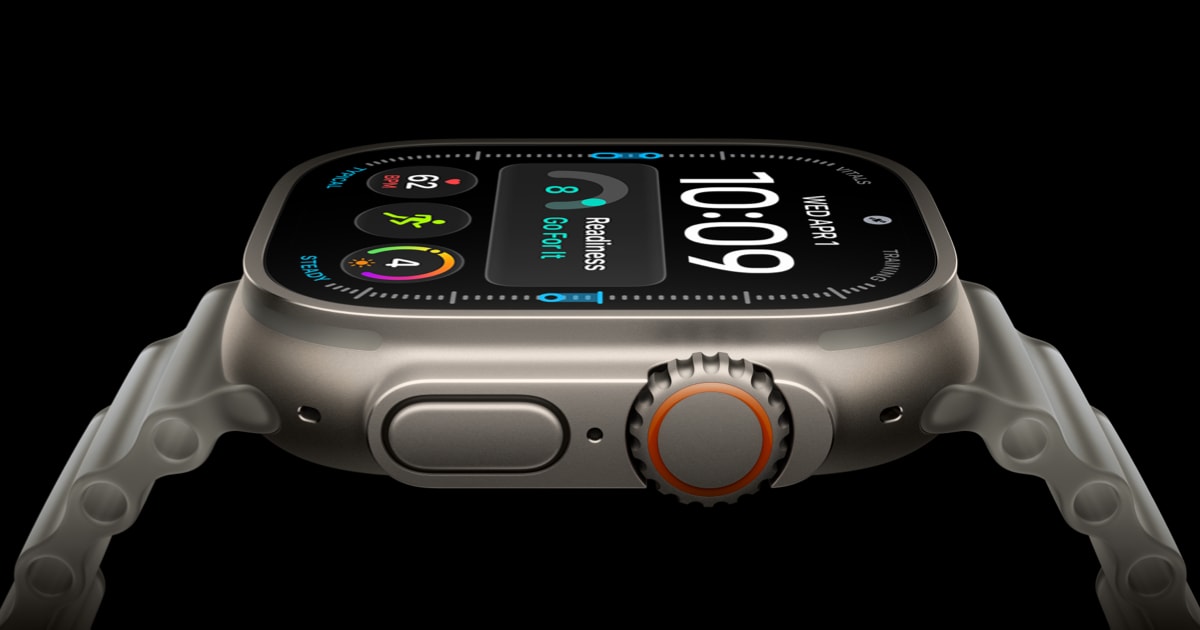
Apple announced Apple Watch Ultra 4 on September 9. A new health sensing system paired with the S11 chip raises both the accuracy and the frequency of heart rate measurement, and a new Readiness feature scores how your body is doing on a scale of 0 to 10. Outdoor workout tracking now stretches to 45 hours. Pricing starts at 142,800 yen including tax in Japan, with pre-orders open from September 9 and availability on September 18[1].
A Redesigned Heart Sensor That Measures Every 5 Seconds
Sensors are where Ultra 4 changed the most. A new health sensing system combines an optical heart sensor and an electrical heart sensor, and together with the S11 chip it delivers continuous monitoring at higher accuracy. Apple says it ran a study with more than 1,000 participants comparing its new heart rate sensor against leading wearables, and that Apple Watch showed the highest accuracy of any device tested[1]. This is Apple's own research, so it should be read with that in mind, though the company does state that the comparison set consisted of high-volume devices on the market.
A larger, more power-efficient green LED lets the watch measure heart rate every 5 seconds throughout the day. That continuous, passive measurement also feeds into the accuracy of the Exercise and Move rings. A new heart rate complication puts the live number on the watch face[1].
Heart rate variability (HRV), a key signal for stress and recovery, is now sampled up to 24 times more often. Apple Watch presents two kinds of HRV: recovery HRV, which is suited to spotting daily stress and recovery signals, and overall HRV, which gives a broader view of health including cardiovascular condition. Alongside overnight vitals, a new daytime vitals view lets users notice changes during the day before checking the overnight figures[1].
Readiness: A Daily Number for How Your Body Is Doing
Readiness, new to Ultra 4, analyzes recent activity, training load, vitals, and sleep score, then delivers a daily score from 0 to 10 along with one of four plain recommendations: Rest, Take It Easy, Ready, or Peak. The score updates through the day as new data such as a hard workout or a shift in daytime vitals comes in, and it breaks down which factors are pushing the number up or down[1].
Recovery metrics of this kind are territory that rivals like Garmin and WHOOP reached first. Apple says the scoring algorithm was built on data from the large-scale Apple Heart and Movement Study, developed jointly by its own exercise scientists and physicians[1].
Up to 50 Hours of Battery, 45 Hours of Outdoor Workouts
Everyday battery life reaches up to 50 hours, which works out to more than 2 days. Low Power Mode extends that to as much as 84 hours. Charging is faster too: 15 minutes on the charger yields up to 18 hours of use[1].
For workouts, the new Long Workout mode records for 25 hours while keeping GPS and heart rate sampling at their highest settings, 25 percent longer than the previous generation. Long Workout Max goes further, tracking outdoor running, walking, and hiking for up to 45 hours while still reading GPS every second. Apple frames that as enough to finish a 100-mile race[1]. The figure clearly targets ultramarathon and long trail runners.
The pedometer model was rebuilt with machine learning, improving distance measurement during indoor workouts and step counting through the day[1].
Audio Intelligence and Siri AI
The S11 chip also powers Audio Intelligence, arriving later this year. Sound Recognition comes to Apple Watch, detecting sirens, alarms, doorbells, and a baby crying and alerting the user even when iPhone is not nearby, while Shazam automatically identifies music playing around you and surfaces it in the Smart Stack[1].
Processing happens inside Secure Exclave, a hardware-isolated area within the S11 chip. Apple states that audio is neither recorded nor stored, and that the raw audio data used for processing is inaccessible to the operating system, apps, users, and Apple itself[1]. It is a concrete answer to the unease that always-on microphone features tend to create.
watchOS 27 brings Siri AI, powered by Apple Intelligence, letting personal context understanding and broader world knowledge run from the wrist. Siri AI arrives in beta on September 15 alongside watchOS 27 and starts in English only. Japanese support is planned for October, so users in Japan will not have the full experience on launch day[1].
Hypertension Notifications Are Not Available in Japan Yet
One caveat is easy to miss. On Apple Watch Series 12 and Apple Watch Ultra 4, hypertension notifications are not available in Japan at launch. Apple says it has filed for additional approval with regulators and expects the feature to become available next year[1]. Anyone buying primarily for the health features should factor in that gap in the Japanese market.
Pricing and Availability
Apple Watch Ultra 4 comes in natural titanium and black titanium, starting at 142,800 yen including tax in Japan. In the U.S. it starts at 799 USD (about 123,000 yen)[1][2]. Pre-orders opened September 9 across more than 50 countries and regions including Japan and the U.S., with availability on Friday, September 18[1].
※1 USD = 154 JPY (as of September 9, 2026)
Bands were refreshed as well. Trail Loop adds dark amber, sand, and burgundy; Alpine Loop adds desert, dark olive, and burgundy. Ocean Band moves to a translucent silicone in translucent grey, translucent kelp, and translucent black. Apple Watch Hermès Ultra 4 also arrives, adding a Grand H titanium strap with a built-in extension mechanism that adjusts over a wetsuit[1].
On the environmental side, the 3D-printed titanium case uses 100 percent recycled titanium and the battery uses 100 percent recycled cobalt, with 45 percent recycled materials overall[1].
watchOS 27 arrives Tuesday, September 15 for Apple Watch Series 9 and later, Apple Watch SE 3, and Apple Watch Ultra 2 and later[1].
Summary
Ultra 4 follows one consistent line: raise sensor accuracy and sampling frequency, then distill that into a single number, Readiness, that people can act on daily. Battery life of up to 50 hours and outdoor workout tracking of up to 45 hours also make it more practical on long trails and endurance races. On the other hand, hypertension notifications are unavailable in Japan for now, and Siri AI does not speak Japanese until October. Whether 142,800 yen is the right price depends partly on when those pieces fall into place.
Sources[1]: https://www.apple.com/jp/newsroom/2026/09/apple-unveils-apple-watch-ultra-4/
Sources[2]: https://www.apple.com/newsroom/2026/09/apple-unveils-apple-watch-ultra-4/