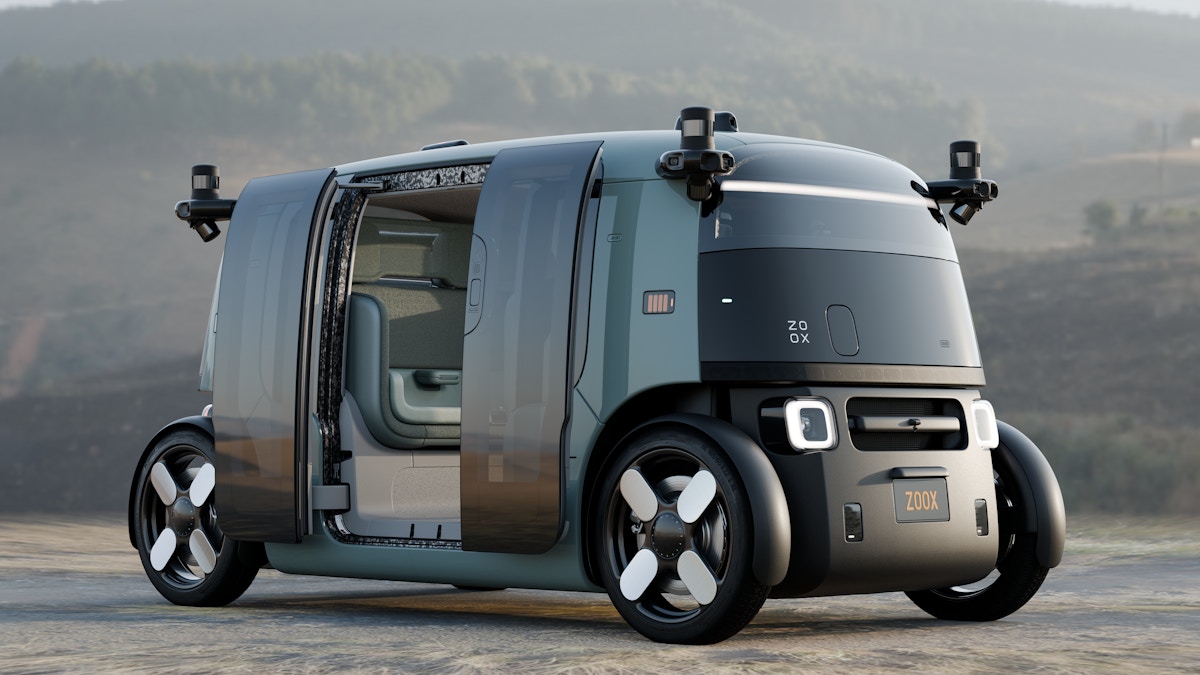
Amazon-owned Zoox has overhauled the purpose-built autonomous robotaxi it developed in-house. Ahead of a commercial service it hopes to launch this year, the company focused the update on ride comfort and usability, drawing on feedback from people who have actually ridden in it. The foundation remains the same — a four-seat electric vehicle with no steering wheel — but the cabin's look and feel and the way the vehicle communicates with the outside world are now new.
A Robotaxi Without a Steering Wheel, Built on the Same Foundation
Even after this refresh, the robotaxi is unmistakably a Zoox. The near-cube-shaped body is an electric, self-driving vehicle with no steering wheel, pedals, or other driver controls. The moonroof and starry interior lighting carry over as well.
The sensors that act as the vehicle's brain are unchanged. Roughly 40 cameras, radars, LiDAR (laser-based ranging sensors), and infrared sensors map the surroundings. The vehicle still drives in both directions, uses four-wheel steering, and can carry four people at speeds of up to 75 mph (about 120 km/h).
An Interior Designed Not to Demand Attention
The biggest changes are inside. The seats and headrests gain more cushioning and body-hugging curves for improved comfort. The color scheme has been refreshed too, pairing aloe-green seating with stone-grey flooring and trim for a brighter overall look.
Zoox says this lighter palette creates a calmer space. The brighter backdrop also makes it easier to spot small items that are easy to leave behind, such as smartphones. Other interior tweaks include fluting on the charging pad to keep phones from sliding, larger cupholders, and a more visible touchscreen. Chris Stoffel, who leads robot industrial design at Zoox, says the goal was a simple, elevated interior that does not pull at riders' attention the way the feature-heavy cabins of today's passenger cars do.
Stronger Safety and Communication on the Outside
The exterior was improved as well. Because the vehicle drives in either direction, the reflectors at each end have been moved to more visible positions. Zoox also added a new speaker and microphone to the door interface, enabling two-way audio.
The company says this improves communication with riders, nearby pedestrians, and other vehicles, as well as between Zoox Support and first responders such as fire and emergency crews. For a vehicle that drives with no one at the wheel, the equipment that handles communication with people becomes essential.
A Step Toward Mass Production and Commercial Service
There are practical aims behind the changes as well. Zoox opened a production site in Hayward, California in 2025, and is eyeing eventual output of 10,000 vehicles a year. This update is part of preparing for that volume production, with the build pace potentially reaching up to 100 vehicles a week.
Still, a major hurdle remains before paid service or full-scale production can begin. Because Zoox's vehicle lacks the standard driver controls required by federal law, the company has filed for a commercial exemption. The public comment period has already closed, and the matter is now awaiting a decision by the National Highway Traffic Safety Administration (NHTSA). In August 2025, the NHTSA granted Zoox an exemption to demonstrate its purpose-built robotaxis on public roads. If the current petition is approved, Zoox intends to begin paid rides. For now, the company is running test operations and offering free rides in Austin, Texas; San Francisco; Las Vegas; and Miami, Florida.
Summary
This refresh is driven less by a new look than by practical engineering aimed at a commercial service that will carry many riders. With a calmer cabin, exterior gear built for communication, and design changes made with mass production in mind, Zoox has moved a step closer to commercialization. The remaining focus is the regulatory decision that paid service — targeted for this year — depends on.