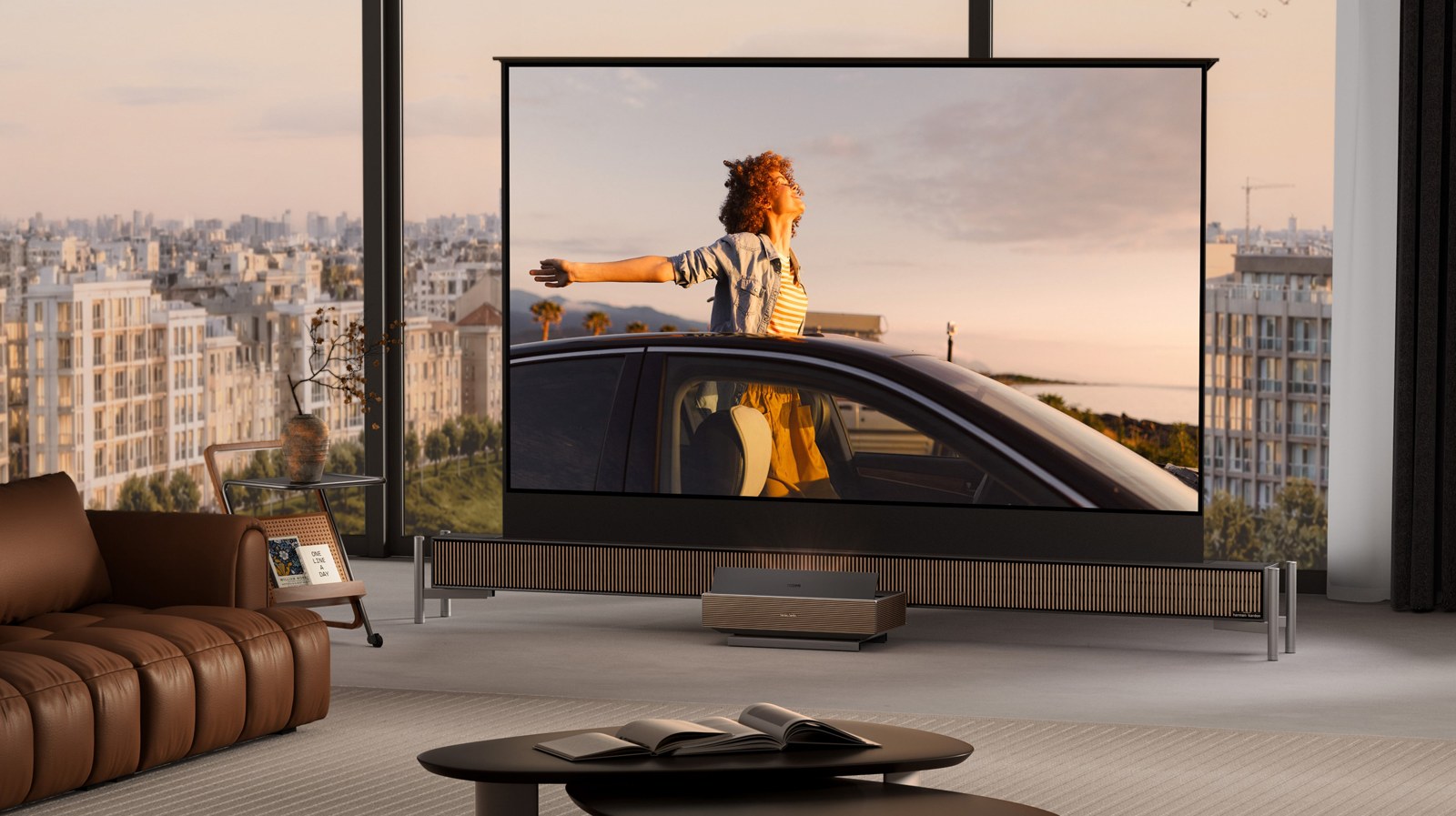
XGIMI has announced the AURA 3 Series, a new lineup of ultra-short-throw laser projectors. The range consists of the higher-end AURA 3 Max and the AURA 3 Pro, and the headline feature of both is the ability to project at 120Hz while keeping full 4K resolution. XGIMI describes the series as the world's first ultra-short-throw projectors with 4K 120Hz support, and the units are on display at IFA 2026 in Berlin from September 4 to 8. Sales begin on Kickstarter on October 20, with campaign pricing of 2,399 USD (about 380,000 yen) for the Max and 2,199 USD (about 350,000 yen) for the Pro.
A 120-Inch Picture From 20 cm Away, Now at 4K 120Hz
The AURA 3 Series belongs to the category often called laser TVs: projectors that sit on a media console and throw the image onto the wall directly behind them. The throw ratio is 0.163:1, so a 120-inch picture is produced with the unit just 8 inches (about 20.3 cm) from the wall, and the maximum screen size is 200 inches. With no ceiling mount or long projection distance required, placement is considerably more flexible than with a conventional projector.
On top of that comes the main attraction: 4K 120Hz playback. Many earlier ultra-short-throw models drop to 60Hz as soon as they receive a 4K signal, so even if a console or PC outputs 120 frames per second, that advantage is lost. The AURA 3 Series is said to pass 120Hz through without reducing 4K resolution, which XGIMI claims is a first for an ultra-short-throw projector. Note that 4K 120Hz is limited to input from HDMI 2.1 sources and is not available for USB media playback.
Gaming features are well covered. The projectors support VRR (variable refresh rate), which keeps the projected image in step with fluctuating frame rates, ALLM, which switches to a low-latency mode automatically when a compatible device is connected, AMD FreeSync Premium, and Dolby Vision Gaming, with a claimed response time as low as 1 ms. Wired LAN is 1Gbps, and there are three HDMI ports including one with eARC. For film and sports, there is also MEMC (frame interpolation) that operates at 4K 120Hz.
Dynamic Dual Iris: Two Apertures for Deeper Blacks
Brightness is 5,700 ISO lumens for the AURA 3 Max and 4,100 ISO lumens for the AURA 3 Pro. Native contrast is quoted at 8,000:1 for the Max and 7,000:1 for the Pro. The differences between the two models essentially come down to brightness and contrast; the optics and feature set are shared.
Supporting that contrast is what XGIMI calls Dynamic Dual Iris, which it says is a first for ultra-short-throw projectors. Two apertures are controlled dynamically according to scene brightness, regulating light at the source to deepen blacks. Combined with processing called DBLE (Dynamic Black Enhancement), the company says dynamic contrast can be boosted by up to 10 times while preserving shadow detail. A dual-iris design was already used in the long-throw TITAN Noir Series that XGIMI ran on Kickstarter earlier this year, and it has now been brought to the ultra-short-throw form factor.
The light source is an RGB triple laser, and the Max covers 110 percent of the BT.2020 color gamut. As for the rainbow effect that can be a concern with triple-laser DLP projectors (red, green, and blue fringes that appear when the eye moves), XGIMI says it has been significantly reduced in both 2D and 3D. 3D display is supported, and two pairs of 3D glasses are included.
Image processing is handled by the X-VISION AI Image Processor developed in-house by XGIMI. It analyzes each HDR scene in real time and dynamically optimizes brightness and contrast. Supported HDR formats are Dolby Vision, HDR10+, HLG, and IMAX Enhanced, and Filmmaker Mode is also supported. The lens uses a 19-element design with ED (extra-low dispersion) glass to suppress chromatic aberration and a broadband coating, which XGIMI says maintains edge sharpness, an area where ultra-short-throw projectors often struggle.
Google TV and an 80W Harman Kardon Speaker System
The platform is Google TV. Major streaming services such as Netflix, YouTube, and Prime Video play without any additional device, and the projector works with Google Home and voice control. When not in use, an app called XGIMI WALL can display digital art on the wall, a touch intended to make a large black box feel less intrusive in the living room.
Audio comes from Harman Kardon speakers with 80W of output and support for Dolby Atmos and DTS Virtual:X. On the setup side, the projectors offer screen alignment assistance, automatic keystone correction, autofocus, compensation for wall flatness and wall color, and an eye protection feature, so initial setup is designed to be almost entirely automatic.
In the box are the projector, two pairs of 3D glasses, a power cable, a warranty card, a manual, and a backlit Bluetooth remote. Rear connections consist of power, LAN, optical digital audio, analog audio, USB 2.0, USB 3.0, and three HDMI ports, one of which supports eARC.
Pricing, Availability, and Japan
Sales will run through Kickstarter, with the campaign starting on October 20. Kickstarter-exclusive pricing is 2,399 USD (about 380,000 yen) for the AURA 3 Max and 2,199 USD (about 350,000 yen) for the AURA 3 Pro. XGIMI's official site is already taking a 50 USD (about 8,000 yen) deposit; those who pay it receive a link on launch day and an additional 200 USD (about 32,000 yen) discount. The deposit is refundable and will be settled together with the extra savings within 10 business days after the campaign ends. The official site describes the earliest-tier pricing as up to 2,800 USD (about 450,000 yen) off, and shipping is expected to begin in December. On the European site, the deposit is 50 euros.
※1 USD = 159 JPY (based on the MUFG Bank published mid-rate as of September 3, 2026)
There is no mention of Japanese availability in this announcement. Since neither a Japan launch timing nor domestic pricing for the AURA 3 Series has been published at this point, Kickstarter is the assumed route for anyone in Japan who wants one.
At IFA 2026, the AURA 3 Max is being shown at booth H21-111 in Hall 21, paired with the company's floor-rising Ascend screen, alongside the TITAN Noir Series, which XGIMI says raised 19.37 million USD (about 3.1 billion yen) on Kickstarter.
Summary
The AURA 3 Series builds on a single premise, pushing 4K 120Hz through an ultra-short-throw projector that sits against the wall, and layers a dual iris, an RGB triple laser, and AI image processing on top of it. The Max offers 5,700 ISO lumens and 8,000:1 native contrast, the Pro 4,100 ISO lumens and 7,000:1, with the remaining specifications shared. The Kickstarter campaign starts on October 20, with exclusive pricing from 2,199 USD (about 350,000 yen). With several long-throw projectors claiming 4K 120Hz arriving this fall, the question is whether an ultra-short-throw model with its placement advantages can compete on the same terms. Most of the published figures are manufacturer claims, and how the projectors look in a real room will have to wait for hands-on evaluation.