
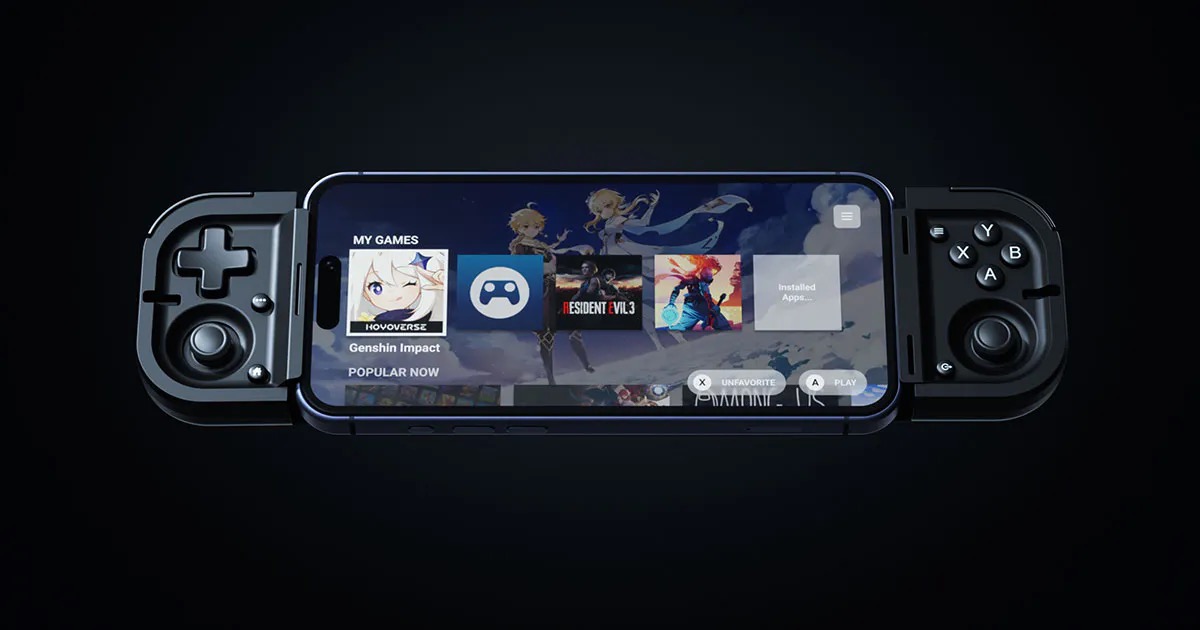
Razer has announced the Razer Prio, a gaming controller for smartphones. Folded up it is about the size of a credit card, and a single twist opens it into a full-size control layout. It costs 16,980 yen including tax in Japan, with a domestic release date of September 11.
107mm folded, and it grips phones up to 7 inches
The defining feature of the Razer Prio is that the controller itself folds. Closed, it measures 101 × 67mm and weighs 101g. Razer describes the folded footprint as roughly credit-card sized, small enough not to weigh down a pocket.
One twist and the left and right grips swing out, turning it into a landscape controller that clamps around a phone. It accommodates handsets up to 7 inches, including larger models such as the iPhone 17 Pro Max and the Samsung Galaxy S26 Ultra. Razer says it works with thin to medium-thickness cases still attached, so removing the case every time is not part of the routine.
The Prio is the first product in a new line of ultra-portable mobile controllers from Razer. It is aimed squarely at the few spare minutes people have while commuting or between classes.
Capacitive sticks, a first for a Razer controller
Folding mechanisms usually cost you something in the controls, but the Prio keeps a full-size button layout. Low-profile analog sticks, a four-way D-pad, face buttons, bumpers and triggers are all present.
The analog sticks deserve attention. The Prio uses capacitive sticks, the first time Razer has fitted this technology to one of its controllers. Because they read movement without physical contacts, there is nothing to wear down, which makes the stick drift that has plagued console controllers for years far less likely. Choosing that approach for a product designed to be thrown in a bag and knocked around is a meaningful decision.
The face buttons are tactile but built to stay quiet. The intent is that keypresses do not carry across a crowded bus or a waiting room, which fits the product's public-space use case.
No pairing, no charging
The only connection is a direct USB-C link, so there is no Bluetooth pairing step. The controller carries no battery of its own, which removes charging from the equation but means it draws power from the phone. Being wired also helps latency, so the design serves both portability and responsiveness.
It supports iPhones running iOS 18 and Android devices on Android 14 or later. Beyond locally installed games, it works with streaming through Xbox Cloud Gaming, Steam Link, PS Remote Play and Razer PC Remote Play. A dedicated button launches Razer Cortex Mobile, dropping you straight into your game library. Pair Cortex Mobile with Razer Cortex on a PC and you can run your desktop games on a phone while away from home.
Price and availability
The Japanese price is 16,980 yen including tax. Global MSRP is set at 99.99 USD (about 16,000 yen) and 109.99 EUR (about 20,000 yen) in Europe. ※Exchange rates as of September 4, 2026: 1 USD = 156 JPY, 1 EUR = 181 JPY
Sales are already underway overseas through Razer.com, RazerStore and selected retailers, with the Japanese launch scheduled for September 11. It is not a cheap smartphone controller, but there are almost no folding rivals in this price band, which makes a straight comparison difficult.
Durability of the folding mechanism is what will decide how this holds up in practice. A twist-open hinge has to survive daily use, and any slack in it also loosens the grip on the phone. And because the controller has no power source of its own, long sessions add directly to the phone's battery drain. Those questions will only be answered once units are out in the wild.
Summary
Razer has announced the Razer Prio, a folding smartphone controller launching in Japan on September 11 at 16,980 yen including tax. It packs down to 101 × 67mm and 101g, then opens into a full-size layout that grips phones up to 7 inches. It is the first Razer controller to use drift-resistant capacitive analog sticks, and it connects over USB-C with no pairing and no charging. Cloud gaming and remote play are both supported, making it a device built entirely around filling short gaps in the day.