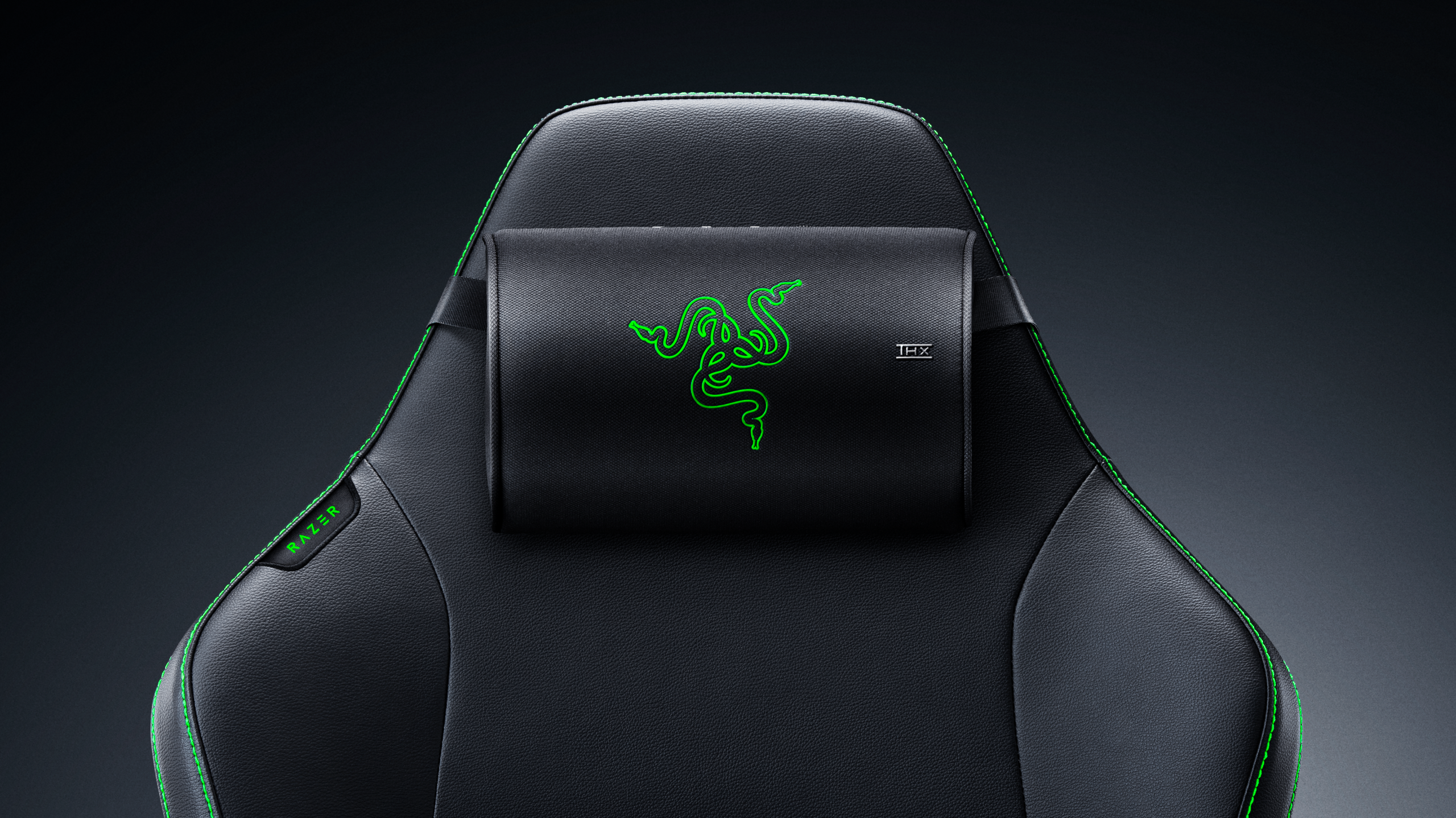
Strap it around the backrest of a gaming chair and it plays audio from just behind your head. Razer has announced the Razer Clio X, a wireless speaker head cushion built around exactly that idea. It takes the concept Razer built with its flagship model and reworks it into something smaller and easier to afford. In Japan it carries a price of 17,980 yen including tax, with a local release planned for September.
The sound behind you stays, even without a headset
Inside the Clio X sits a near-field speaker array combining two 38mm full-range drivers with two 55mm passive radiators. The drivers are not aimed straight ahead. They are angled toward the ears of the person sitting in the chair. Because the distance is so short, modest driver sizes can still deliver real pressure, which is the design advantage a head cushion enjoys.
THX Spatial Audio handles the soundstage, with acoustic widening modes that stretch the image outward. The goal is to add direction and depth to games and films without putting anything on your head. For anyone who wants to escape the weight and heat of a headset during long play or streaming sessions, that alone makes the product worth a look.
Equalization is adjusted through Razer Synapse. Three quick presets cover gaming, music and multimedia, and the settings can be refined further from there.
Powered by a power bank, with no battery inside
The connection runs over Razer HyperSpeed 2.4 GHz wireless, avoiding the latency that comes with Bluetooth. Nothing tethers the cushion to a PC or console, so the chair can be moved without dragging a cable along.
The power design is the interesting part. The Clio X carries no internal battery and instead draws power from a USB-C PD 2.0 power bank, sold separately. With a 10,000mAh power bank, Razer cites up to 40 hours of use. Reusing a battery you already own is convenient, though the power source does need to meet certain conditions. Reaching maximum volume requires a PD 2.0 supply rated at 15W or more, and a non-PD source limits power draw and caps how loud the unit can go.
The USB Type-C cable used for power is built into the product and tucks into a pouch on the rear of the cushion when not in use, keeping cables from hanging around the chair.
An adjustable nylon strap covering 30 to 65 cm handles mounting. Razer says it fits its own gaming chairs as well as most high-back gaming and office chairs.
A main speaker on its own, or a rear channel in a surround setup
There are two ways to use it. The first is as a standalone main speaker for playing games, films and music without a headset. The second is Surround Mode, pairing it with a soundbar or a 2.0 or 2.1 speaker system so that it works as the rear channel.
The second option is a practical way around the placement and cabling headaches that rear speakers usually bring. Instead of putting speakers at the back of the room and running wire along the floor, the chair itself becomes the rear channel. Mounting the speaker on the chair also guarantees that the listening position and the speaker position always move together.
What separates it from the flagship Clio
Razer already sells the flagship Razer Clio. The difference between the two lies mainly in acoustic architecture. The Clio uses 43mm full-range aluminium cone drivers, while the Clio X substitutes two 38mm drivers and two 55mm passive radiators. The aim is to secure bass weight within a more compact package.
The core experience of headset-free game audio, near-field speakers and THX Spatial Audio is shared between them, and the Clio X is positioned as a tighter version of that package.
The Clio X was announced on September 4, 2026 in Irvine, California, and made its debut at PAX West 2026, held from September 4 to 7. It is already on sale through Razer.com, RazerStore and selected retailers around the world, with the Japanese release planned for September. Warranty coverage runs up to one year, and purchases made directly from RazerStore include 14 days of free returns.
Summary
The Razer Clio X turns the backrest of a gaming chair into a rear speaker. It pairs two 38mm drivers and two 55mm passive radiators with THX Spatial Audio, and uses Razer HyperSpeed 2.4 GHz for a low-latency wireless link. By skipping an internal battery and running from a USB-C PD 2.0 power bank, it lands at 17,980 yen including tax. It answers two different frustrations at once: the pressure of a headset, and the hassle of installing rear speakers.