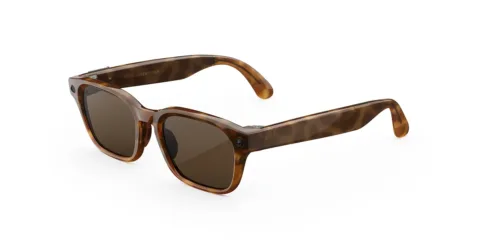
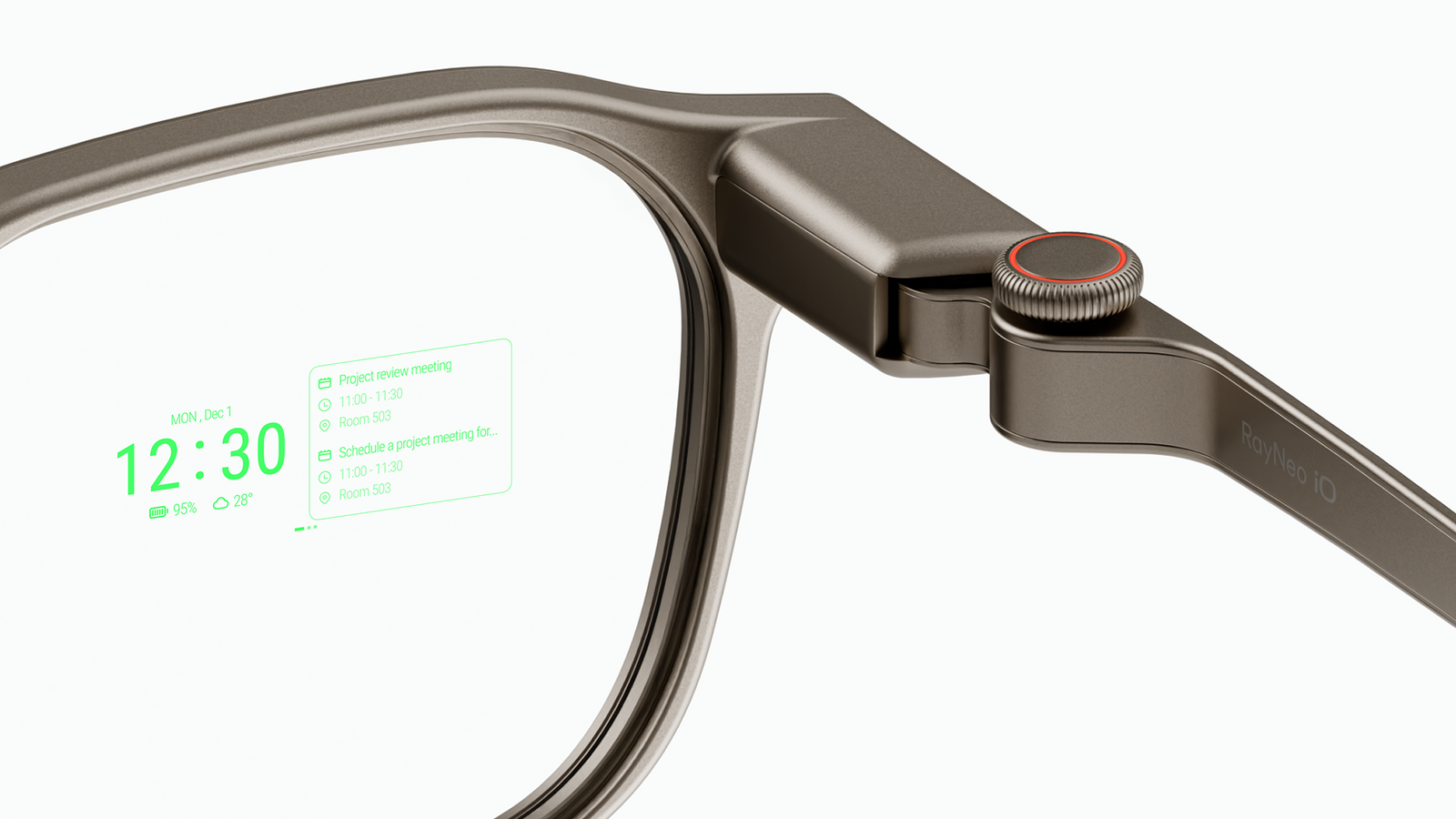
RayNeo will release its smart glasses, the RayNeo iO, on September 4. While most products in this category race to add cameras, this one deliberately leaves the camera out. The frame weighs 34g, runs for roughly 48 hours under standard use, and handles real-time translation across 55 languages along with a full day of conversation logging. With the display off, it looks almost like an ordinary pair of glasses.
Leaving out the camera is the whole pitch
For the past few years, any conversation about smart glasses has come bundled with a debate over the camera sitting next to the lens. How do you get consent from the people around you? Is it acceptable to walk into a restaurant or an office wearing one? The convenience always arrives with that question attached.
The RayNeo iO tries to erase the question itself. It was built around a Privacy by Design approach, and there is no camera at all. Data is encrypted when transmitted or stored, and personal information is de-identified. The product is compliant with and certified against security standards including GDPR and ISO 27001.
No camera means no vision-based AI features. Translating a sign in front of you, or pointing at a meal to ask about its calorie count, is off the table. In exchange, the glasses can be worn into a meeting room without making anyone uncomfortable, which is a coherent trade. For a device meant to stay on your face all day, whether you can keep wearing it matters more than how many features it lists.
Magnesium alloy and titanium hold the weight to 34g
The shape is a crown panto silhouette, the rounded profile of a conventional pair of glasses. An AZ91D magnesium aluminum alloy front frame is paired with titanium alloy temples, bringing the total to 34g. IP54 dust and water resistance means the occasional splash is not a problem.
The transmittance figures are the more interesting design detail. The display area reaches 93 percent and the non-display area 98 percent, so with the screen off you see through the lenses much as you would with normal eyewear. Smart glasses tend to get rejected simply because it is obvious you are wearing them, so putting numbers on this is a clear appeal.
Operating it without raising your hand
There are three input methods. The centerpiece is a physical dial called the Smart Crown, mounted on the top of the frame, which you rotate or click with a fingertip to move between functions. Head gestures and voice input are supported as well.
Because nothing needs to be touched on a screen, your line of sight and the flow of a conversation stay unbroken. A dedicated dashboard appears when you glance upward, laying out schedule items, weather, and notifications as cards. This amounts to skipping the act of pulling a phone out of your pocket, but that act is exactly what breaks up plenty of conversations.
The generative AI backend can be chosen from options such as Qwen and DeepSeek. There is also a real-time assist feature that picks up on questions raised mid-conversation and displays an answer, so looking something up no longer requires stopping the discussion.
55 languages and 18 hours of recording
The multilingual side covers real-time translation across 55 languages and 109 accents. Spelling out the accent count suggests the team was thinking about how recognition accuracy drops across different speakers of the same language.
Audio capture combines a four-microphone array with a bone conduction microphone, identifying who is speaking and from which direction to improve accuracy. There is also a teleprompter function that scrolls a script automatically at your speaking pace, clearly aimed at presentations and streaming.
On the recording side, the glasses can continuously log a day of conversations and ideas at low power. Continuous recording runs up to 18 hours and continuous translation for 6.2 hours. The battery is a modest 240mAh, yet standard use is rated at about 48 hours, a figure only possible because no display-heavy or camera workload is draining it. Connectivity is Bluetooth 5.4, and the product carries Apple MFi certification.
2,499 yuan in China, no Japanese price yet
Two colors are offered: Polar Black and Dune Brown.
Pricing has been announced for the Chinese market at 2,499 yuan (about 59,000 yen), or 2,798 yuan (about 66,000 yen) bundled with the charging case. Global pricing, including Japan, has not been disclosed. RayNeo is running a campaign on its official site where registering an email address takes another 5,000 yen off the early-bird price, so anyone watching the price should sign up first.
※1 CNY = 23.7 JPY (as of August 24, 2026)
Summary
The RayNeo iO is a pair of smart glasses that prioritizes being wearable all day by dropping the camera. The 34g weight, 93 percent display-area transmittance, and roughly 48-hour battery all point in the same direction: blending into daily life. Translation across 55 languages and continuous logging are confined to what audio alone can deliver, and what the product gained by giving up visual AI should become clear once units reach reviewers after September 4.