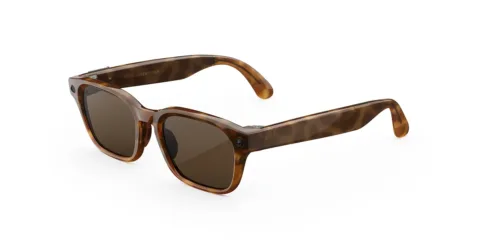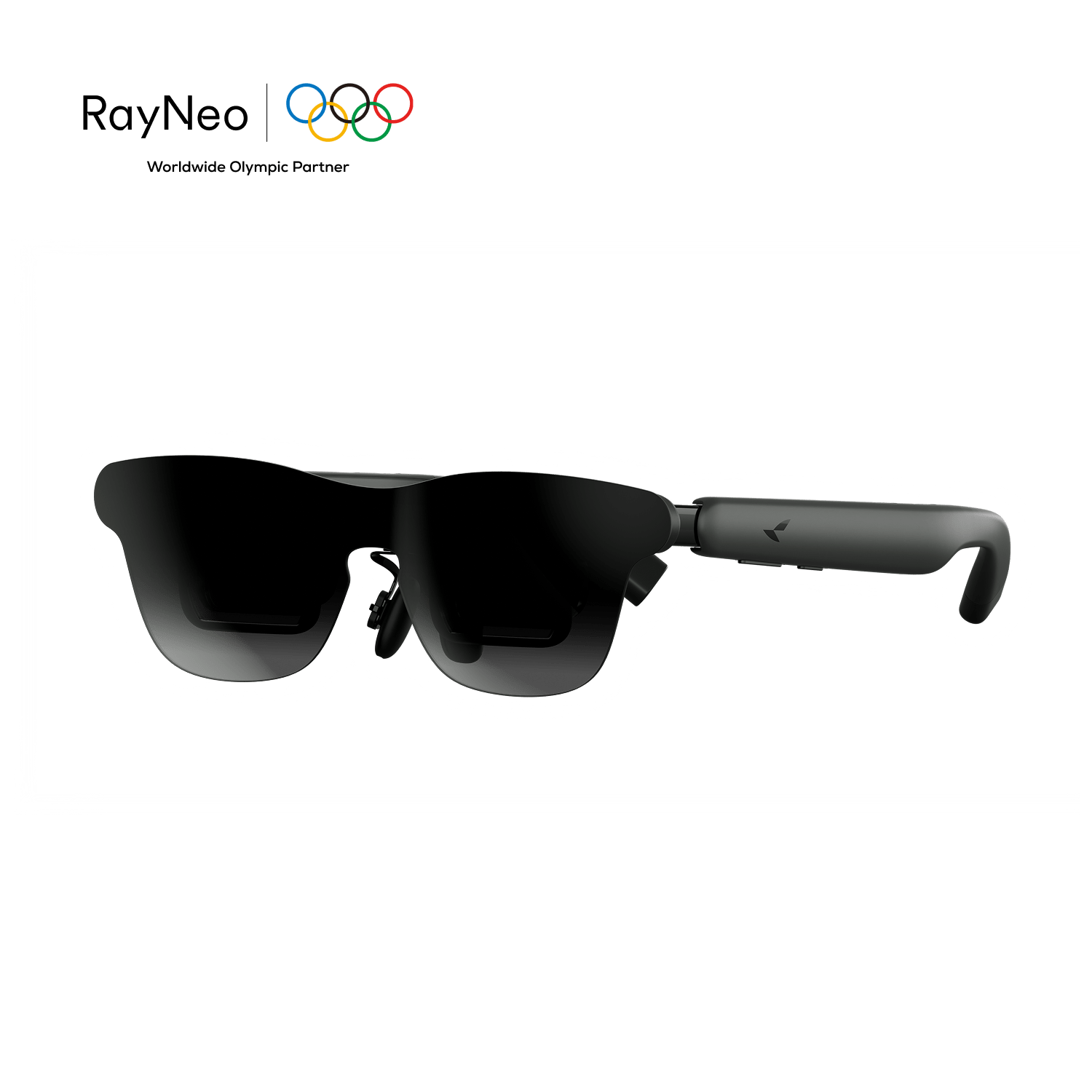
RayNeo, a TCL subsidiary, began selling the RayNeo GT Max on September 4. These AR glasses are built around video viewing: a 59-degree field of view puts the equivalent of a 267-inch screen in front of you, and 3DoF head tracking is handled on the glasses themselves. The price is 399 USD (about 62,000 yen). The GT Max sits above a cheaper GT model, and the most unusual part of the package is that Dolby Vision only becomes available when the glasses are paired with RayNeo's own streaming device.
Dolby Vision Does Not Work on Its Own
RayNeo describes the GT Max as the world's first Dolby Vision AR glasses system, but the wording carries a condition. Dolby Vision is available only when the glasses are paired with the company's portable streaming device, the Pocket TV Pro. On their own, the glasses handle HDR through a separate feature called AI HDR, which lifts SDR footage toward an HDR look in real time.
The Pocket TV Pro is a compact Google TV player, listed at 199 USD (about 31,000 yen) in RayNeo's own store. It supports expandable storage and acts as the video source for the glasses. RayNeo states in its FAQ that the Pocket TV Pro is not required to use the GT Max. Connect a phone or a laptop directly and video still works. Dolby Vision is the single feature sitting behind an extra purchase.
If the phrase world's first is what draws you in, it is worth knowing that reaching it costs roughly another 31,000 yen.
Two Chips Behind the 59 Degrees and 267 Inches
The display is a 0.6-inch micro-OLED panel at 1920 by 1080 pixels, running at 120Hz in 2D and 60Hz in 3D. RayNeo says the 59-degree field of view gives a display area 70 percent larger than the 47 degrees of its earlier design. The virtual screen can be set to 227, 267, or 307 inches, and 267 inches is the figure used throughout the company's standard marketing.
Brightness is quoted at 336 nits in Pinned mode, which locks the screen in space, and 1,200 nits in the other modes. Contrast is 200,000 to 1, color coverage is 98 percent of DCI-P3 and 145 percent of sRGB, and color accuracy is under Delta E 2. Angular resolution is 38 PPD. Dimming runs at a high frequency of 3840Hz, which matters for eye comfort.
The work is split between two chips: the Vision 4000 for image processing and the Zone 360, dedicated to 3DoF head tracking. Three spatial modes are offered: Follow, where the screen travels with your gaze, Steady, which absorbs motion, and Pinned, which fixes the screen in place. That is where these glasses part company with products that simply paste an image in front of your eyes. A 2D-to-3D conversion feature is also included.
Four Speakers Tuned by Bang & Olufsen
Audio comes from a racetrack-shaped quad-speaker array tuned jointly with Bang & Olufsen. RayNeo calls the back-to-back driver arrangement an industry first, and the system supports spatial audio that tracks head movement.
The interesting part is that more effort has gone into containing sound than into projecting it. A feature called Whisper Mode 2.0 is designed, according to RayNeo, so that the content becomes hard to make out from roughly 1.5 meters away. Holding the volume rocker cycles through three modes: standard, Whisper, and spatial surround. For situations where you want more sound in your ears, RayNeo sells a separate accessory called the Sound Tube.
A 76-Gram Body and an Approach to Vision Correction
The spec sheet lists the weight at 76 grams. The marketing copy on the same product page says 78 grams, so RayNeo's own site does not agree with itself. The real figure will have to wait for hands-on reviews. The unibody shell uses an NCVM composite finish with a sandblasted texture, and the nose pads adjust for height.
Fitting is unusually granular. Three sizes are offered by interpupillary distance: S for under 64mm, M for 64 to 67mm, and L for over 67mm. RayNeo publishes a web tool for measuring IPD with a smartphone, so the intended flow is to measure first and then choose.
What the glasses do not have is a built-in diopter dial for nearsightedness. Vision correction is handled with prescription insert lenses, and RayNeo points buyers to its partner Lensology. Compared with rival products that build diopter adjustment into the frame, that means extra cost and an extra step.
Devices It Connects To, and How the GT Differs
Connection is over USB-C using DisplayPort Alt Mode. RayNeo lists the iPhone 15 through 17 series (the 16e, 17e, and Air are not supported), the Galaxy S8 through S25 series, USB-C iPads from the 10th generation onward, MacBooks from 2015 onward, and USB-C handheld consoles and laptops. The PS4, PS5, Xbox, and Nintendo Switch connect through an HDMI adapter, and the Switch and Switch 2 also need a back clip. Lightning devices require Apple's own adapter, sold separately.
The GT, launched alongside it, has a 46-degree field of view, a 201-inch virtual screen, and a fixed 64mm IPD, at 299 USD (about 47,000 yen). The 120Hz refresh rate, 1,200 nits, Bang & Olufsen tuning, 3DoF, and Dolby Vision playback with the Pocket TV Pro are common to both models. The difference comes down to the width of the view, the screen size, and whether the fit can be matched to your eyes.
The GT Max carries a regular price of 429 USD (about 67,000 yen) and is currently discounted by 30 USD to 399 USD. No separate announcement has been made about availability in Japan.
Summary
The RayNeo GT Max packs a 59-degree field of view, a 267-inch virtual screen, 200,000 to 1 contrast, and a Bang & Olufsen-tuned quad-speaker array into 76 grams, aimed squarely at watching video. The Vision 4000 and Zone 360 chips handle 3DoF on the glasses, with Follow, Steady, and Pinned modes to switch between. The headline Dolby Vision support, however, assumes the 199 USD Pocket TV Pro alongside it; on its own the GT Max stops at AI HDR. How the 399 USD price reads depends on whether you count that extra purchase in.
Exchange rate: 1 USD = 156 JPY (as of September 6, 2026)