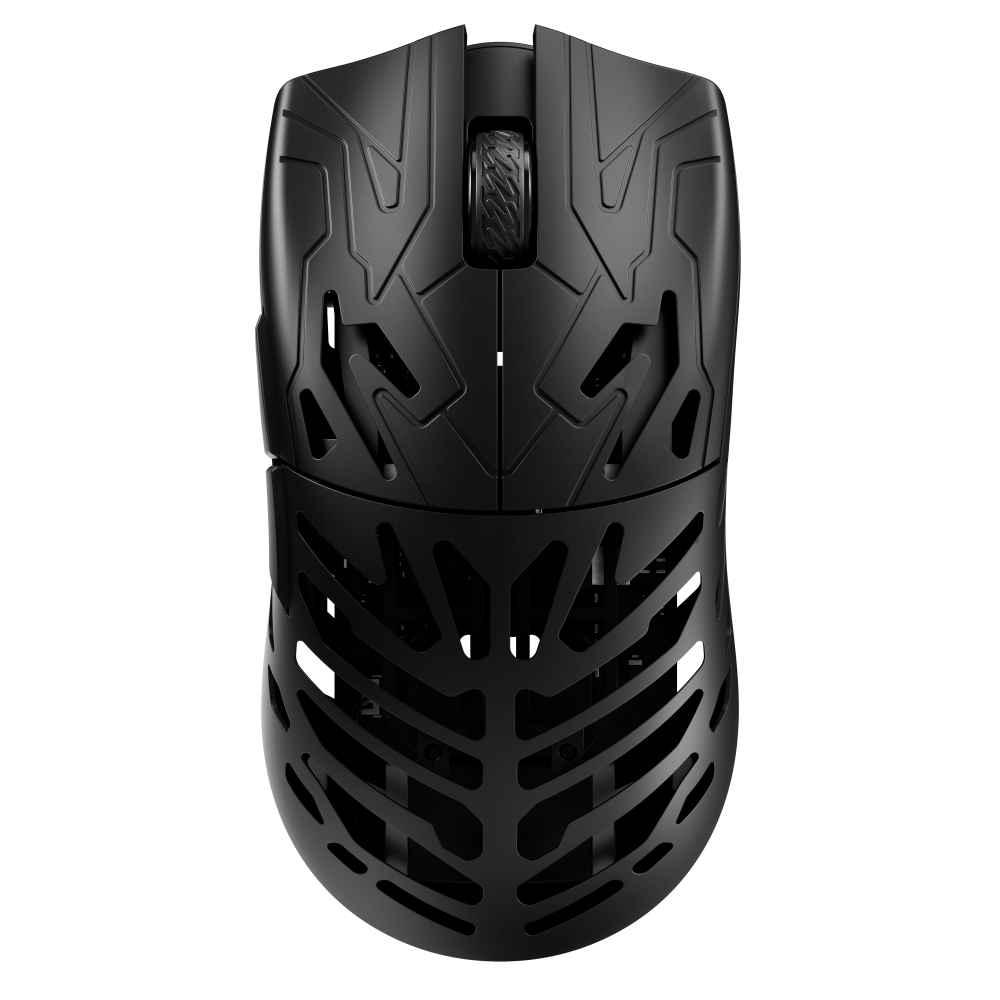
The click feel of a gaming mouse has always been a single setting chosen at the factory. Vanta, the wireless mouse that California peripheral maker Pwnage has just opened for pre-order, puts a small screw into that assumption. Instead of swapping the switch, it mechanically reshapes how the button delivers force into the switch. The mouse weighs about 49 grams, starts at 159 USD (about 25,000 yen), and ships from September 28, 2026.
One screw changes the character of the click
At the center of Vanta is what Pwnage calls the VANTAGE Click System. You insert a driver through an opening on the top shell and physically adjust how force travels from the button into the switch. Six properties can be moved: click force, initial resistance, force curve, actuation feel, break point and return feel. Left and right buttons are tuned independently.
The interesting part is that the switch itself never changes. Vanta uses a dual-contact SPDT switch rated for 70 million clicks. The same switch produces a different feel purely because the force path around it has been altered.
This is a different philosophy from magnetic sensors that shift the actuation point. Sensor-based designs let you dial in numbers from software, but the detection circuit runs constantly. Vanta keeps the adjustment entirely mechanical, so it costs nothing in battery life or latency. The trade-off is that every change requires picking up a tool, which is why a screwdriver is in the box.
Magnesium alloy behind the 49 grams
The chassis is magnesium alloy. Pwnage notes that magnesium is the lightest structural metal, 33 percent lighter than aluminium, 50 percent lighter than titanium and 75 percent lighter than steel. Rather than drilling holes to shave plastic away, the weight saving comes from the density of the material itself.
In numbers, the body occupies 288 cubic centimetres and weighs roughly 49 grams, which works out to 0.17 grams per cubic centimetre. Pwnage puts the density of a typical gaming mouse at 0.30, close to twice that figure. The argument behind the spec is that at equal weight, a larger volume feels lighter in the hand.
The symmetrical shell measures 120 by 61 by 39 millimetres with a matte coating, and comes in four colours: Black, Platinum, Nacho and White.
The sensor position moves too
Vanta also lets you shift the sensor forward and back. It carries the XERO sensor, a PAW3950 tuned jointly by PixArt and Pwnage, and the idea is to align it with the natural pivot point of a fingertip, claw or palm grip.
Pwnage backs the feature with published research from Aalto University on optimal mouse sensor position, citing up to 14 percent better throughput and up to 23 percent less path deviation while aiming. Hand size and grip style differ from person to person, so the ideal position should differ as well.
On the wireless side, Vanta uses a Nordic Semiconductor nRF54L15 and supports an 8,000 Hz polling rate in both wired and wireless modes with no extra hardware. The sensor tops out at 36,000 DPI, 750 IPS and 50 G of acceleration. Battery life is rated at up to 160 hours for office use, with a full recharge in about two hours.
Key specifications and pricing
| Item | Detail |
|---|---|
| Weight | About 49 g |
| Chassis | Magnesium alloy |
| Size | 120 x 61 x 39 mm |
| Sensor | XERO (custom PixArt PAW3950) / 36,000 DPI |
| Polling rate | 8,000 Hz (wired and wireless) |
| Wireless chip | Nordic nRF54L15 |
| Switch | SPDT / 70 million clicks |
| Battery | Up to 160 hours, full charge in about 2 hours |
| Price | 159 USD (Nacho only, 169 USD) |
| Shipping | September 28, 2026 |
Black, Platinum and White are 159 USD (about 25,000 yen), while the limited Nacho colourway is 169 USD (about 27,000 yen). Pure PTFE skates are included as standard, and glass skates add roughly 20 USD (about 3,100 yen).
1 USD = 157 JPY (as of August 4, 2026)
The box also holds spare PTFE skates, dot skates, grip tape, an 8K USB receiver with its extension stand, a USB Type-C paracord cable and the adjustment screwdriver. Warranty runs one year, with a 30-day money-back guarantee.
Summary
Pwnage Vanta moves in a direction other gaming mice have not taken, letting the feel of a click be adjusted mechanically with a tool. It also covers the competitive basics: roughly 49 grams thanks to a magnesium alloy shell, 8,000 Hz polling and a sensor that can be repositioned. Pricing starts at 159 USD with shipping from September 28, 2026. Anyone who wants every setting handled in software should look elsewhere, but for players with strong opinions about how a button should feel, this one is worth a try.