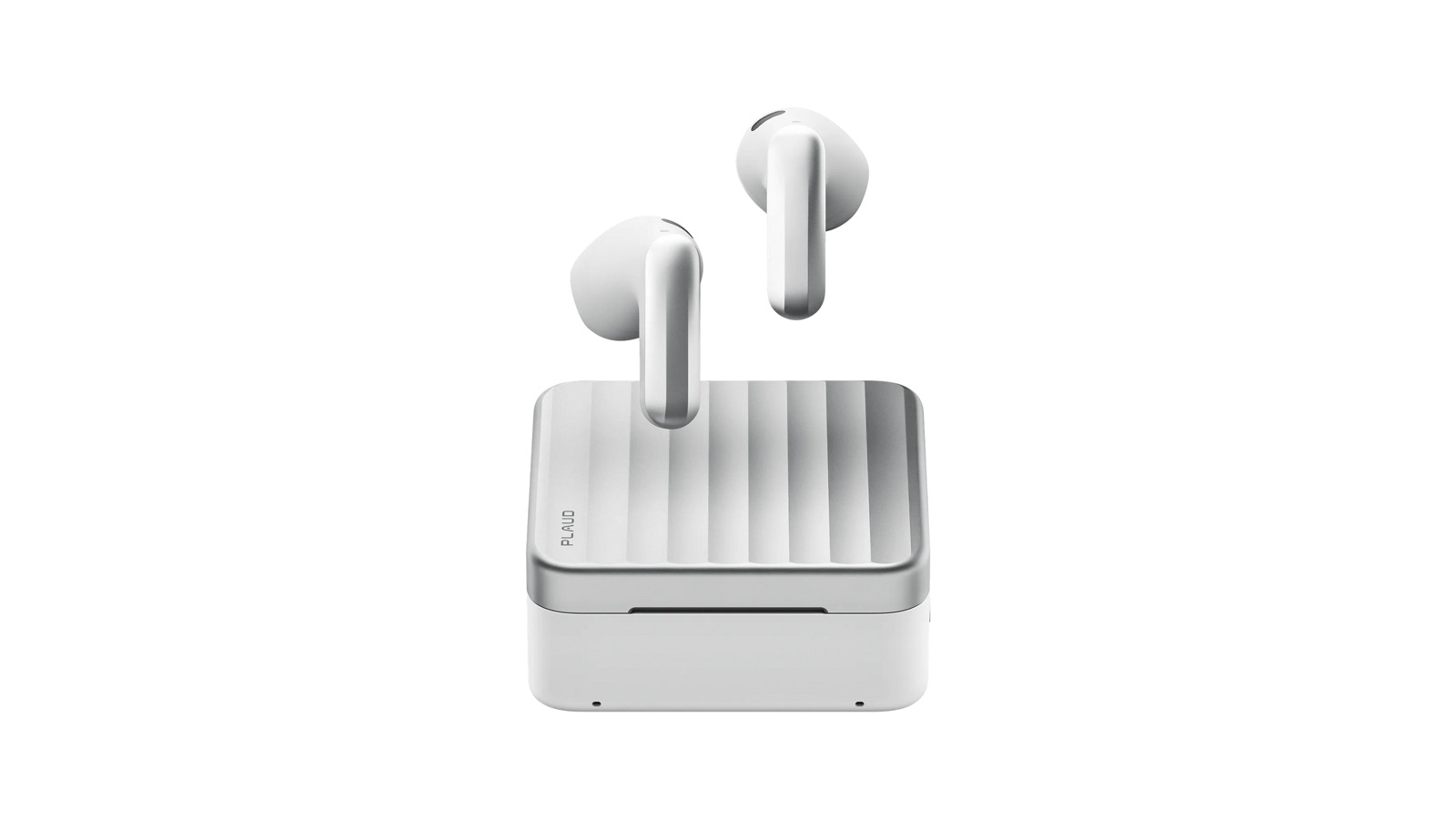
Plaud, the company behind a line of AI note-taking devices, has announced Plaud One, a pair of true wireless earbuds. The interesting part is the charging case. It packs four microphones, a speaker and 4G LTE connectivity through a built-in eSIM, so once the earbuds are out of it, the case alone can keep recording for up to 25 hours. It launches first as a globally limited Explorer Edition of 2,000 units at 249.99 USD (about 39,000 yen), with shipping planned before the end of 2026.
The charging case becomes a standalone recorder
Plaud's earlier products were built around a single job. The card-shaped Plaud Note attached to the back of a phone, and NotePin clipped to a collar. Both simply captured audio, leaving transcription and summarisation to the phone app and the cloud. Plaud One redraws that division of labour.
The new charging case carries four MEMS microphones with AI beamforming. The stated pickup range is roughly 16.4 feet, about 5 metres, which is far enough to catch someone on the other side of a meeting table. Along the edge of the case sit a record button, an agent button for talking to the AI, and a speaker. Taking the earbuds out and setting the case on a desk is, in itself, the act of starting an independent recorder.
Connectivity changed too. The case has an embedded eSIM and connects over 4G LTE on its own. Because it does not have to route audio through a phone or a Wi-Fi network, recording and processing continue even with the handset left in a bag. The internal battery is 830 mAh, rated for up to 21 days on standby and up to 25 hours of continuous recording. It charges over USB-C and supports fast charging, with 10 minutes yielding roughly 2 hours of use. The case weighs 2.20 oz, around 62 g.
Three microphones per earbud and up to 40 dB of ANC
The earbuds themselves are also designed around capture. Each side holds three MEMS microphones plus one VPU (Voice Processing Unit) dedicated to speech processing, aimed at phone calls and online meetings. Pickup range on the earbuds is about 6.6 feet, roughly 2 metres.
The music side of the spec sheet is complete enough. Each earbud uses a 12 mm dynamic driver with a frequency response of 20 Hz to 20 kHz. Noise cancellation is adaptive, with a hybrid design rated at up to 40 dB of reduction. There is a transparency mode, and the supported codecs are SBC and LDAC. Three EQ presets are offered: Balanced, Bass Boost and Vocal.
Connection is over Bluetooth 5.4 with multipoint support for two devices. Apple Find My support is a practical touch for something this small. The fit is half-in-ear rather than a sealed canal design, and the only colour is white. Each earbud weighs 0.16 oz, about 4.5 g.
Battery life runs to 6 hours of playback with ANC off and 4.5 hours with it on, or up to 36 hours in total when counting the case. For recording, the figures are up to 6 hours from the earbuds and up to 25 hours from the case.
Turning recordings into finished work
What Plaud is really selling here is not the recording but what happens afterwards. Press the agent button and speak, and the AI answers, then assembles meeting notes, slides or a draft email from what it heard.
The integrations named officially are Gmail, Google Drive, Google Calendar, Slack and Notion. Plaud also says any service compatible with MCP (Model Context Protocol) can be connected, which effectively hands the question of coverage over to the standard. The intended experience is finding the meeting notes already sitting in Notion, or a follow-up draft waiting in Gmail, shortly after the call ends.
The Explorer Edition ships with a starter plan covering 300 minutes of transcription and 200 USD (about 31,000 yen) in Plaud credits for AI features. Put another way, heavier use of the AI side will cost more over time. The hardware price is not the whole running cost, which is worth knowing before buying.
※Exchange rates as of September 5, 2026: 1 USD = 156 JPY, 1 EUR = 182 JPY
Price, availability and the situation in Japan
The Explorer Edition is priced at 249.99 USD, or 249.90 EUR (about 45,000 yen) in Europe. The run is capped at 2,000 units worldwide, and Plaud has signalled that a wider consumer version will follow in 2027 once it has watched how early buyers use the device. Shipping is scheduled for the fourth quarter of 2026.
The pre-order allocation is already gone, however. As of September 6, Plaud's official product page shows the item as out of stock, pre-orders closed, with an invitation to join a waitlist for notification if they reopen. Anyone who saw the unit on the IFA 2026 show floor and decided to buy will have to wait for the next opportunity.
There is no announcement yet about sales in Japan, about Japanese radio certification, or about whether the eSIM will work on domestic carrier networks. Since the product includes 4G connectivity, using it in Japan depends on clearing the Radio Act requirements first. Given that the Plaud Note series is already sold in Japan, a future launch is plausible, but nothing is confirmed at this point.
Summary
Plaud One packs four microphones, a speaker and 4G connectivity via eSIM into its charging case, letting the case alone record for up to 25 hours after the earbuds come out. The earbuds carry three microphones and a VPU per side, with up to 40 dB of noise cancellation and LDAC support. Captured material is written directly into Gmail, Slack, Notion and similar tools by the AI. The price is 249.99 USD, the 2,000-unit Explorer Edition had already closed pre-orders as of September 6, and a general release is planned for 2027. Availability in Japan has not been announced.