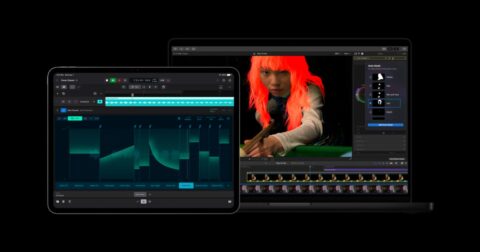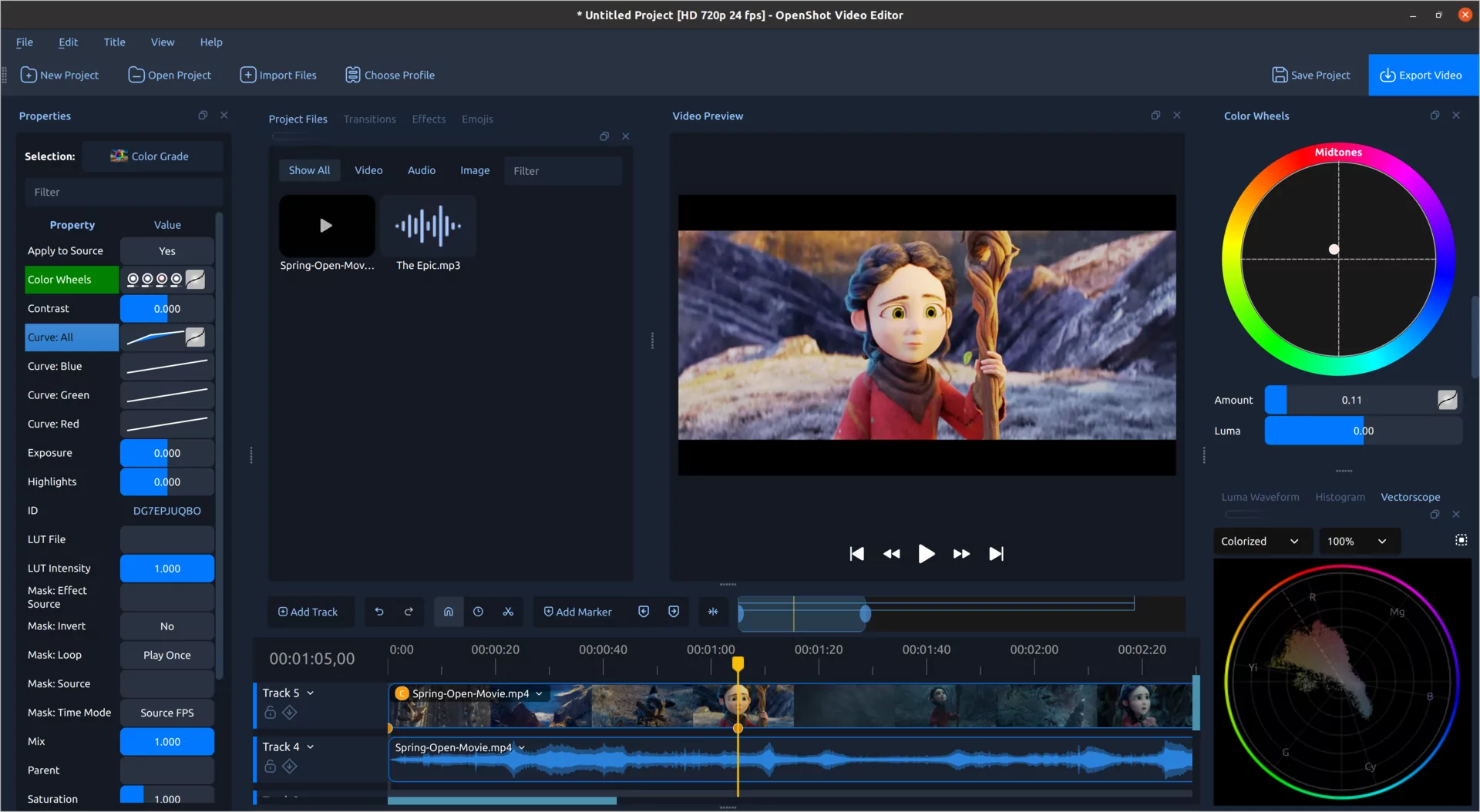
The free video editor OpenShot has reached version 4.0. Released on August 30, 2026, it is the first major update since 3.5.1 in April. Screen and webcam capture now happen inside the application, a dedicated color workspace has been added, and a new effect can cut a moving subject out of a clip automatically. The license remains GPLv3, and the editor is still free on Windows, macOS and Linux.
Capture, Edit and Finish in One Place
Earlier versions of OpenShot assumed you had already prepared your footage elsewhere. The new Recording View lets you pick a microphone, the desktop, a webcam, or system audio and pull them straight into the project.
The interesting part is that every enabled source is stored as its own file. Your voice stays separate from system audio, and the screen stays separate from the webcam, so after a take you can nudge the webcam window, lower only your own volume, or apply an effect to a single source. Record the screen and webcam together and OpenShot can build a rounded picture-in-picture layout for you.
While recording you can watch the microphone meter, preview the webcam, and see temporary clips grow on the timeline. Because an existing project can play back while you record, the workflow suits voice-over and commentary work. Right-click a clip and choose to record audio, and OpenShot jumps to the start of that clip and opens the recording controls for you.
Capture paths are provided per operating system, covering Windows, macOS and Linux X11, with Linux Wayland handled through PipeWire. Which screens, regions and system-audio options are available depends on the platform and on the permissions you have granted.
Color Work Now Finishes Inside the Editor
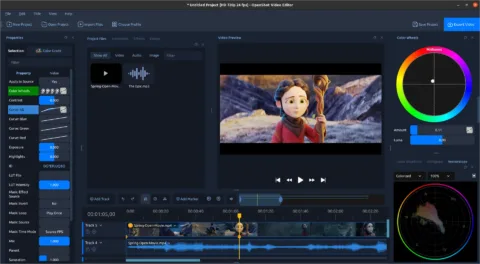
The new Color View arranges a large preview, clip properties, color wheels and video scopes around your footage. Getting in is simple: right-click a clip, choose the color adjustment under Look, and the whole panel set opens.
At the center sits the new Color Grade effect. Alongside correction controls for exposure, contrast, temperature, tint, highlights, shadows, saturation and vibrance, it carries separate color wheels for the global image, shadows, midtones and highlights. Four editable curves cover the full image plus the red, green and blue channels, with Bezier handles for smooth transitions. Industry-standard .cube LUT files load as well, and an intensity control lets you blend a LUT in partially. Every parameter is keyframable, so you can track a shot whose lighting shifts mid-take.
Four scopes are included: luma waveform, histogram, RGB parade and vectorscope. Each has a region tool for analyzing only a face, a patch of sky or a product, and the vectorscope draws a skin-tone reference line that makes color casts easier to spot. For a quicker start, presets such as Auto Contrast, Lift Shadows and Warm Up simply call the same Color Grade effect, so nothing is locked in.
Subject Masks Run Entirely on Your Own Machine
Isolating a moving subject normally means drawing a mask frame by frame. The new Object Mask effect builds a selection from a few positive points on the subject and a few negative points around it, then follows that mask through the clip. When the shape changes sharply, you add more points on that frame.
What stands out is where the work happens. The effect uses YOLO, EfficientSAM and Cutie machine learning models converted to the ONNX format, downloaded on demand and executed on your own computer. There is no cloud processing, no AI account and no extra subscription. For anyone editing footage that should not leave the building, that makes it a practical option rather than a compromise.
The finished mask can be shown as an effect or reused as the mask source for Blur, Pixelate, Color Grade and other effects, and inverting it lets you treat the background instead. Object Detection was updated at the same time, adding downloadable YOLOv5 ONNX models and segmentation masks.
Ten New Effects, Plus Real Performance Gains
Ten effects have been added. Audio Visualization turns sound into waveforms, bars, radial patterns, spectrum displays and VU-style meters. Beat Sync layers color that reacts to the energy in a track. Film Grain reproduces 35mm, 16mm and Super 8 textures, Denoise Image cleans up noisy footage, Shadow adds drop shadows, Glow adds a halo, Displacement Map warps one clip with another, Timer produces count-up and count-down displays, and the list closes with Color Grade and Object Mask.
On performance, compared with 3.5.1 the Blur effect finished its test workload 61.8 percent faster, Sharpen improved by 12.8 percent, timeline rendering by 3.4 percent, and the timeline test with transforms by 5.1 percent. The Blur figure is the eye-catching one, but timeline drawing sits on the path used by clip editing, preview updates, thumbnails and zooming, so even a few percent is felt during a session. All 10 audio visualization modes ran above common 24, 30 and 60 fps project rates, with the heaviest modes still exceeding 170 frames per second.
The Foundation Was Rebuilt at the Same Time
Less visibly, the timeline has moved fully to a native Qt implementation. With the old web-based components gone, zooming is smoother and clips and keyframes read more clearly. The timecode in the ruler can now be clicked and typed into directly.
Support for Qt 6 and PySide6 has widened, which helps OpenShot fit into newer Linux distributions. The underlying libopenshot and libopenshot-audio libraries have both reached version 1.0.0. The codebase also picked up Android compatibility groundwork for file access, rendering and large ARM64 memory addresses, although Android was not announced as a supported platform for 4.0 and no timeline has been given.
Summary
OpenShot 4.0 pulls recording, color finishing and subject isolation, tasks usually handed off to separate applications, into a single editor. The mask workflow in particular runs entirely on the local machine with no account and no payment involved, which is an unusual position for a free video editor. The timeline foundation was replaced in the same release, so new features and structural work landed together.