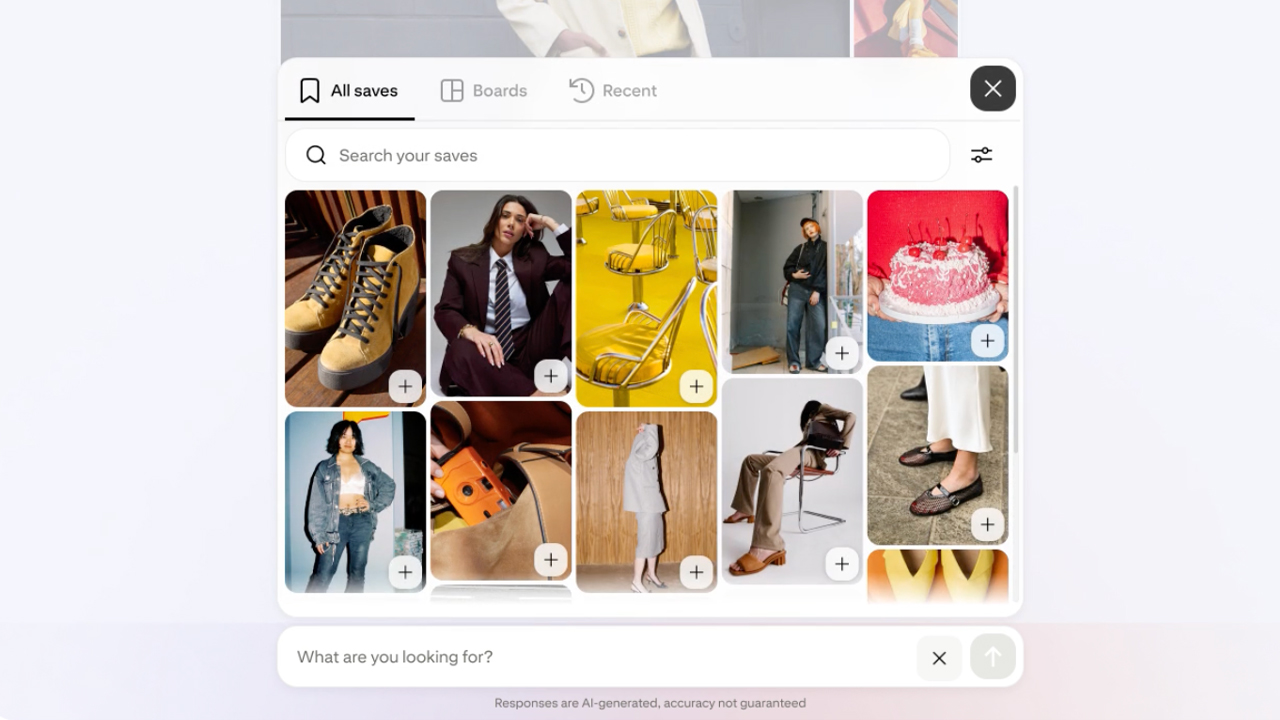
Pinterest, known as a service for discovering things you want starting from images, has launched an experimental new app called "Ask Pinterest" that lets you explore shopping ideas through conversation. Instead of typing keywords into a search box, you can chat with an AI and receive recommendations tailored to your tastes. For now it is available to a limited number of users, offered through the web on both smartphones and PCs.
From Keyword Search to a Consultation
Ask Pinterest is an attempt to extend the image-centered discovery experience Pinterest has refined into a conversational form. Users pose questions in natural language, much like talking to a chatbot, and receive recommendations and inspiration in return.
Pinterest's traditional search has been good at finding things that fit within a single search term. Ask Pinterest, by contrast, aims at more involved, multi-step requests. For example, planning a home party within a budget, or furnishing a room little by little over time—requests that a single search term cannot fully capture. Because it is designed to remember context across a conversation, its suggestions move closer to the user's intent the more they interact.
The "Taste Graph" as the Foundation for Recommendations
At the core of Ask Pinterest is proprietary data that Pinterest calls the "Taste Graph." It is a mechanism that captures how people's interests connect with their aesthetic preferences, and it represents a strength the company has built up over many years.
If you use it while signed in, your own saved Pins and Boards also become material for recommendations. In other words, answers are assembled for each individual based on what that user has already expressed a liking for. Rather than letting outside AI services draw on its data, Pinterest's approach is to train AI models on its own data and put them to work in its own products.
Why Now
Behind this is a situation in which AI chatbots have begun competing with traditional search engines for users' attention. Google has already introduced features that use AI to help shoppers find products, track prices, and even check out. ChatGPT has also experimented with agentic shopping, and Meta, Shopify, and others are exploring the same direction.
Lee Brown, Pinterest's chief business officer, noted that the future of discovery will not be driven by keywords alone but will be shaped by context, taste, and trusted recommendations. He emphasized that this is precisely where Pinterest holds a unique advantage.
Testing Without Disrupting the Main App, Plus New Ad Tools
Carving Ask Pinterest out as a standalone app is said to be a way to test the new technology without disrupting the experience of the flagship Pinterest app. The insights gained here are expected to feed into building AI experiences for the main app in the future.
The announcement was made alongside a set of updates aimed at advertisers and marketers. An AI assistant, still in beta, was added to Ads Manager in the United States, and a new AI model called "Performance+ creative" was introduced globally to choose the ad creative most likely to perform well each time an ad is shown. In addition, the company prepared a "Pinterest MCP (Model Context Protocol)" infrastructure layer that lets advertisers manage and monitor campaigns in a standardized way from third-party agentic tools. The timing also came just ahead of Cannes Lions, the annual event where the question of how to put AI to work for advertising and marketing takes center stage.
Summary
Ask Pinterest is a step that hints at a move from keyword-based search toward a shopping experience in which you find what suits your tastes by conversing with AI. The keys are the Taste Graph, which captures users' interests and aesthetic preferences, and personalization based on saved Pins and Boards. For now it remains an experimental stage offered to a limited number of users on the web, but if the mechanisms refined here spread to the main app, the very way we search may begin to change.