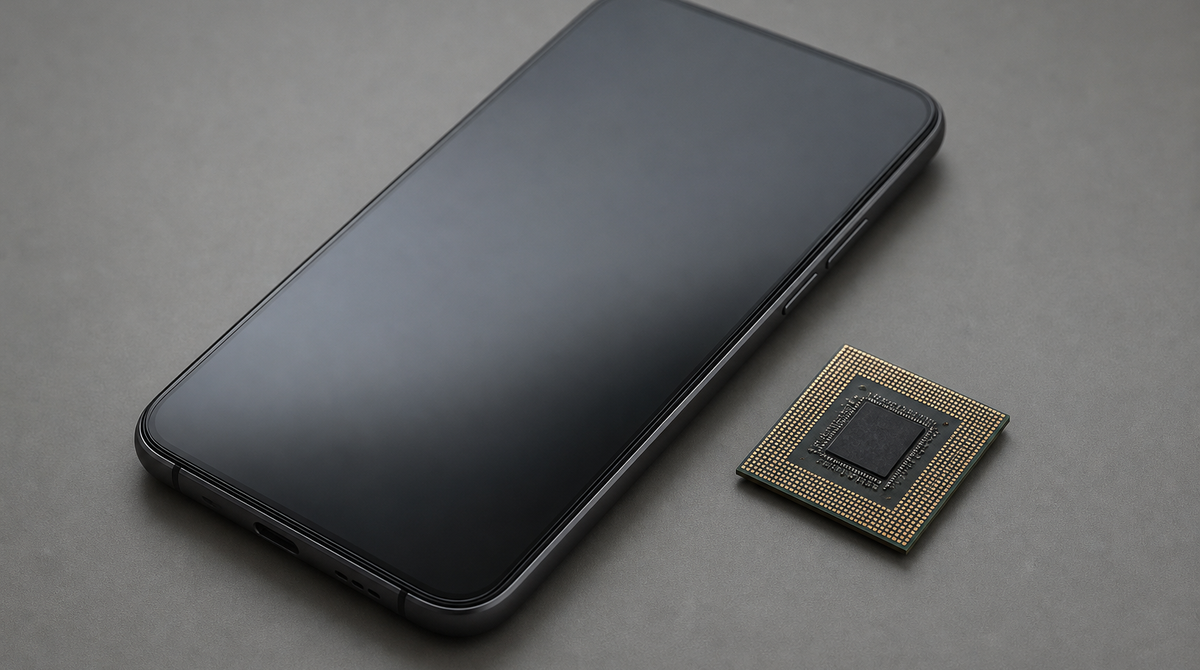
OpenAI is reportedly developing its own smartphone processors with the help of MediaTek and Qualcomm[1]. According to a prominent analyst, the chips would power an AI-focused smartphone, with mass production expected around 2028[1]. None of this has been officially confirmed, but here is a summary of what has been reported.
An analyst's claim of an "AI phone"
The claim comes from Ming-Chi Kuo, an analyst at TF International Securities[1]. On X (formerly Twitter), Kuo said that OpenAI is working with MediaTek and Qualcomm to develop smartphone processors as part of its plan for an AI phone[1]. Mass production is tipped for 2028, and the specific chip specifications and suppliers are expected to be finalized between late 2026 and early 2027[1].
Last year, OpenAI announced a partnership with Broadcom to develop custom AI chips for the computer clusters that will power its next generation of systems[1]. If the latest rumor is accurate, the company's custom-silicon strategy would extend beyond the data center and into smartphone chips[1].
A design focused on power efficiency and small on-device models
According to Kuo, the key design considerations for the chip will be "power consumption, memory hierarchy management, and basic small-model execution"[1]. The idea is to run lightweight AI models locally on the device while handing more complex, demanding tasks to AI running in the cloud[1]. Because cloud-based AI tends to be more powerful than on-device processing, splitting the workload this way is a sensible approach.
Kuo also hints that the device would need to understand the user's context "continuously"[1]. As a result, it may feature extensive always-on capabilities[1]. Low-power, always-on operation is not a new idea, however; Qualcomm's "Sensing Hub" on recent chips already supports similar scenarios[1].
On the manufacturing side, Luxshare — a Chinese company known as a rival to Foxconn — is said to be the exclusive "system co-design and manufacturing partner"[1].
If a dedicated processor does arrive, it is likely to prioritize AI silicon over raw CPU and GPU horsepower[1]. That would be broadly in line with Google's Pixel, which emphasizes AI features over raw performance[1]. That said, machine-learning models that are not optimized for dedicated AI silicon can fall back to the GPU or CPU, so if the phone is meant to run models other than OpenAI's own, the chip cannot compromise too heavily on CPU and GPU performance[1].
Summary
If the reports prove accurate, OpenAI is moving toward an AI smartphone powered by its own custom chip, targeting 2028[1]. Even so, this remains an analyst's observation rather than an official announcement from OpenAI. It is worth waiting for further updates once the specifications and suppliers are reportedly settled from late 2026 onward.
出典:https://www.androidauthority.com/openai-smartphone-mediatek-qualcomm-chips-3660993/