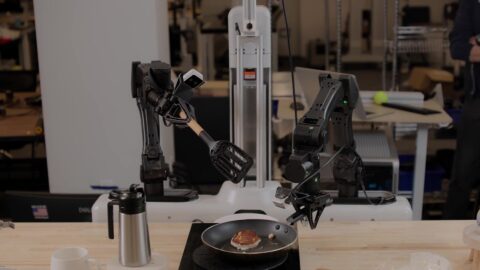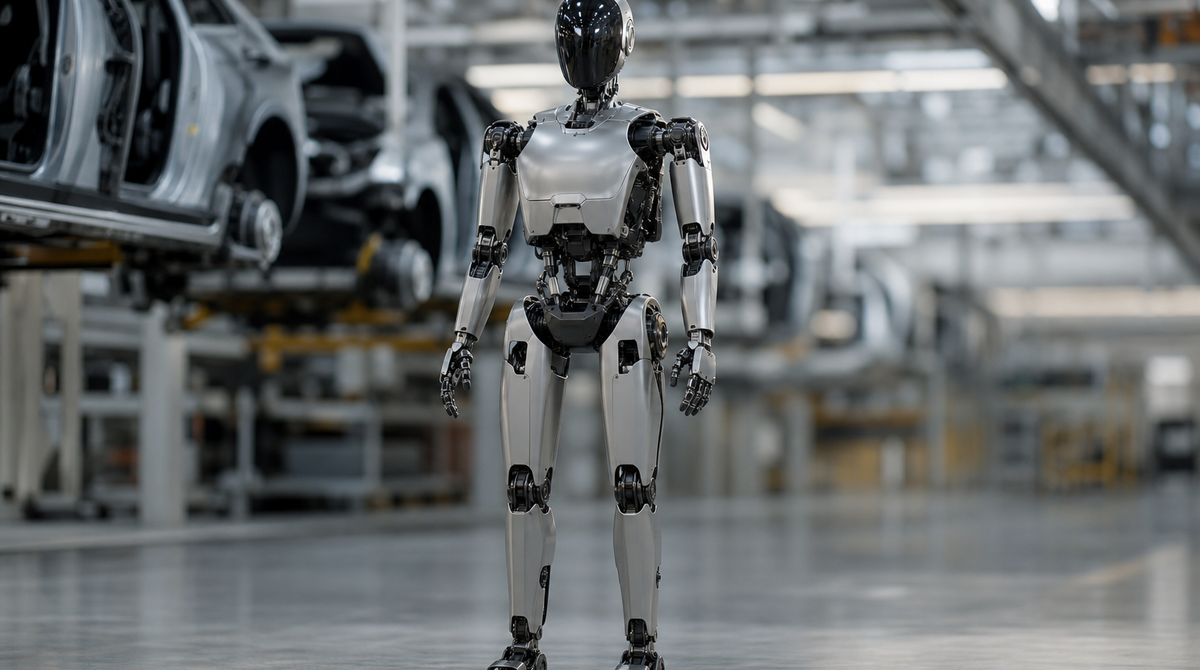
On June 8, NVIDIA and Hyundai Motor Group announced in Seoul that they are significantly broadening their partnership. The goal is to take physical AI (AI that operates in the real world) and robotics out of the research stage and turn them into products that can actually be used in factories. At the center of the story is Atlas, the humanoid robot built by Hyundai-owned Boston Dynamics, which is shifting from a star of demo videos into a working asset on the manufacturing line.
From the Lab to the Factory: the Next Move
What the two companies emphasized in this agreement is a clear objective: to move humanoid robots from "prototypes built to be shown off" to "tools that earn their keep on the floor." NVIDIA CEO Jensen Huang and Hyundai Executive Chair Chung Euisun both spoke of a shared vision of embedding AI into every form of mobility.
The foundation for this is an AI supercomputer that Hyundai will build using NVIDIA's latest Blackwell architecture. Bundling thousands of GPUs, it is designed to train models for autonomous driving, smart manufacturing lines, and robotics control, and the investment is reported to reach several billion dollars (in the hundreds of billions of yen). Rather than a desktop machine, this is computing infrastructure rebuilt from the ground up to support the core of the business.
*Converted at 1 USD = 160 JPY
Software Is Where the Contest Is Decided
Just as important as the hardware is the software that makes the robots move. This effort runs on NVIDIA's robot development platform Isaac and its simulation environment Omniverse. Isaac is the framework for developing and deploying robot applications, while Omniverse enables "digital twins" that recreate real-world facilities faithfully in virtual space.
The biggest advantage of a digital twin is that robots can be trained any number of times in a virtual space before they ever touch real hardware. By recreating an entire production line and teaching robots to operate within it before deploying them, both the time spent on trial and error and the risk of accidents can be greatly reduced. In bringing humanoid robots closer to practical use, this flow of "train in the virtual world, then move to the real one" holds the key.
A Continuous Strategy from Autonomous Driving to Robotics
This is not the first time the two companies have worked together. Back in March 2026, they announced an expansion of Level 4 (autonomous driving that requires no human operation under limited conditions) robotaxi development through their autonomous-driving joint venture Motional. There, NVIDIA's automotive platform Drive is used to realize vehicles that can run without human intervention under defined conditions.
Autonomous driving, smart manufacturing, and humanoid robots: connecting all of these on top of a single AI foundation is the bigger picture behind this expanded partnership. A structure is taking shape in which every domain related to mobility is tied together by shared computing infrastructure and development tools.
Boston Dynamics Is the Trump Card
What sets this partnership apart from other corporate alliances is the fact that Hyundai holds roughly 80 percent of Boston Dynamics. The Atlas humanoid robot sits at the very center of the robotics strategy laid out here.
Across its generations, Atlas has transformed from a hydraulically driven research platform into a fully electric humanoid built with real-world tasks in mind. The strength of holding both an in-house robotics company and the AI foundation that powers it is not easily imitated. For NVIDIA, too, it is a stepping stone to spreading Isaac and Omniverse as the standard base for physical AI. In other words, it is trying to retrace, in the field of robotics, the same path by which CUDA became indispensable in the world of machine learning.
Summary
The expansion of the NVIDIA-Hyundai alliance is a move to push humanoid robots and autonomous driving from "technology for research" to "products usable on the floor." With three elements in place — a Blackwell-based AI supercomputer, virtual training via Isaac and Omniverse, and Boston Dynamics' Atlas — the march toward putting physical AI into practical use has become markedly more concrete. The day when the humanoid robots we are used to seeing in demo videos work as members of the factory is steadily drawing nearer.