
NVIDIA and South Korea's Doosan Group announced an expanded collaboration spanning physical AI (AI that lets robots and machines in the real world perceive, reason, and act), robotics, and AI factory infrastructure (next-generation data centers built for AI workloads)[1]. The effort reaches across the group's businesses, including Doosan Robotics, the construction equipment maker Doosan Bobcat, the power systems company Doosan Enerbility, and Doosan Corporation Electro-Materials BG.
"Agentic Robot OS" Aims to Make Industrial Robots Smarter
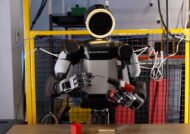
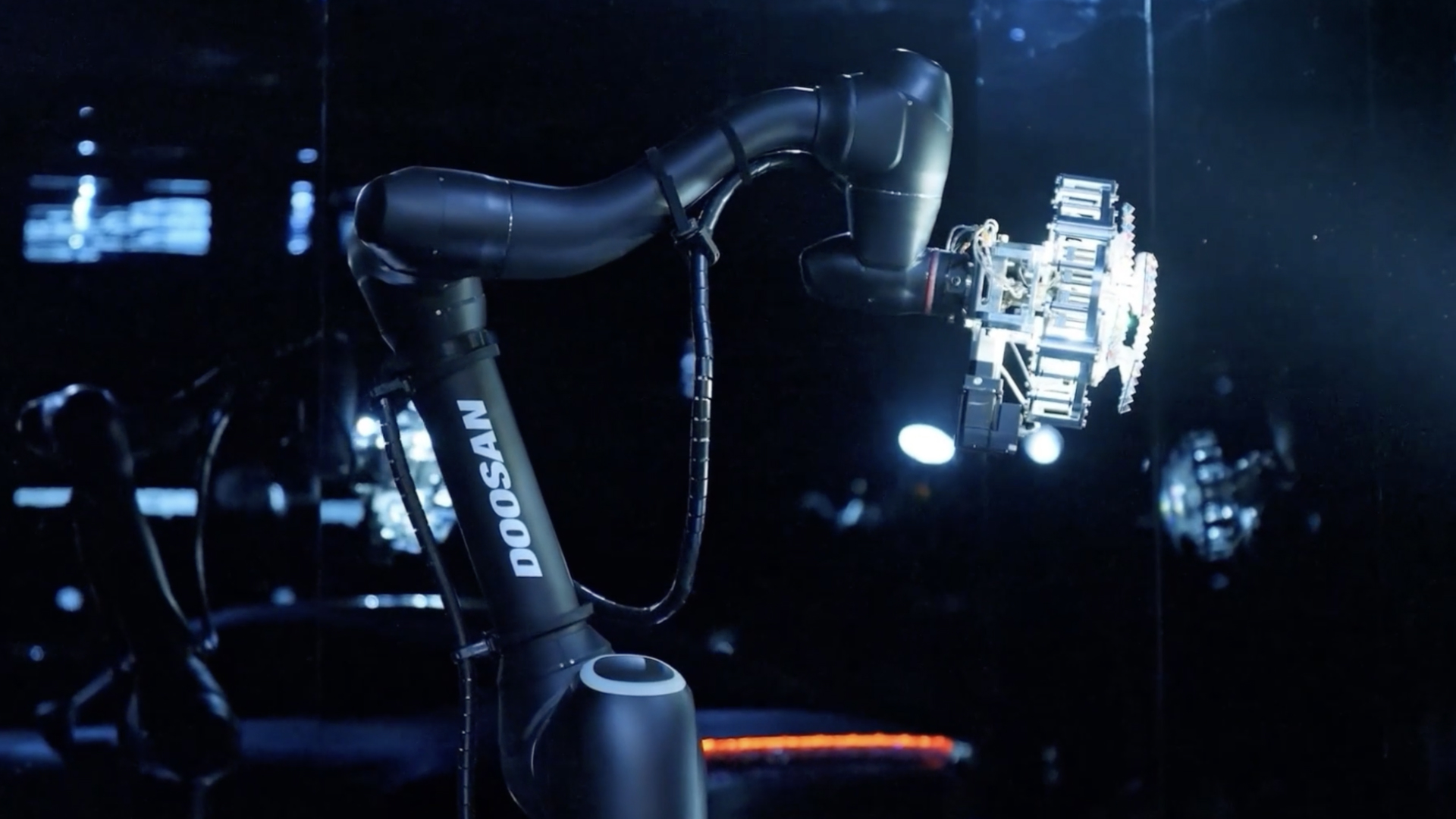
At the center of the collaboration is the "Agentic Robot OS" that Doosan Robotics is developing. It is an AI-powered robotics platform connecting perception, reasoning, simulation, learning, and on-device inference, with the goal of letting robots understand a situation and act on their own[1].
The platform incorporates NVIDIA's physical AI technologies: NVIDIA Isaac Sim and Isaac Lab, which train and validate robot movements in virtual space; NVIDIA Cosmos, world foundation models that help robots understand the physical world; the open-source Newton physics engine; and NVIDIA Jetson Thor, a compact computer mounted on robots to run inference. By combining simulation-to-real workflows, physics calibration, and AI reasoning, the companies say they will make collaborative robots more adaptable, more specialized for specific tasks, and ready for large-scale deployment.
The two companies also plan to develop reference use cases for high-value industrial tasks such as depalletizing (unloading stacked goods one by one) and sanding, and to work on new robot form factors including dual-arm and humanoid platforms. Through this work, Doosan Robotics aims to evolve from a robot arm provider into a full-stack, AI-first robotics company.
Doosan Bobcat Eyes Autonomy in Construction Equipment
The momentum is not limited to robots. Doosan Bobcat, which makes construction machinery, plans to explore integrating NVIDIA's physical AI technologies into equipment used in construction, landscaping, agriculture, and material handling[1].
The key here is specialized "world models" (AI models that let a machine understand its surroundings and predict what comes next) that enable equipment to recognize diverse operating environments, judge changing conditions, and perform tasks more autonomously. The companies also aim to help establish an industry-standard ecosystem for compact autonomous equipment. Autonomy in construction equipment is especially anticipated at worksites that face labor shortages or dangerous tasks.
Power and PCB Materials Supporting the AI Factory
The collaboration extends beyond software and robots to the foundations that keep AI factories running. Doosan Enerbility, which builds power generation equipment, is exploring the possibility of supporting NVIDIA's AI factories on the power side by combining large-scale power infrastructure such as gas turbines, steam turbines, and small modular reactors (SMRs, reactors scaled down for easier mass production) with Doosan Fuel Cell's hydrogen fuel-cell systems[1]. Because AI data centers require a stable supply of large amounts of power, the aim is to connect power-generation expertise with the requirements of AI infrastructure.
In addition, Doosan Corporation Electro-Materials BG supplies copper clad laminate (CCL), the foundational material for printed circuit boards (PCBs), supporting next-generation AI data center infrastructure on the materials side. CCL plays an important role in the boards of AI accelerators and AI servers, where low signal loss and high reliability are essential. As "NVIDIA MGX," a modular reference architecture for building AI servers, spreads, advanced materials that carry high-speed signals reliably are becoming more important.
Summary
The NVIDIA and Doosan Group collaboration is broad, connecting in a single thread the AI enablement of industrial robots, autonomy in construction equipment, power supply for AI factories, and the supply of board materials. Much of it is still at the exploration or goal stage, but with well-known companies joining forces around concrete physical products, it is a move that symbolizes the spread of physical AI. It will be worth watching how much smarter robots and construction machines can become in the real world.
Source: https://blogs.nvidia.com/blog/nvidia-and-doosan-group-physical-ai/