NVIDIA has announced that it is open sourcing cuFile, the API that lets GPUs read from and write to storage directly, along with the vertical storage software stack beneath it[1]. The announcement lands alongside the Future of Memory and Storage (FMS) conference, running August 4 to 6 in Santa Clara, California, where the company also outlined Storage-Next, an initiative involving more than 40 storage and flash vendors[1][2].
Storage Becomes Part of the Data Path Itself
Storage used to be treated as a passive place to park data. But AI agents now consume enormous volumes of it, and GPUs themselves can issue storage requests directly, generating thousands of concurrent operations[1].
Storage systems have to keep encrypting, compressing, verifying and reconstructing data while serving those requests. NVIDIA argues that these data services are becoming the bottleneck. Benchmarks cited in the company's technical blog show that the NVIDIA Vera CPU, part of NVIDIA Vera BlueField-4 STX, delivers up to 3.21 times the throughput of an x86 CPU in a two-stage compression and encryption pipeline[1].
Whether data belongs in memory or on a drive is a tradeoff that was first framed 40 years ago, when access times were measured in minutes. On today's GPUs paired with AI storage solutions, the same tradeoff plays out in microseconds[1]. When the premise changes that much, the design has to change with it.
cuFile Goes Public, With Google, Intel and Meta on Board
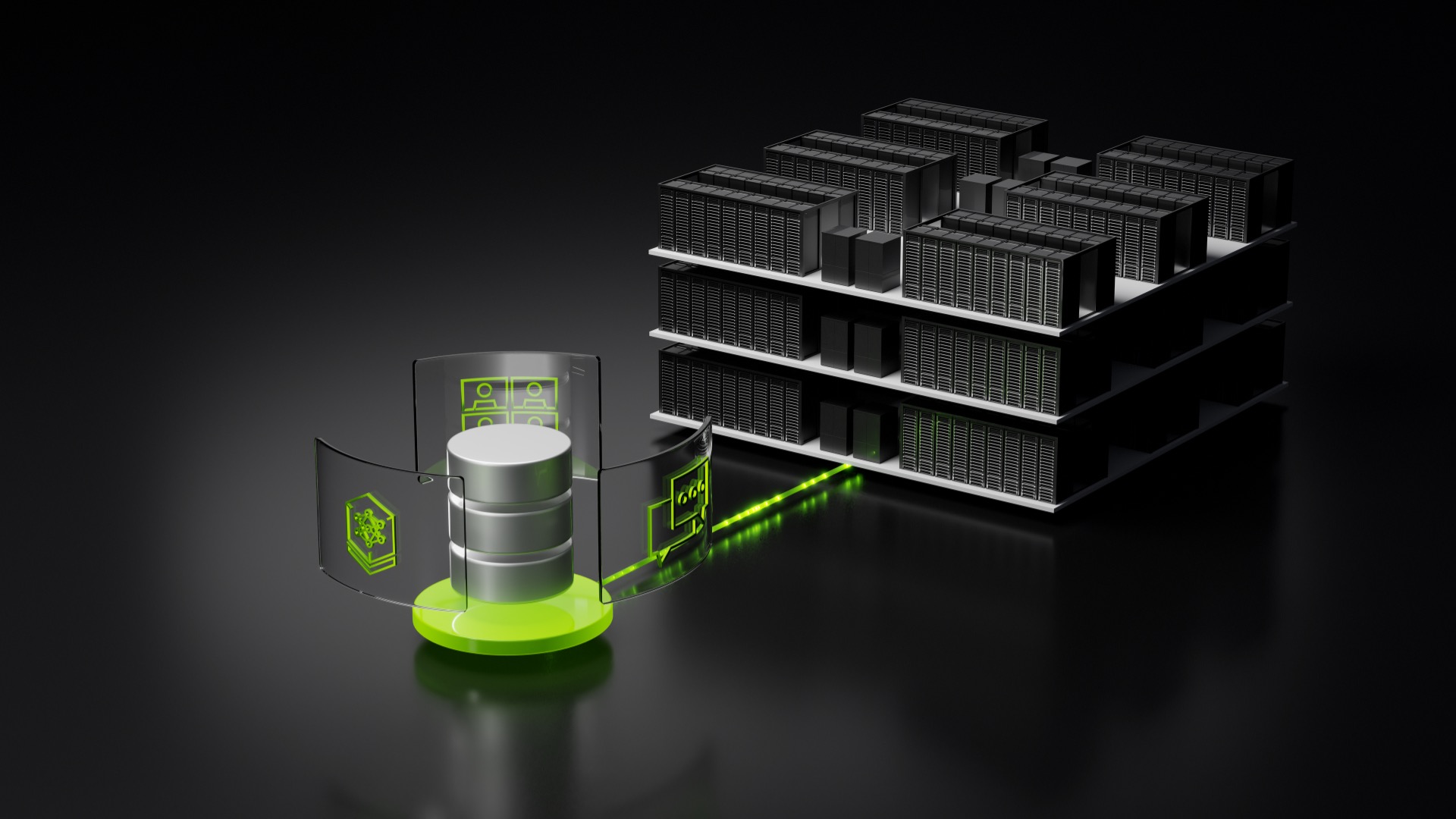
cuFile is an open source component of NVIDIA GPUDirect Storage. It allows GPUs, not just CPUs, to read from and write to storage directly, using hundreds of thousands of GPU threads and fast high-bandwidth memory to reach data in microseconds[1].
The new site hosting the APIs lists Google, Intel, NVIDIA and Meta as inaugural maintainers[1]. The setup suggests an intent to make the stack portable across software and hardware platforms rather than tuning it for one vendor's silicon.
NVIDIA also points to the security angle. Fast, secure access to data and storage underpins both preventive and detective cybersecurity measures. Making cuFile openly available should let security context, data and storage move at the speed AI-powered defenses require, and the company says it supports efforts such as the newly formed Open Secure AI Alliance[1].
Storage-Next Brings Together More Than 40 Vendors, With SCADA at Its Core
Storage-Next gathers storage makers, controller vendors, thermal design, cooling and orchestration operators, and standards bodies to agree on how GPU-driven storage should behave, then turn that agreement into interoperable, open industry standards[1].
More than 40 leading storage and flash vendors take part, including DDN, KIOXIA and Micron[1]. The underlying technology is SCADA, short for scaled, accelerated data access, which lets massively parallel GPUs pull only the data an application needs directly from storage into their own high-speed memory. DDN is integrating SCADA with Infinia, its software-defined, AI-native data intelligence platform[1].
Sven Oehme, chief technology officer at DDN, framed it this way: AI success will be defined not by how much infrastructure organizations own, but by how productively they use it. He described the collaboration as creating a more direct, efficient connection between GPUs and data[1].
Splitting the Job to Keep Speed and Safety Together
Letting an application talk straight to a drive is fast, but handled carelessly it can scribble over another process's memory. That is a security hole, not a feature[1].
SCADA works around the problem by splitting the job in two. The parts of an application that need raw speed stay outside the trusted computing base. A separate, privileged component then configures protected access between the user application and its approved storage at setup time, following standard Linux protocols for security enforcement[1].
The foundation for Storage-Next and SCADA is NVIDIA Vera BlueField-4 STX, a modular, rack-scale platform combining the NVIDIA Vera Rubin platform, NVIDIA Vera BlueField-4 storage processors and NVIDIA Spectrum-X Ethernet networking. Its unified NVIDIA DOCA security stack lets enterprises enforce policy continuously along the AI data path. NVIDIA CMX Context Memory Storage, built on STX, adds an AI-native context tier for long-context, multi-turn, agentic AI inference[1].
Summary
At FMS, NVIDIA open sourced the cuFile API and the storage software stack beneath it, with Google, Intel and Meta joining as inaugural maintainers. The company also introduced Storage-Next, backed by more than 40 vendors, and SCADA, which pulls only the required data straight into GPU memory. It is a reminder that AI infrastructure debates, usually centered on compute, also need to be read from the side that feeds the data.
[1] Source: https://blogs.nvidia.com/blog/ai-storage-fms/