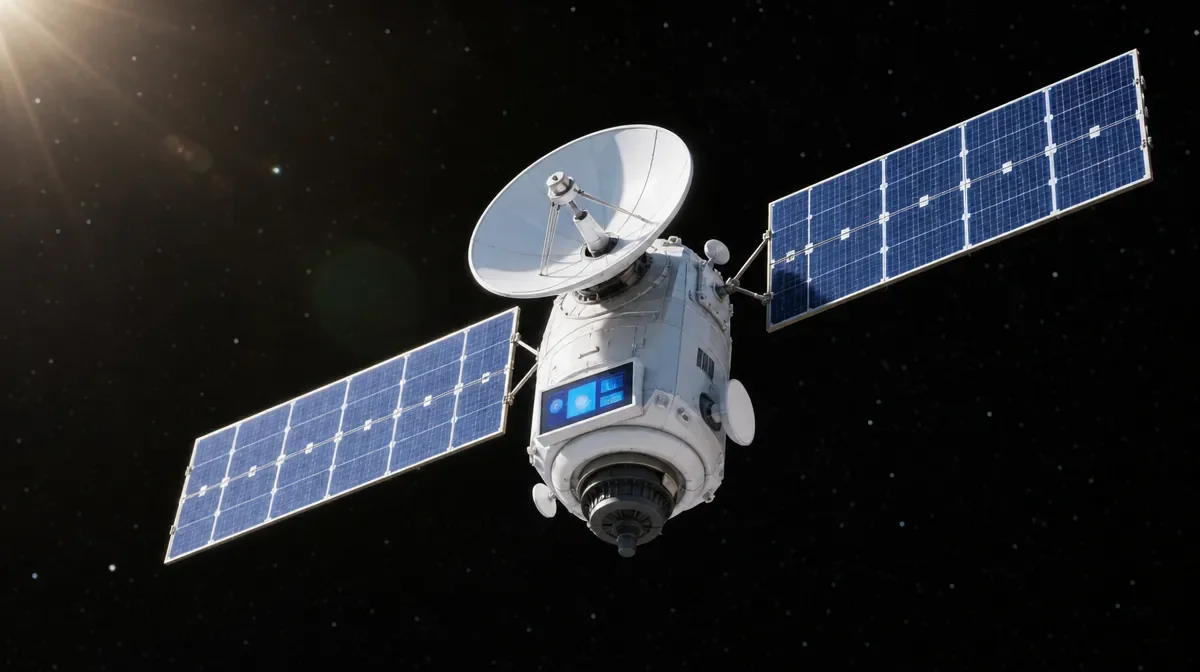
The U.S. Federal Communications Commission (FCC) announced on November 25, 2026 (U.S. time) that it has authorized SpaceX to deploy "Starmind," its proposed constellation of orbital data center satellites. The authorization covers up to 1 million satellites, and the FCC describes it as the first authorization in U.S. history for a constellation of data centers in space. However, the application was granted in part and deferred in part, with numerous conditions attached.
What was granted: backup radio links, with optical links as the main channel
According to the order issued by the FCC's Space Bureau (DA 26-1273), Starmind satellites will be deployed into orbital shells, each spanning 50 km, at altitudes from 500 to 1,002 km. Inclinations fall into two groups: around 30 degrees and sun-synchronous.
The grant itself covers radio communications for backup and emergency telemetry, tracking and command (TT&C). The frequencies are 18.8-19.3 GHz (space-to-Earth) and 28.6-29.1 GHz (Earth-to-space) in the Ka-band, on an unprotected, non-interference basis. SpaceX says each satellite will rely primarily on optical inter-satellite links with its Starlink satellites, and that it will use the Ka-band only if those optical links fail.
| Item | Details |
|---|---|
| Satellites | Up to 1 million |
| Altitude | 500-1,002 km (50 km shells) |
| Radio use | Backup and emergency TT&C only |
| Frequencies | 18.8-19.3 GHz (down) / 28.6-29.1 GHz (up) |
| License term | 15 years from certification of the first satellite's operation |
First satellite by 2033, full constellation by 2040
The authorization comes with deployment milestones. SpaceX must have one satellite operating by November 25, 2033, 10% of the maximum by November 25, 2035, and 50% by November 25, 2038, and must deploy the rest by November 25, 2040. Otherwise, the authorization becomes null and void. SpaceX must also submit semi-annual reports to the FCC, covering items such as conjunction events and the number of satellites deployed.
What the FCC deferred was the question of satellite disposal. SpaceX had asked for flexibility to move satellites operating above 600 km into disposal orbits or heliocentric orbits instead of re-entering the atmosphere. The FCC said it lacked sufficient information to decide and required SpaceX to file a modification application with a final orbital debris mitigation plan before deploying such satellites. It found that the plan for satellites below 600 km complies with its rules.
Petitions from Amazon, Viasat and the American Astronomical Society denied
SpaceX filed its application on January 30, 2026, and it was accepted for filing on February 4. Amazon's satellite unit (Amazon Leo), Viasat and the American Astronomical Society (AAS) filed petitions to deny, all of which the FCC denied.
The FCC said space-based activities are outside the scope of environmental review under the National Environmental Policy Act (NEPA). On optical astronomy, it pointed to SpaceX's commitment to coordinate with the National Science Foundation (NSF) and declined to impose additional conditions. It also said doubts about the technical and economic feasibility of orbital data centers fall outside the FCC's radiocommunications mandate.
The FCC is reviewing other orbital data center proposals
In a statement, FCC Chairman Brendan Carr framed the decision as supporting the computing infrastructure for America's "super intelligence" era. The FCC says it is continuing to review additional orbital data center proposals and intends to issue decisions on each expeditiously.
The FCC documents do not address when SpaceX plans to begin launches or the details of the satellites' computing performance or uses.
Our Take
It is significant that a constellation on the scale of 1 million satellites now has a regulatory path, complete with milestones and reporting requirements. As AI computing demand runs into land and power constraints on the ground, the idea of putting compute in space has moved a step forward on the regulatory front.
However, what was actually authorized is backup radio communications, and the disposal plan for satellites above 600 km remains unresolved. Concerns about astronomy and debris were set aside as outside the FCC's jurisdiction, not resolved. Even so, a 2033 deadline for the first satellite leaves considerable time, and it will likely take a while before the technology and economics come into clearer focus.
Summary
The FCC has authorized SpaceX to deploy up to 1 million "Starmind" orbital data center satellites, subject to milestones and conditions. The decision matters to companies pursuing space-based computing as well as to satellite operators and astronomers. Next to watch are SpaceX's modification application covering disposal of satellites above 600 km and whether the first satellite is operating by November 25, 2033.
Sources: FCC order "Memorandum Opinion and Order and Authorization" (DA 26-1273, November 25, 2026); FCC news release "FCC Authorizes 1 Million Satellites for Data Centers in Space" (November 25, 2026)