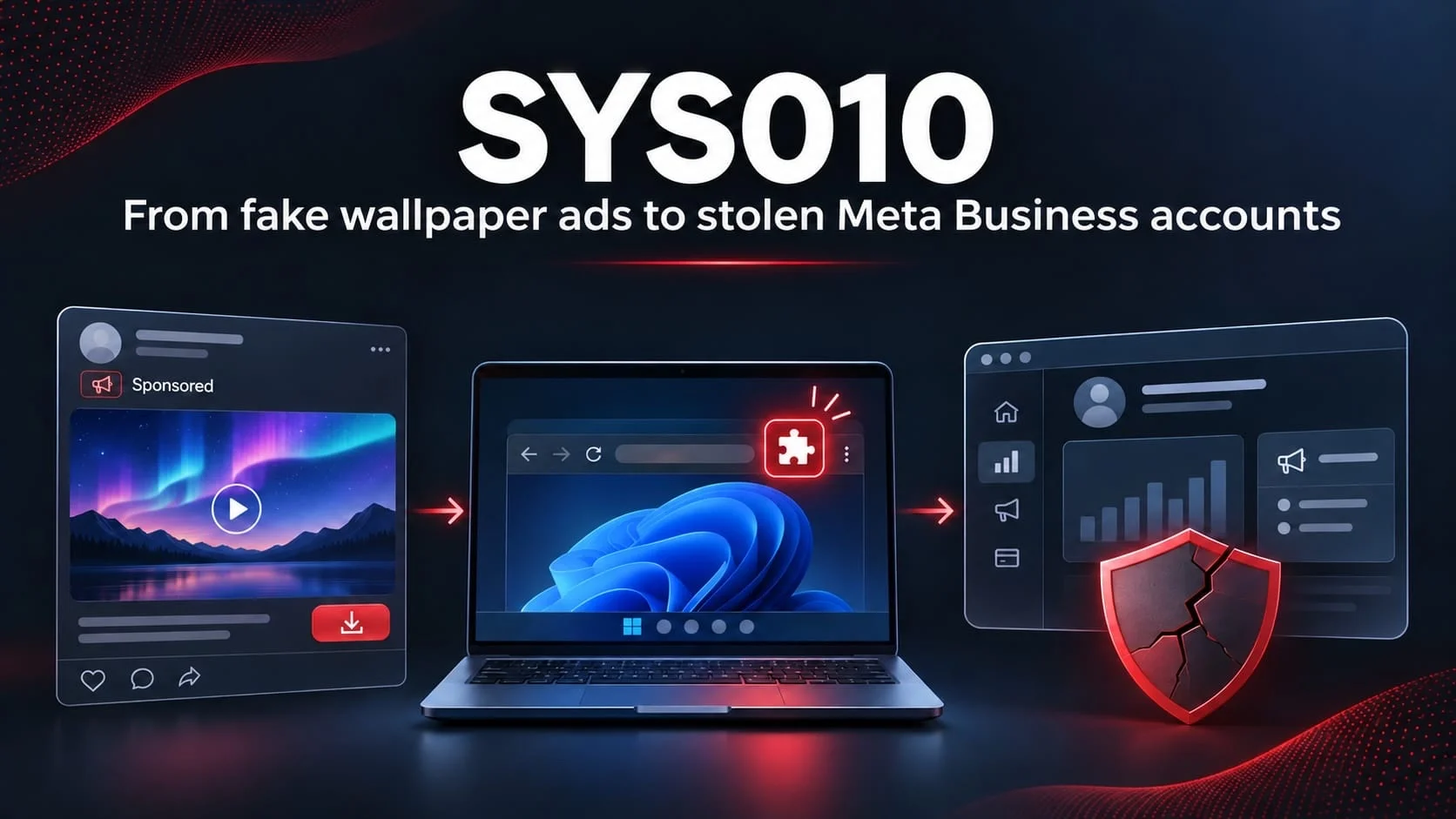
Bitdefender Labs, the research arm of security company Bitdefender, published an analysis on November 26, 2026 of "SYS010," an attack campaign that uses Meta ads as its entry point to infect Windows PCs. Posing as free "live wallpaper" apps, it gets users to install malware and then abuses browser management features to force-install malicious extensions. According to the company, the end goals are taking over Meta Business accounts and spying on Gmail and Outlook email.
Meta Ads Impersonating Wallpaper Engine Serve as the Lure
According to Bitdefender, the attackers run ads on Meta's platforms promoting live wallpaper software for Windows. Ads impersonating the wallpaper software "Wallpaper Engine" and others were observed, and the first malicious ad was identified on October 16. Dozens of ads have been created since October, and one reached more than 6,000 people.
The ads lead to dedicated websites that serve a roughly 74MB ZIP file. The "Wallpaper Engine.exe" inside is a legitimate, signed executable of the real task management app "MeisterTask," renamed. Because this app was built on an old version of Electron that does not detect tampered resources, it loads the attacker's code as-is.
While it shows a working wallpaper app as a decoy, it unpacks a PHP runtime in the background and registers two tasks in Task Scheduler to persist. This component is a loader that contacts a command server every three minutes to receive instructions; the data-stealing functions themselves are delivered later.
Extensions Force-Installed via Chrome, Edge, and Firefox Management
What sets SYS010 apart is its abuse of enterprise browser management. In Bitdefender's analysis, Chrome is enrolled into an admin console controlled by the attacker, and Firefox is made to force-install an extension from an external source through policy settings. For Edge, if conditions are met, the Windows device itself is enrolled into the attacker's MDM (mobile device management) server.
These settings require administrator rights. The script therefore keeps showing the User Account Control (UAC) prompt every three seconds, up to 99 times, until the user approves it. The extensions installed are named "Docs Helper" for Chrome and "Document Hub" for Firefox, and the Chrome version's icon mimics the Google Docs logo.
Stealing Cookies and Email to Target Meta Business Accounts
The extension uploads cookies from various sites when the command server requests them. Bitdefender says this lets attackers hijack sessions without knowing any password, and two-factor authentication does not stop them. For Facebook, it uses the logged-in session to call Meta's Graph API and collect information on ad accounts, Business Managers, and Pages, including ad spending and payment methods.
The Chrome version also reads the latest messages from the web versions of Gmail and Outlook, up to 50 at a time, and uploads the subject, sender, and body. Attackers can also choose specific messages to delete; in Outlook, they disappear without passing through "Deleted Items." Bitdefender sees this as a feature for erasing login codes and security alert emails so victims do not notice the takeover.
A Rebuilt Second Generation of SYS01
According to Bitdefender, the name SYS010 indicates the second major version of "SYS01," an attack the company reported in 2024. It keeps the ad-based distribution approach but rebuilds the loader, the extensions, and the account-theft components. Bitdefender's data showed traffic to related servers from many countries, including the Philippines, Thailand, Bangladesh, Poland, and Mexico, but the company says this does not represent the number of infections. It has not disclosed the number of victims.
Our Take
Hiding behind a legitimate signed app and using enterprise management features to install extensions is a combination that likely makes it easier to slip past antivirus software and users' attention. On the other hand, gaining administrator rights requires getting through the UAC prompt, so there are situations where repeatedly refusing those prompts can stop the attack. Still, Meta Business accounts, with their ad budgets and payment methods, are easy targets to monetize, and individuals and small businesses that run social media ads may be particularly at risk.
Summary
Bitdefender has published details of SYS010, an attack that starts with fake wallpaper app ads and abuses browser management features to steal cookies, email, and Meta Business accounts. The company advises installing software from official sites or app stores rather than from ads, refusing UAC prompts you do not understand, and checking if a personal PC shows a "managed by your organization" notice. It also recommends reviewing Meta Business account roles and payment methods and protecting the recovery email address.
Source: Bitdefender Labs, "SYS010 Reloaded: The new malvertising campaign targeting Meta Business Accounts"