Cheap Lightning cables labeled "genuine" are sold on flea-market apps like Mercari and Yahoo! Auctions. There are so many of them listed that you've probably seen them yourself. They come in bulk sets for a few hundred yen — a "super" low price. If you can really get a genuine cable that normally costs nearly 2,000 yen (about 13 USD) for that, it sounds like a great deal — but is it really that good to be true? This time I bought one of these suspicious Lightning cables, and to compare it I also bought one from a major electronics retailer, then put the two side by side to figure out whether the one from Mercari is a fake.
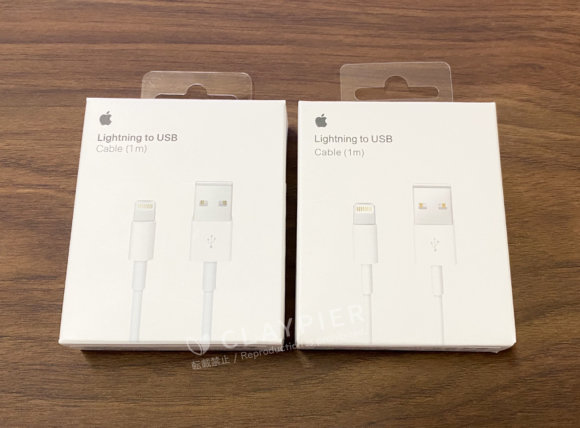
The one on the left was bought at Yodobashi Camera, which has an Apple shop counter inside, and the one on the right was won on Mercari. When choosing the auction listing, I picked one that was described as "genuine," "brand new and unopened," and "with serial number," and I picked it at random from a seller who had previously listed many Lightning cables.
* I deliberately avoided the common "equivalent to genuine" or "FOXCONN-made" listings and chose one explicitly labeled "genuine."
Comparing the packaging
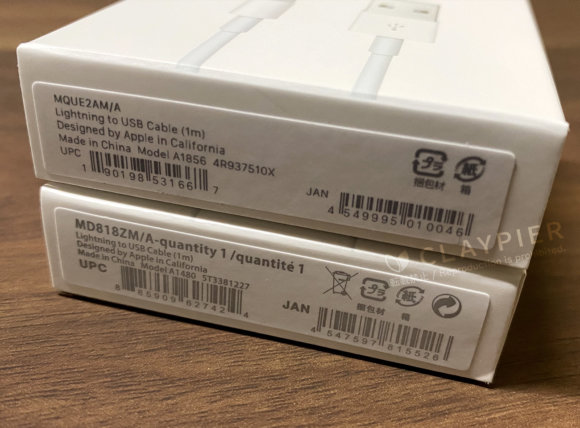
Looking at the packaging, the lettering on the sticker and the colors are different, but that's because the Yodobashi Camera one is the "A1856 (MQUE2AM/A)" model (top) while the Mercari one is the "A1480 (MD818ZM/A)" model (bottom). They are both Lightning cables, but the model numbers are different. The A1480 cable is an older model released in 2012, and Apple and major electronics retailers no longer stock it, so at the time of writing I couldn't buy one from a definitively trustworthy shop. When I asked Apple about it, they told me that even though the model number is different, the cable's performance and appearance are basically the same. So for this test I prepared not only these two cables but also several others — the Lightning cables that come with iPhones and iPads, plus an MFi-certified third-party cable — to make the comparison as thorough as possible.
You can't tell them apart from the outer box
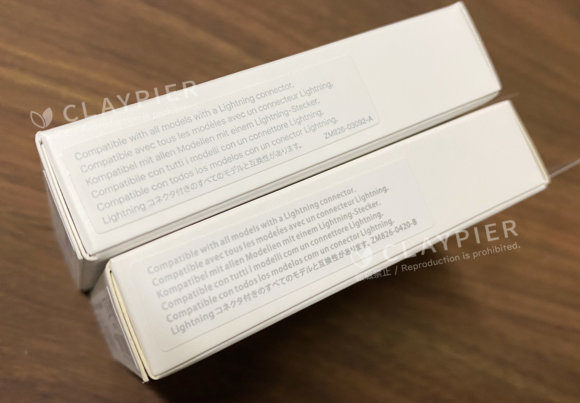
Because the models are different, the outer boxes can't be compared exactly to determine whether one is counterfeit. But the auctioned one didn't show the typical signs of fakes — there was no "weird Japanese" or "poor print quality" — and the quality didn't feel any lower than the genuine one. If anything, the print quality on the auctioned one even looked slightly better. The only thing was that part of the auctioned box had yellowed, which just tells you it had been stored for a long time.
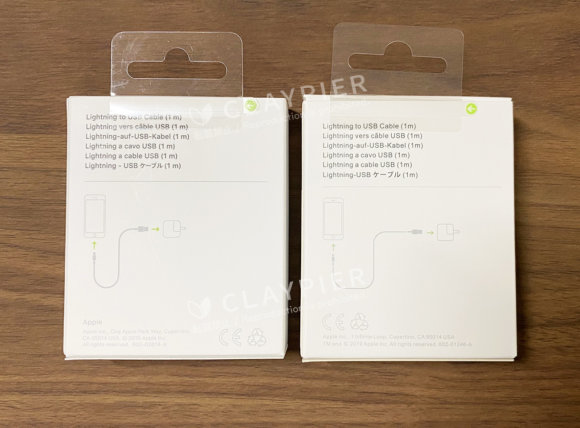
Both have a clear plastic seal on the back for opening, but on the auctioned one the seal is applied a bit sloppily and the flap is slightly open, which is a bit concerning. Still, the plastic seal isn't peeled off and there's no sign that it was reapplied later, so it doesn't look like it had been opened. Other than that, there was nothing notable, and from the box alone it just looked like a genuine product.
Let's open the box and check the contents
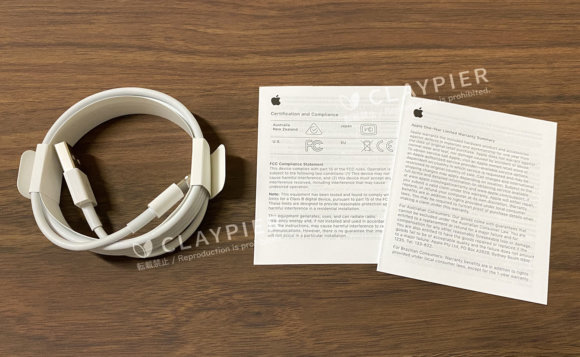
The image above shows the contents of the one bought at Yodobashi Camera. There's the cable itself plus two sheets of instructions.
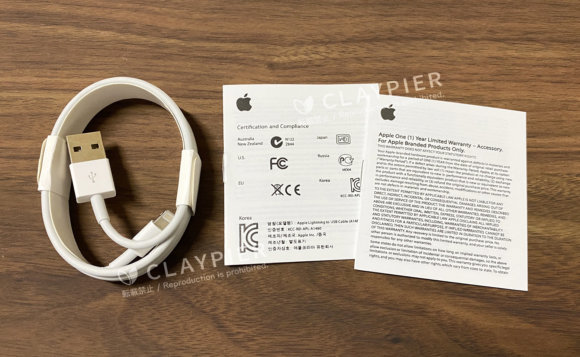
The auctioned one likewise comes with the cable and instructions. * Because the models differ, the design of the instructions and the paper holding the cable in place are different.
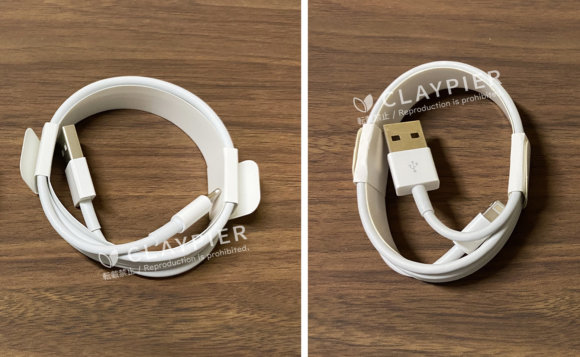
When you compare the two, the paper holding the cable in place on the Yodobashi Camera one is clean, and of course there isn't a single scratch on the cable. The auctioned one, despite supposedly being brand new and unopened, has scratches and dirt that make it look like a used item — you can see at a glance that the manufacturing quality is poor.
The cable connectors are subtly different
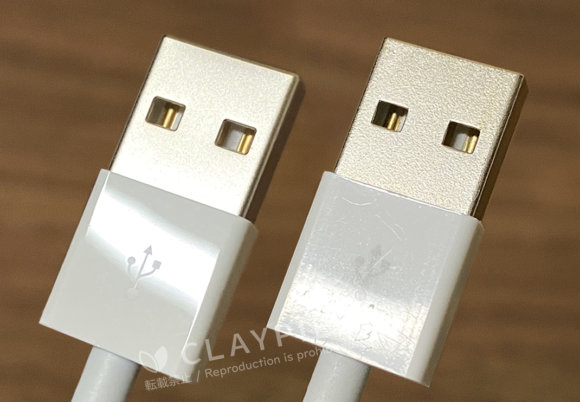
This is a comparison of the USB connector side. Even though it had just been unboxed, for some reason the auctioned one has noticeably more small scratches than the bought one.
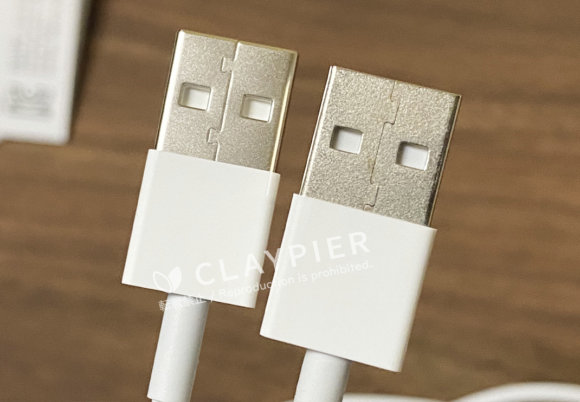
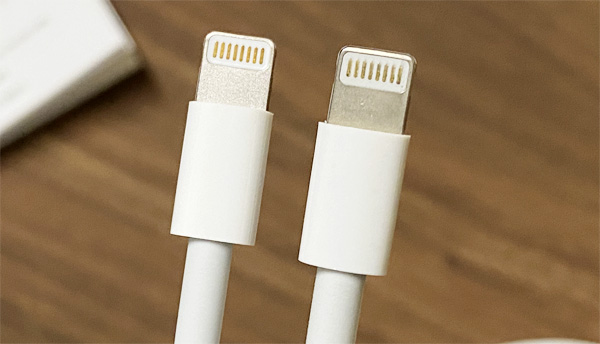
Here's the back of the USB connector. One major difference: on the auctioned one, the seam of the metal shell is on the right side. According to Apple's "Identify counterfeit or uncertified Lightning connector accessories" page, on a genuine cable the spacing up to the shell joint is even and the seam faces left.
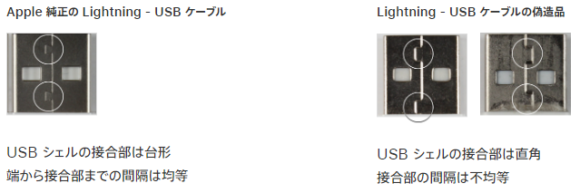
Just to be sure, I checked four genuine Lightning cables I had on hand, and unsurprisingly not a single one had a right-facing seam like the auctioned one. At this point it was effectively confirmed that the auctioned cable is a fake.
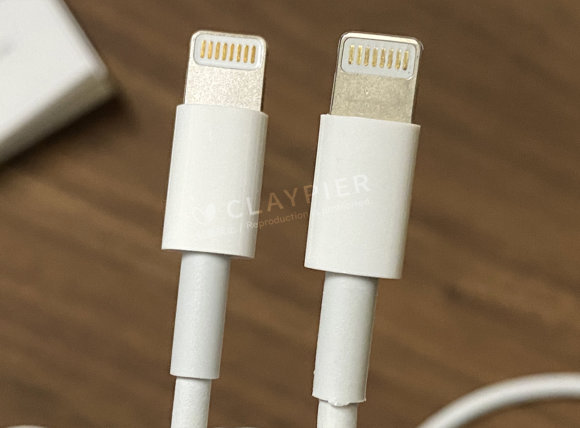
Looking closely at the Lightning connector side as well, the metal contacts on the bought cable are clean, while on the auctioned cable they're a bit dirty and there's leftover flashing on the strain-relief at the base of the cable. At this point there's no doubt that the auctioned cable is a counterfeit. (Hereafter, I'll refer to the "auctioned one" as the "counterfeit.")
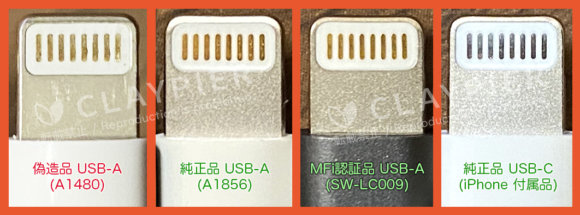
To make it easier to see, I lined up the tips of four different Lightning cables for comparison. You really have to look closely to tell, but the size of the white plastic part and the way it's recessed (the genuine one is recessed smoothly) are subtly different.
The serial-number printing is off
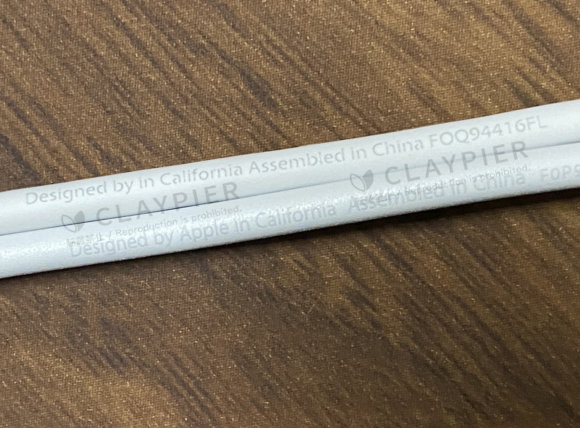
The auctioned cable does of course have a serial number printed on it. But when you compare it to the genuine one, the font is subtly different, and letters like "a" and "b" look slightly faded. And here's a decisive clue: on the counterfeit, the word "Apple" doesn't appear after "Designed by." Furthermore, according to Apple's page, the serial number should be 12 digits, but this cable only has 10.

Based on all of the above, the Lightning cable I won on Mercari is confirmed to be a fake.
Comparing the cables' performance
Since I went to the trouble of buying it, I compared it head-to-head with the genuine cable. First, I used a USB voltage/current checker to compare the readings while connected to a PC.
Because this is a counterfeit, there is risk involved in operating it. I'm doing this carefully with safety in mind. Please don't try this yourself.
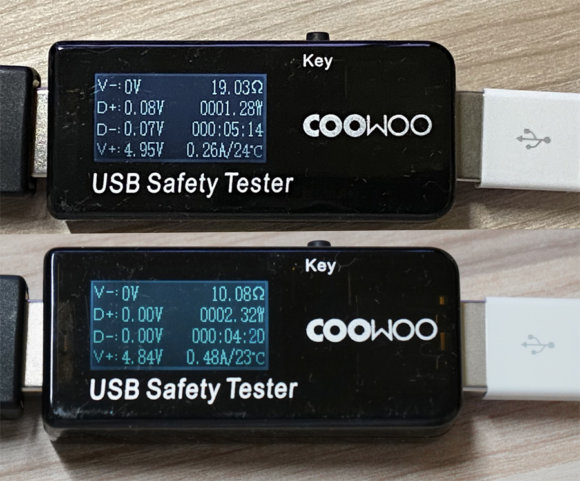
The checker showed that the amperage was different. The auctioned one only drew about 0.26 A — roughly half of what the genuine cable did. Even a 100-yen cable with contacts on only one side draws around 0.36 A, so this cable performs even worse than that. Charging is going to be miserably slow.
I took it apart to see what's inside
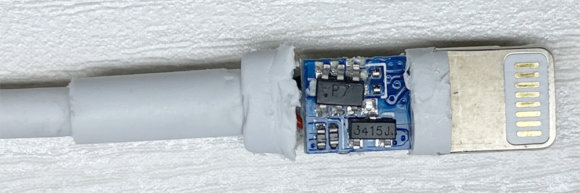
Once the plastic was peeled away, the bare circuit board was exposed. There are two IC chips and what appear to be a MOSFET and a USB power switch. There's no resin coating, and the IC chips were so poorly soldered that they came off almost immediately. The design is nowhere near what you'd see in a genuine cable.
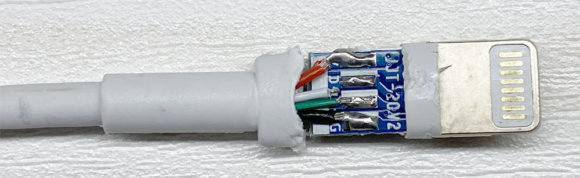
The back side has four wires soldered on. The soldering here was sloppy too — the wires came off right away. Even if you used this cable normally, you couldn't expect it to be durable.
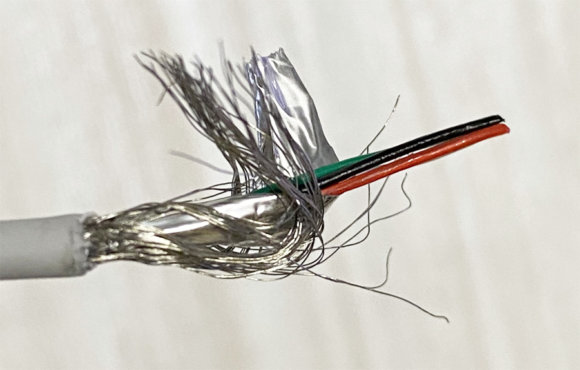
The cable itself did, however, courteously (?) include a shield.
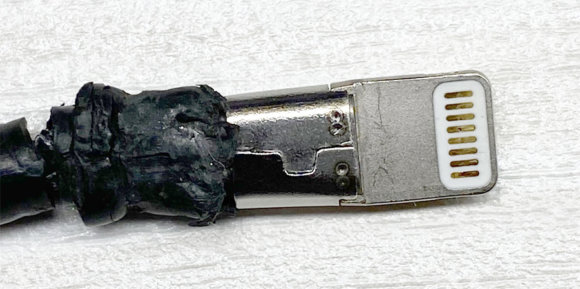
In a properly made cable, the board is securely covered by solid metal parts and the ICs are firmly potted in resin.
Buy from a trustworthy shop — that's the safest bet
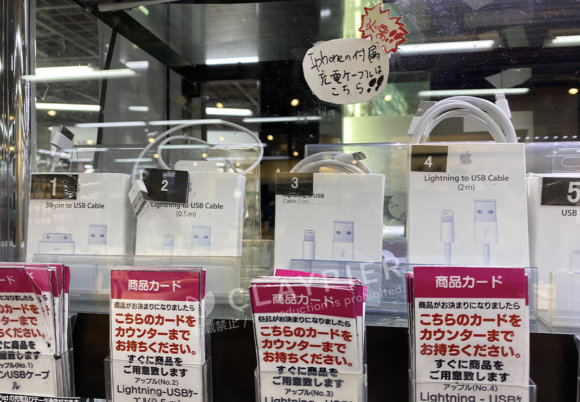
Because genuine cables are expensive, when you see one cheap on an auction site it's tempting to feel "lucky" and buy it on impulse. But just keep in mind that whether it's actually genuine is a real gamble. Not every listing is a fake, but using an unreliable charging cable every day raises the risk of unexpected accidents like fires. The fake cable I bought this time was 650 yen (about 4 USD). For roughly that price, DAISO sells an MFi-certified Lightning cable for 500 yen (about 3 USD, excluding tax), which is a much safer buy. You can also find plenty of options on Amazon.
There are all kinds of cables sold — heavy-duty iron-braided cables that also support iTunes sync, products with warranties, and so on. When buying anything other than a genuine cable, always pick one that is MFi-certified. To check whether a product is officially MFi-certified, look for the official "Made for iPhone/iPad" badge on the packaging or product listing. For genuine cables, your safest bet is to buy them at the Apple Store or a major electronics retailer.