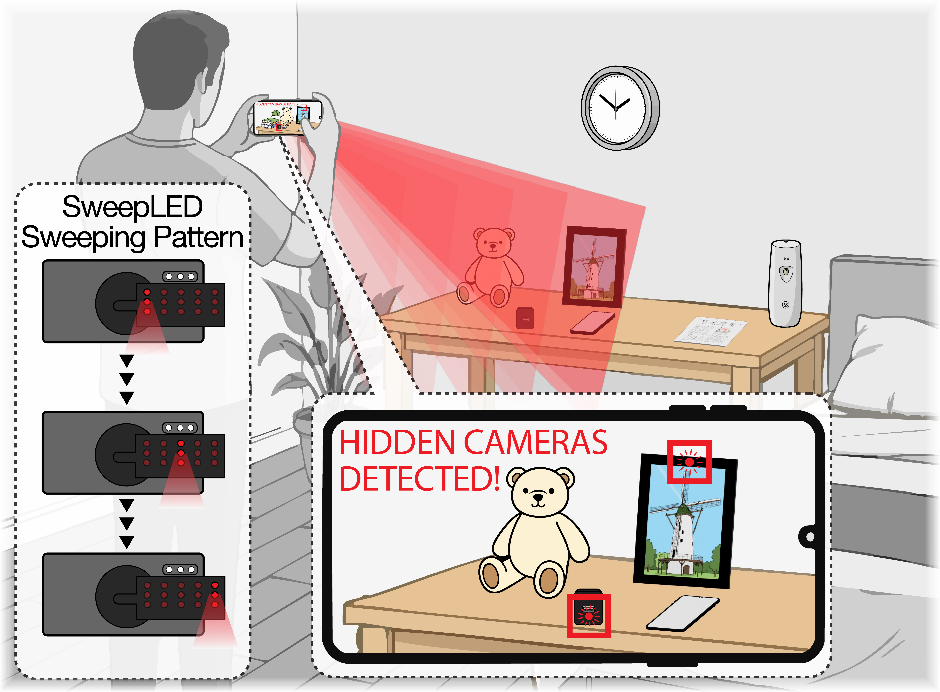
A research team at the Korea Advanced Institute of Science and Technology (KAIST) has unveiled SweepLED, a technology that turns a smartphone into a hidden-camera detector simply by attaching a small LED case. The system sweeps the direction of LED illumination while filming, and an AI model analyzes how the reflections move to pick out camera lenses. In tests on real objects it detected hidden cameras with roughly 94% accuracy, and inspecting a single object took less than five seconds. The core components of the case cost under 7 USD (about 1,100 yen), which could pave the way for a detection tool anyone can afford.
Countering the invisible cameras spreading through hotels and rentals
Tiny cameras hidden inside everyday items such as chargers, desk clocks, and remote controls are used for illicit filming in hotels, short-term rentals, and restrooms, and have become a global social problem. Portable detectors are sold commercially, but most work by shining a bright light and asking the user to spot glowing dots by eye. Metal, glass, and glossy plastic also reflect strongly, so these devices often produce false positives while still missing small lenses.
KAIST (President Choongsik Bae) announced on August 30 that a team led by Professor Jun Han of the School of Computing developed SweepLED jointly with the National University of Singapore (NUS) and Singapore Management University (SMU). Rather than asking people to hunt for hard-to-see dots, the approach lets AI judge the nature of the reflection itself, which is what sets it apart from earlier methods.
Move the light, and only lens reflections behave differently
At the heart of SweepLED is an illumination sweep: the smartphone camera stays fixed while the lit position of the LEDs arranged on the case shifts in sequence. When the light source moves, reflections on ordinary glossy surfaces shift position or disappear. A camera lens, however, contains a lens stack, an aperture, and a sensor, so its reflection deforms in a distinctive way.
The team trained a deep-learning model to recognize these differences in how reflections change over time. The software picks out candidate reflections from the consecutive frames of a recorded video, analyzes the pattern of change across frames, and decides whether a hidden camera is present. Results from multiple viewpoints are then combined to improve reliability. Unlike simply looking for bright spots, the method uses both the movement and the shape change of reflections as clues at the same time.
About 94% accuracy across 30 objects, under five seconds each
The researchers prepared 30 objects likely to be found in real living spaces and hid cameras among them for evaluation. Detection accuracy came to roughly 94%, and each object took less than five seconds to inspect. That is fast enough to check suspicious items one by one in a hotel room within a realistic amount of time.
The hardware consists of an LED array mounted on an inexpensive printed circuit board and a modular case that attaches to a smartphone. The core components cost less than 7 USD (about 1,100 yen), or roughly 10,000 Korean won (about 1,100 yen), so users would only need to add a case to the phone they already own instead of buying an expensive dedicated detector.
※1 USD = 160 JPY, 1 KRW = 0.11 JPY
Professor Han said that hidden cameras pose a serious threat to personal safety and privacy in everyday spaces, adding that the research is significant because it combines low-cost smartphone hardware with AI analysis to show that a practical detection technology usable even by non-experts is possible.
Presented at MobiSys 2026, paper already published
The work was written up as the paper Hide-and-Sweep: Detecting Concealed Cameras via LED Illumination Sweeps, with KAIST doctoral student Jonghyuk Yun as first author, and presented on June 20 at ACM MobiSys 2026, one of the leading international conferences in mobile computing. The author list includes researchers from NUS and SMU alongside KAIST. The research was supported by Korea's Ministry of Science and ICT and the National Research Foundation of Korea.
At this stage SweepLED is a research prototype, and no plans for a commercial product have been announced. Still, the fact that it takes the form of a portable phone case, that the parts cost around 1,000 yen, and that a dedicated app delivers the verdict automatically are all elements that translate easily into a consumer product. A future in which anyone can run a just-in-case check in a few seconds at a hotel or on a business trip appears to be drawing closer.
Summary
SweepLED, developed by KAIST together with NUS and SMU, uses an inexpensive LED case attached to a smartphone to sweep the direction of illumination and has AI analyze the changing reflection patterns to identify hidden camera lenses. In tests on 30 objects it achieved about 94% detection accuracy with inspection times under five seconds, and its core components cost under 7 USD (about 1,100 yen). The paper has been presented at ACM MobiSys 2026, and the technology is drawing attention as a way to make anti-voyeurism checks in lodging facilities accessible to everyone.