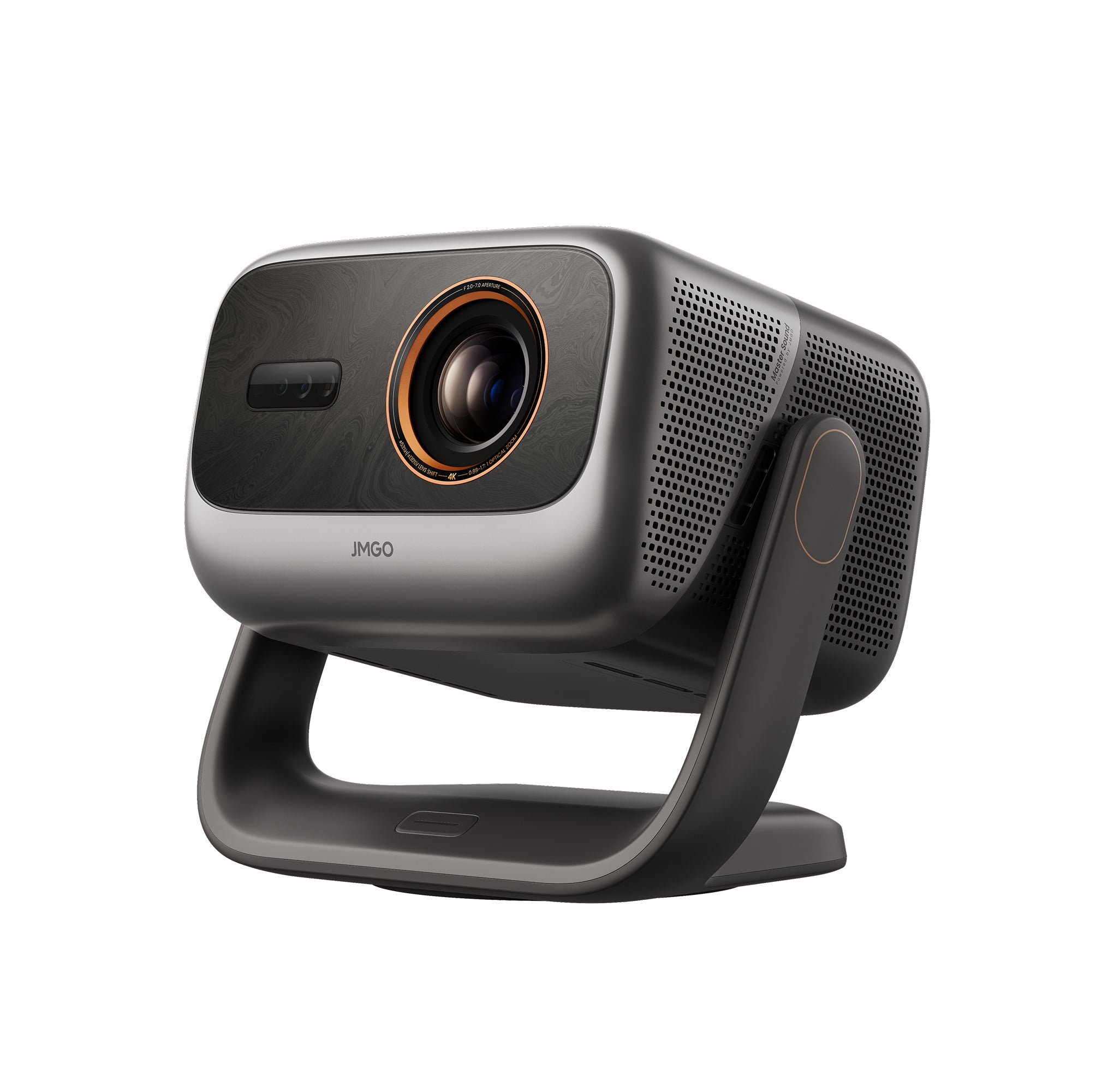
JMGO is bringing its new IRIS home projector series to global markets alongside IFA 2026. The flagship IRIS Ultra Max is described as delivering 4K resolution and a 120Hz refresh rate at the same time, with brightness of up to 6,500 ISO lumens. Preorders open on September 4, and shipments are scheduled to begin on October 19. The technology launched first in China in May 2026, where the company says it sold more than 5,000 units in its first three months.
The Claim: 4K and 120Hz Together
In the projector world, 4K resolution and high refresh rates have rarely fit together. Most models stop at 60Hz once they are fed 4K content, which caps things even when a console or PC can output 120 frames per second. The IRIS series is built to remove that ceiling, carrying 4K at 120Hz all the way from input to the screen.
The hardware behind that is a dual-DLPC architecture, which uses two DLP controllers, plus a driver JMGO calls the HyperPulse Actuator that shifts 480 times per second. DLP projectors form pixels by moving tiny mirrors at high speed, and it is not unusual for a product to accept a 120Hz signal while quietly cutting resolution somewhere in the chain. JMGO says this shifting speed lets the projector hold full 4K detail while running at 120Hz.
The gaming features are in place as well. Both models support VRR, or variable refresh rate, which syncs the projector to a fluctuating game frame rate to reduce visible tearing, and ALLM, which switches into a low-latency mode automatically with compatible hardware. The IRIS Ultra Max is also positioned as the first projector to handle Dolby Vision HDR at 4K and 120Hz, meaning the format's expanded brightness and color information can be kept without falling back to 60Hz.
For movies and sports there is 4K 120Hz MEMC processing. MEMC estimates motion between frames and inserts extra ones, which makes camera pans and ball movement easier to follow, though viewers who value the texture of film tend to dislike the resulting smoothness. How much control JMGO offers over the effect is worth checking on a real unit.
Brightness, Contrast, and the Iris Design
The light source is JMGO's MALC 6.0 triple-laser engine. The IRIS Ultra Max is rated at up to 6,500 ISO lumens with a 10,000:1 native contrast ratio, while the lower-tier IRIS Ultra is rated at 4,500 ISO lumens and 7,000:1. ISO lumens are a standardized brightness measurement, and these are strong figures for projectors meant to work in rooms that are not blacked out.
The iris design is the more interesting detail. Both models use a Dual-Iris system with a 15-blade 6+9 arrangement, which JMGO says suppresses stray light 11.34 percent better than its earlier 12-blade 6+6 design. Stray light spills into areas that should stay dark, lifting blacks toward gray. Six iris adjustment levels let the projector rebalance brightness against contrast depending on the room and the content.
Color coverage is quoted at 110 percent of BT.2020, with color accuracy of roughly Delta E 0.7. Delta E measures color error, and a value under 1 is generally difficult to notice in controlled conditions. Whether that accuracy survives everyday brightness modes is a separate question, and one that will need independent measurement.
On the rainbow effect that concerns some DLP viewers, both projectors add hardware-level Anti-RBE processing. RBE shows up as brief red, green, and blue flashes around bright objects or during quick eye movement. Some people never notice it, while others cannot unsee it. JMGO says the processing works without raising fan noise, which matters in a bedroom or living room where trading one annoyance for another would be a poor deal.
How Far the Placement Constraints Can Be Pushed
The dream of a huge picture usually loses to furniture, windows, and power outlets. The IRIS Ultra Max attacks that with three optical mechanisms: a 0.88-1.7:1 optical zoom range, four-way lens shift of up to plus or minus 130 percent vertically and plus or minus 53 percent horizontally, and a motorized gimbal capable of 360-degree panning and 150-degree tilting.
Being able to move and resize the image optically reduces reliance on keystone correction. Keystone is digital, so the more you apply, the more usable pixels you give up. Solving placement physically is the better outcome for image quality.
On the software side, AI Screen Fitting can size the picture automatically to a detected screen, and AI Spatial Image Memory can store projection positions along with the apps tied to each location. That suits a setup where one wall handles movies, another works for workouts, and the ceiling covers watching from bed. The less expensive IRIS Ultra keeps the same optical zoom and four-way lens shift, but the announced specifications do not include the motorized gimbal.
Pricing, Preorders, and Where the Two Models Split
Preorders open September 4. The IRIS Ultra Max carries a retail price of 3,499 USD (about 560,000 yen) with an early-bird price of 2,999 USD (about 480,000 yen). In Europe, 3,499 EUR (about 640,000 yen) becomes 2,999 EUR (about 550,000 yen).
The IRIS Ultra lists at 2,399 USD (about 380,000 yen) and starts at 1,899 USD (about 300,000 yen) during the preorder window, with European pricing beginning at 1,999 EUR (about 370,000 yen) against a regular 2,499 EUR (about 460,000 yen). Preordered units ship from October 19. JMGO also plans model-specific accessory and screen offers, though the announcement does not spell out the bundles.
Exchange rates: 1 USD = 159 JPY, 1 EUR = 184 JPY (MUFG Bank published mid rates, September 3, 2026)
The gap between the two models comes down to brightness, contrast, and placement flexibility. The core 4K 120Hz capability is intact on the cheaper unit, so in a room with straightforward geometry and a tighter budget, the IRIS Ultra at 1,100 USD (about 170,000 yen) less will often be enough. The more a setup involves daytime viewing or an awkward projector position, the more the Ultra Max hardware earns its price.
Summary
JMGO's IRIS series is organized around one central capability, 4K at 120Hz, with brightness, contrast, and placement flexibility separating the two tiers. The IRIS Ultra Max offers 6,500 ISO lumens and a motorized gimbal from an early-bird price of 2,999 USD (about 480,000 yen), with preorders opening September 4 and shipping from October 19. The published numbers are confident throughout, but stray-light suppression, color accuracy, and the behavior of the MEMC processing all shift with the room. What these projectors look like once they leave controlled demos will decide how the series is judged.