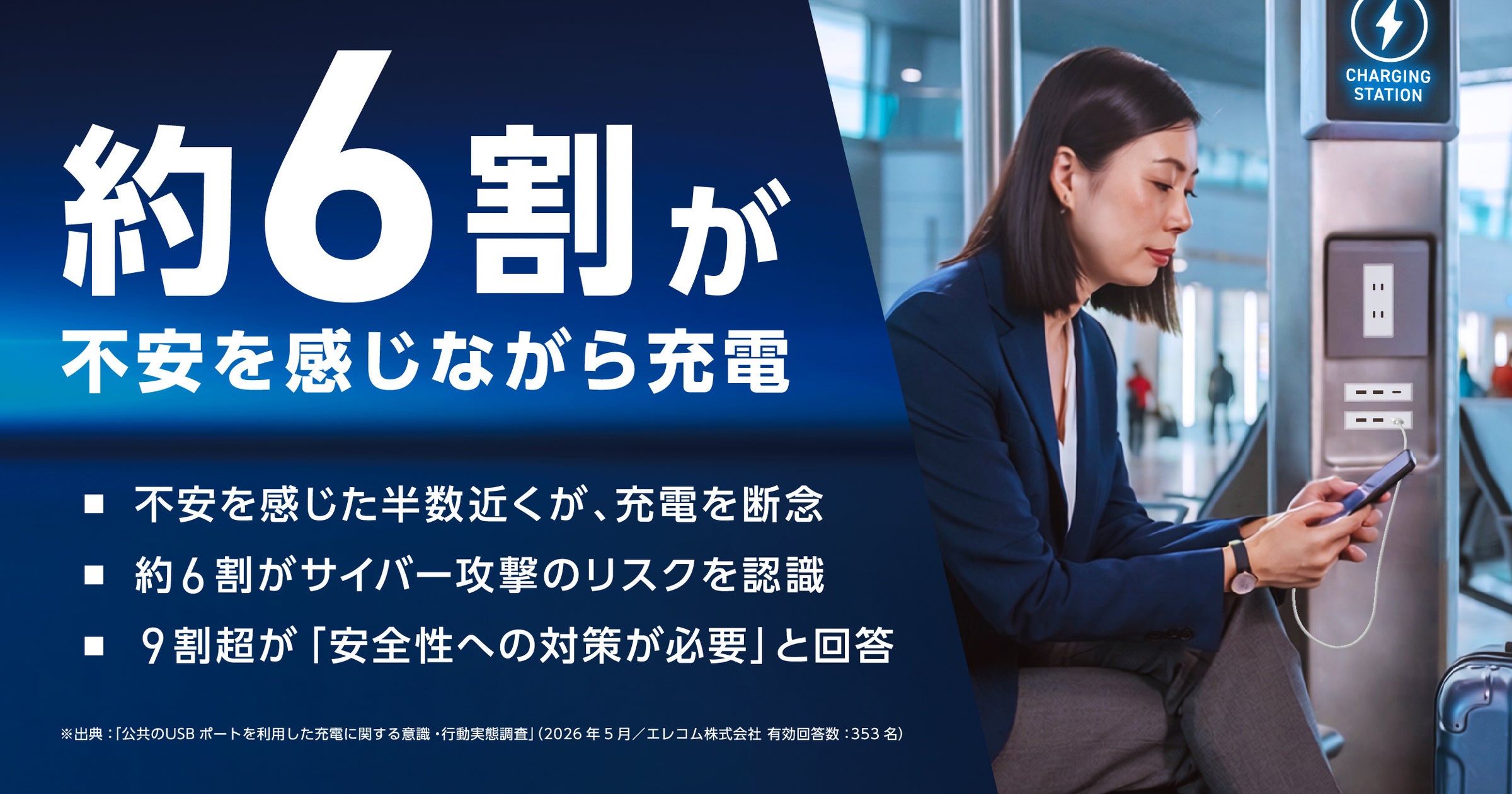
Elecom will release its "Anshin Charge-Only Cable (USB Type-C)" in July 2026, a lineup built to reduce the risks of charging at public USB ports found in cafes, airports, and hotels. Each cable includes a "Data Blocker" that physically cuts the data lines, so a device can draw power without exposing itself to data theft or malware. In a company survey, roughly 60 percent of people who had charged at public ports said they did so while feeling uneasy[1].
What "Juice Jacking" Means for Public Ports
Juice jacking is a cyberattack in which a public USB port is used, under the guise of charging, to secretly extract data from a connected device or to push in malware. Because it can happen in everyday places such as cafes, airports, and hotels, countermeasures at charging time are increasingly called for[2].
A USB cable carries both power lines and data lines together. The Anshin Charge-Only Cable is designed to block the data communication among them so that only power flows through. By closing off the data path itself, the idea is that even when the cable is plugged into a malicious port, there is no route for information to leave the device[1].
A Survey Revealing People Who "Charge While Anxious"
Ahead of the launch, Elecom surveyed attitudes and behavior around charging at public USB ports. Of 353 respondents with charging experience, 60.1 percent said they charge while feeling uneasy about safety, combining the 17.3 percent who feel "very anxious" and the 42.8 percent who feel "somewhat anxious." Only 6.2 percent said they feel "no anxiety at all"[1].
The most common response to that anxiety was not using protective gear but "avoiding charging whenever possible," at 46.2 percent. In other words, many people manage the risk simply by giving up on charging. In addition, 38.5 percent did not know the term "juice jacking," suggesting that the issue may be less about being unable to act and more about the existence of a solution not reaching people[1].
Differences by age group also stand out. While 61.4 percent overall said they knew about the attack method, 73.0 percent of people in their 50s said they had not. That same group reported the lowest anxiety level, at 32.6 percent, indicating a segment that uses public ports without recognizing the risk. Notably, after reading an overview of the attack, 93.5 percent acknowledged that countermeasures are necessary, combining 49.9 percent who said "very necessary" and 43.6 percent who said "somewhat necessary"[1].
A Lineup With Choices of Power Output and Cable Character
The Anshin Charge-Only Cable blocks unintended data communication with its "Data Blocker" to prevent data extraction, while still supporting charging via USB Power Delivery. Beyond smartphones and tablets, it can also charge laptops. The connector is printed with its specifications, and the cable uses flame-retardant materials and gold-plated pins that suppress signal degradation, with attention paid to safety. It also complies with the EU RoHS Directive on restricting hazardous substances[1][2].
Two power levels are offered: 60W (20V/3A) and 240W (48V/5A). The construction can also be chosen from three types. Alongside the standard model, there is a "high-durability model" made resistant to breakage with a high-density wiring structure and nylon-mesh material, and a "smooth model" using silicone material that resists tangling even when bundled, letting buyers match the cable to how they use it[1].
Pricing is quoted at street-level retail prices: the 60W, 1m standard model is 880 yen, and the 2m version is 1,080 yen. The high-durability model runs around 1,780 yen and the smooth model around 1,580 yen, while the 240W high-durability model is the most expensive at 1,980 yen. The cables do not support data transfer or DisplayPort Alternate Mode, keeping their purpose narrowed to charging. The warranty period is one year, and model numbers differ by retailer[1][2].
Summary
The Anshin Charge-Only Cable is a single-purpose cable that guards against public-port charging risks by severing the data path. The survey findings, with about 60 percent charging while anxious and more than 90 percent feeling countermeasures are needed, show a high level of concern about the risks hidden in an everyday act like charging. With a broad set of options across 60W and 240W and standard, high-durability, and smooth builds, it looks set to be an affordable way for frequent on-the-go chargers to prepare.
Source:https://prtimes.jp/main/html/rd/p/000001472.000026881.html