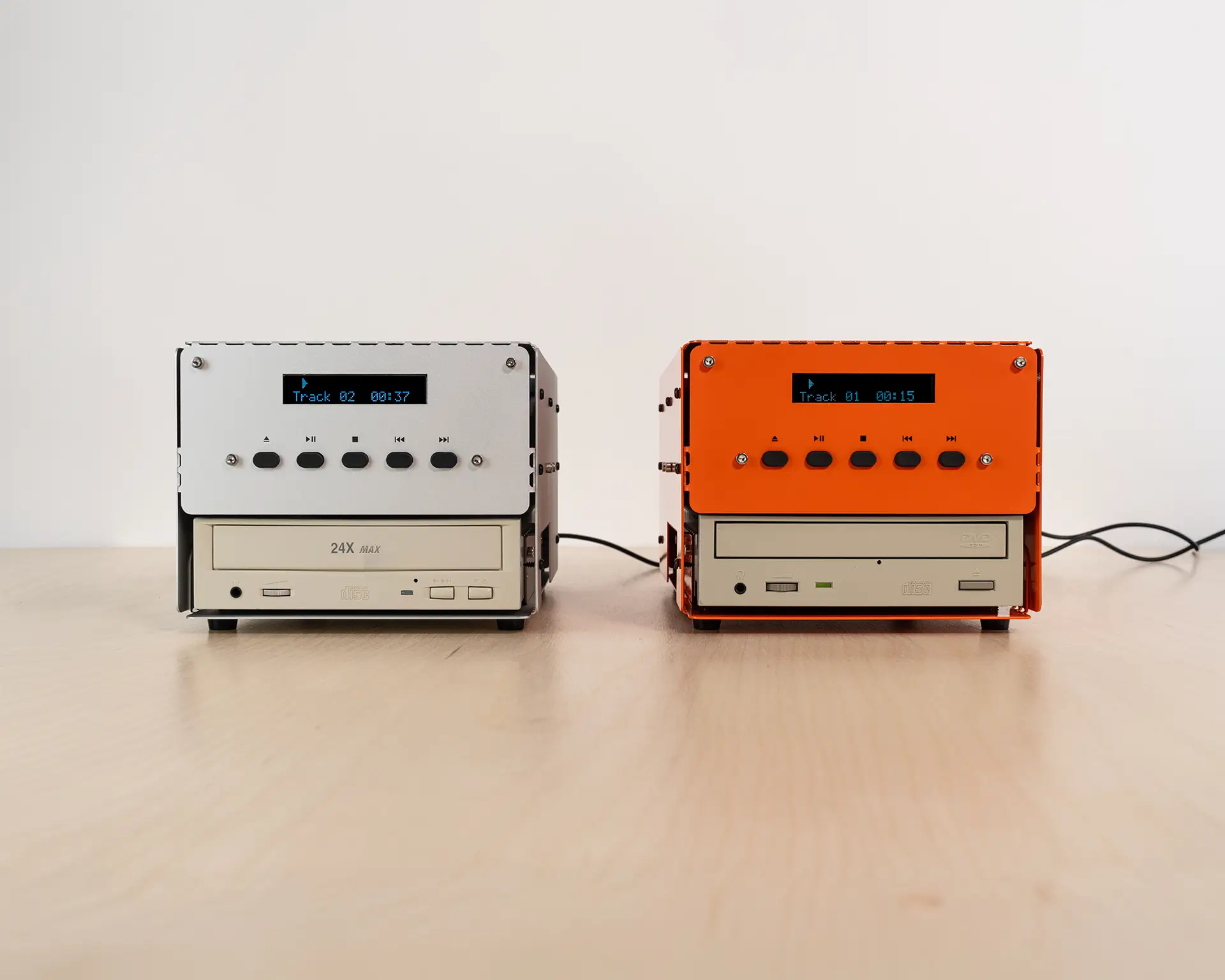
das_POD, a small Korean maker, is selling CD-ROM PLAYER 01, a kit that rebuilds an old IDE CD-ROM drive into a desktop CD player. The kit pairs a 1mm laser-cut aluminum enclosure with an IDE controller board, a power PCB, a remote and an assembly manual. The optical drive itself is not included; you supply your own. Two finishes are offered, at 190 USD and 220 USD.
You bring the drive
The first thing that stands out in the parts list is what is missing: there is no CD-ROM drive in the box. das_POD ships the aluminum enclosure parts, an IDE controller, a power PCB, a remote, buttons, cables and hardware, and an assembly manual. The part that actually reads the disc is left to the owner.
The company frames this as intent rather than omission. The product page leads with three ideas: designed to be assembled, repaired, and owned. Compatible IDE drives, it notes, often turn up in old computers, second-hand markets, recycling centers, or forgotten boxes in storage. Because every donor drive has its own history, every finished player ends up slightly different.
This is less about nostalgia than about using hardware that already exists. Anyone who built PCs in that era probably still has a working optical drive or two with nowhere to go, and this gives that stock an exit. If you have none, das_POD also sells refurbished drives for roughly 10 to 40 USD, shipped after belt replacement, lens inspection and lubrication.
No soldering, 30 to 60 minutes to build
No soldering is required. The listed tools are a multi-bit screwdriver and a pair of working gloves, and estimated assembly time is 30 to 60 minutes. The build is kept within reach of people with no electronics experience.
The enclosure is 1mm laser-cut aluminum in two finishes: shot-blasted semi-gloss anodized at 220 USD (about 36,000 yen), and RAL 2002 orange powder coating at 190 USD (about 31,000 yen). das_POD notes up front that minor surface imperfections may appear as a result of the manufacturing and finishing processes.
The front panel carries a small dot-matrix display for track number and elapsed time, plus five buttons: eject, play and pause, stop, previous and next. Power is DC 12V and audio output is a 3.5mm AUX jack. Note that the AUX cable and the 12V power adapter are not included either; adding them at checkout on das_POD's store works out to roughly 25 to 30 USD more. Together with the drive, the sticker price is not where the spending stops.
※1 USD = 162 JPY (as of July 21, 2026)
IDE only, SATA drives will not work
Compatibility is narrow and clearly stated: standard IDE CD-ROM drives. Newer SATA DVD and Blu-ray drives will not work.
That is not an arbitrary cutoff. Most optical drives of the IDE era carried an analog audio output on the drive itself, so once the drive is told to play a track, everything up to line level is handled inside the drive. Later SATA-era drives dropped that analog output, so the same circuit design no longer applies. The practical test is whether the drive on your shelf has a 40-pin flat-cable connector on the back.
Is 190 USD reasonable?
If the goal is simply playing CDs, a used CD player is cheaper. What justifies the price here is the machined aluminum enclosure and the fact that you assembled it yourself. Some outlets have compared its look to Teenage Engineering's products, and the design clearly leans toward being an object you want on a desk.
The uncertainty is the donor drive. A drive with a worn pickup will not track reliably, and buying a refurbished one adds cost. Judged purely as a tool it is expensive; judged as a product where the build process is part of what you are buying, it makes more sense.
Assembling a machine that spins discs, in an era when music arrives by subscription. das_POD's emphasis on ownership and repairability is aimed squarely at that impulse.
Summary
das_POD's CD-ROM PLAYER 01 is a DIY kit that repurposes an IDE CD-ROM drive into a desktop CD player. It includes a 1mm laser-cut aluminum enclosure, an IDE controller, a power PCB and a remote, and takes 30 to 60 minutes to assemble without soldering. Pricing is 190 USD for the powder-coated version and 220 USD for the anodized one. The drive, AUX cable and 12V power adapter must be sourced separately, and SATA drives are not supported.