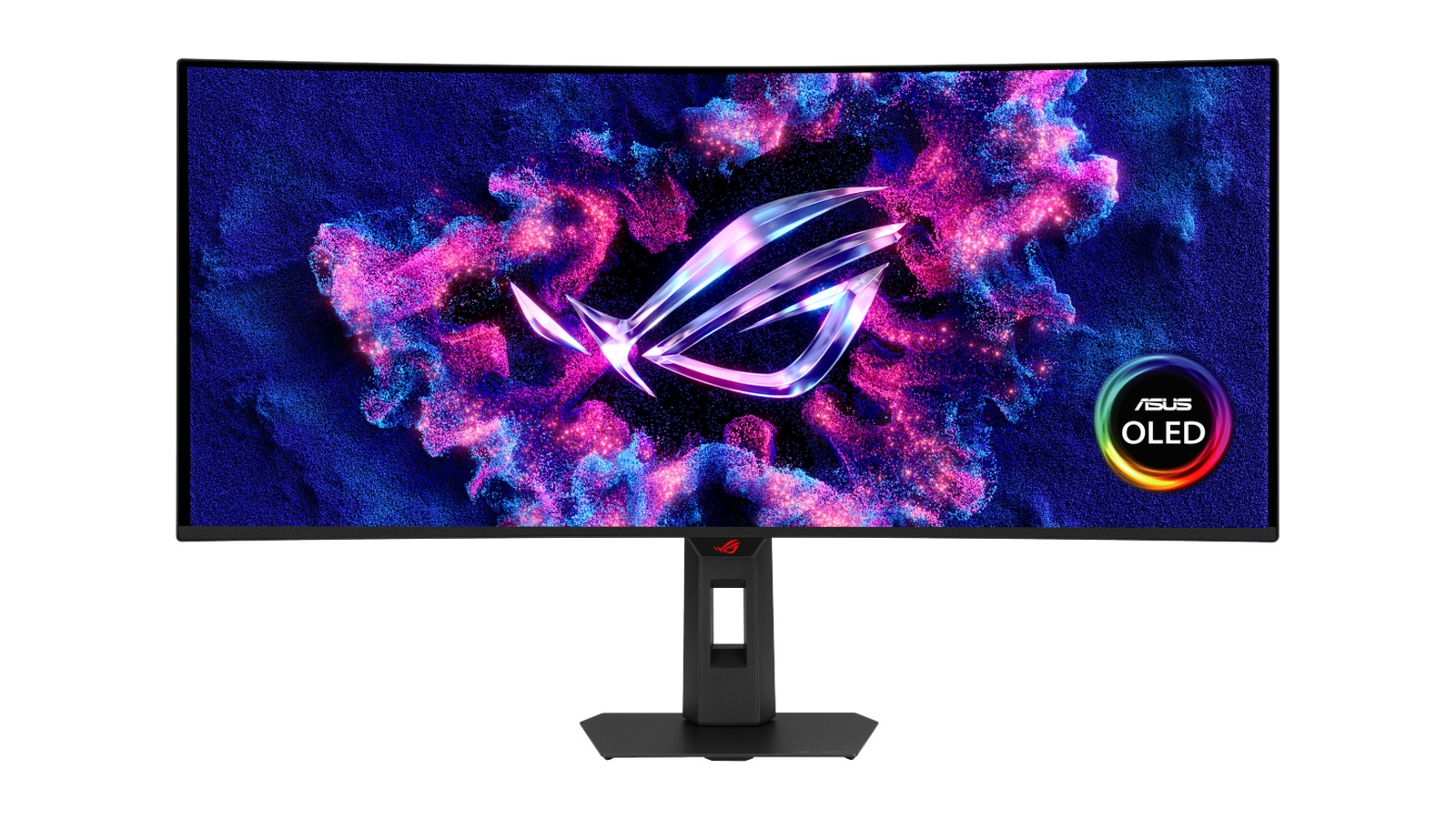
ASUS JAPAN has added two OLED gaming monitors to its ROG (Republic of Gamers) lineup: the 34-inch ultrawide ROG Strix OLED XG34WCDMS and the 26.5-inch ROG Strix OLED XG27AQDMES. Both use QD-OLED panels and began rolling out to electronics retailers and online stores across Japan on July 24. The 34-inch model is priced at 152,820 yen and the 26.5-inch model at 71,820 yen.
The 34-inch ultrawide runs at 280Hz
The higher-end XG34WCDMS is a 34-inch panel with a 3,440 by 1,440 resolution, shaped into a gentle 1800R curve. It reaches a refresh rate of up to 280Hz with a 0.03ms (GTG) response time, aiming to suppress ghosting even in fast-moving competitive titles.
The panel is a tandem-structure RGB QD-OLED with a contrast ratio of 1,500,000 to 1 and 99 percent DCI-P3 coverage. Color accuracy is rated at Delta E under 2, gradation is 10-bit, and the display carries VESA DisplayHDR 500 True Black certification. That is a level of color reproduction that holds up for photo and video editing, not just gaming.
The subpixel layout is worth noting as well. ROG uses an RGB stripe arrangement here, with red, green and blue subpixels lined up vertically. That layout works well with Windows font rendering (ClearType), so the color fringing often criticized on OLED panels is less likely to appear, and text edges stay crisp during work that is mostly reading and writing.
BlackShield film addresses OLED weak points
The feature ASUS puts front and center on the XG34WCDMS is BlackShield, a new film applied to the panel surface. It raises panel hardness, delivering roughly 2.5 times the scratch resistance of previous QD-OLED panels. OLED surfaces are delicate enough that even wiping them down takes care, and this is meant to ease that concern.
The other benefit is how black appears. QD-OLED can take on a purple cast in bright rooms, lifting black levels; BlackShield corrects for this and improves perceived black levels by up to 40 percent, according to ASUS. That makes contrast easier to hold onto in rooms where the lights cannot be dimmed.
Burn-in countermeasures are covered too. ASUS OLED Care Pro bundles pixel cleaning, small screen shifts and taskbar dimming, while a Neo proximity sensor detects when the user steps away and switches the screen to black. Detection distance is adjustable from the menu, and the image returns instantly once the user comes back. Inside, a custom heatsink and airflow design handle heat, and the warranty runs three years.
Connectivity and dual-PC use
Video inputs consist of one DisplayPort 1.4 with DSC and two HDMI 2.1 ports, plus a USB Type-C port that supplies 15W of power. Three USB 3.2 Gen1 Type-A ports are also on board, letting peripherals connect through the monitor.
Auto KVM is supported, so a single keyboard and mouse can drive two PCs. That is a practical feature for anyone running a gaming desktop alongside a laptop, or building out a streaming setup. An aspect ratio control that shrinks the viewing area to a 24.5-inch or 27-inch equivalent is also included, for competitive players used to narrowing their field of view on smaller displays.
The 26.5-inch model offers 240Hz at 71,820 yen
The XG27AQDMES is the more entry-level option, built around a 26.5-inch QD-OLED panel at 2,560 by 1,440. It runs at 240Hz with the same 0.03ms (GTG) response time, a 1,500,000 to 1 contrast ratio and 99 percent DCI-P3 coverage, essentially bringing the higher-end model's fundamentals down to a lower price.
It also carries ASUS OLED Care Pro and the Neo proximity sensor. Extreme Low Motion Blur (ELMB) reduces ghosting, HDR10 is supported, and variable refresh rate works with both G-SYNC Compatible and AMD FreeSync Premium.
The stand handles tilt, swivel, height adjustment from 0 to 110mm, and pivot of plus or minus 90 degrees, so portrait orientation is on the table. Video inputs are one DisplayPort 1.4 with DSC and two HDMI 2.1 ports; the USB Type-C port and USB hub found on the larger model are not included.
Summary
The ROG Strix OLED XG34WCDMS and XG27AQDMES build on QD-OLED's high contrast and 0.03ms response time while working on OLED's traditional weak spots: fragile surfaces, raised black levels in bright rooms, and burn-in anxiety. The 34-inch XG34WCDMS packs in 280Hz operation, BlackShield film and Auto KVM for 152,820 yen, while the 26.5-inch XG27AQDMES runs at 240Hz for 71,820 yen, splitting the two clearly by price and use case. With the RGB stripe layout improving text legibility, both are worth a look for buyers who want a main monitor for everyday work rather than a gaming-only display.