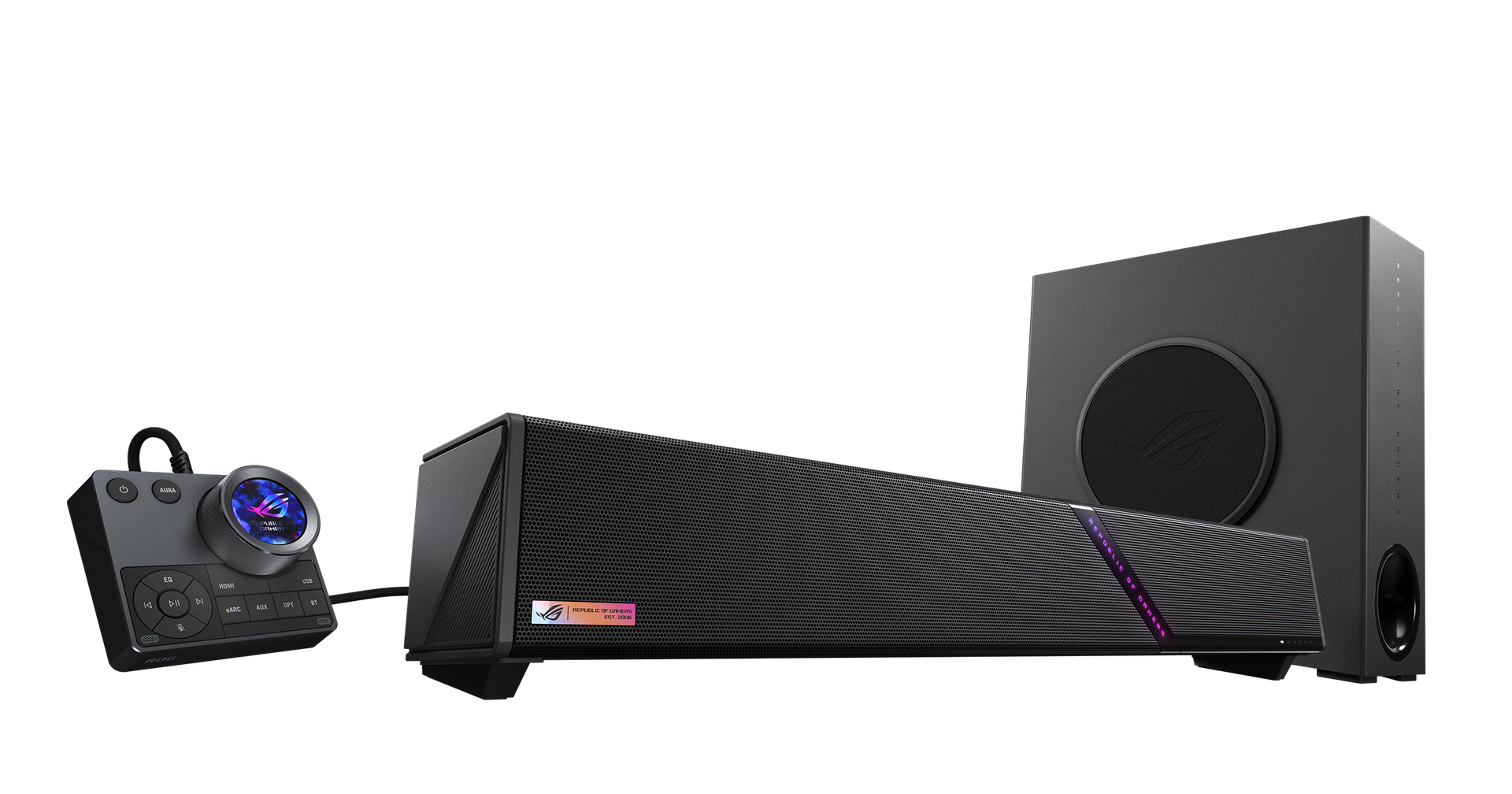
ASUS gaming brand Republic of Gamers (ROG) announced the ROG Gjallar in Taipei on July 9, 2026, the first soundbar the brand has ever shipped. It supports 2.1.2-channel Dolby Atmos and pairs a 6.5-inch, 65-watt wireless subwoofer with a separate control hub carrying echo-cancelling microphones. Pricing and release timing have not been announced.
A 2.1.2 Layout That Adds Height on a Desk
The Gjallar uses a 2.1.2 configuration. Read left to right, the numbers mean horizontal speakers, subwoofers, and up-firing channels aimed at the ceiling. That works out to left and right mains, one subwoofer, and two overhead channels.
The bar itself carries four 50mm full-range drivers and two 27mm tweeters, with a frequency response of 50Hz to 20kHz. The up-firing channels bounce sound off the ceiling to build the height layer, letting a single desk-mounted bar handle Dolby Atmos.
ROG's argument is that you can get directional audio without wearing headphones. In competitive titles where footsteps and gunfire give away positions, a soundstage with a vertical dimension gives players more to work with than a purely horizontal one.
The Subwoofer Runs Over 5GHz Wireless to Keep Latency Down
Low end comes from a 65-watt subwoofer with a 165mm (6.5-inch) driver. It connects wirelessly over the 5GHz band rather than by cable, operating between 5.180GHz and 5.825GHz.
Cutting the cable frees up placement, but transmission delay puts bass out of step with the picture. Using 5GHz instead of Bluetooth is what keeps that latency in check. When the sounds involved are explosions and impacts that have to land on the same frame as the visual, this is not a detail you can skip.
The subwoofer measures 125 x 315 x 356mm, a tall narrow shape meant to sit beside a desk or under it, and weighs 5.7kg.
One Hub for EQ and Microphone Control
The separate control hub is the part that stands out. It is a small 90 x 82 x 37mm unit weighing just 191 grams, with an LCD display for switching EQ profiles, controlling playback, selecting inputs, and adjusting RGB lighting. Moving between gaming, music, and movie EQ presets happens without opening any software.
The hub also holds the microphones. They use AEC, or acoustic echo cancellation, which subtracts the game audio and teammate voices coming out of the speakers from your own microphone input. That addresses the classic problem of running voice chat over open speakers and sending everyone's voice back to them.
An AI beamforming algorithm further tightens directional pickup and suppresses ambient noise such as PC fan and power supply hum. Microphone frequency response runs from 100Hz to 10kHz with sensitivity rated at -37 ±3dB. The whole design points toward making voice chat work with the headset off.
Inputs Built for a PC and a Console Side by Side
Connectivity is broad. The Gjallar offers USB-C, HDMI 2.1 with eARC, optical, AUX, and Bluetooth 5.3. HDMI 2.1 supports 4K 120Hz passthrough, and eARC carries lossless high-resolution audio. In practice that means dropping the soundbar into the chain without giving up image quality or refresh rate.
Listed platform support covers TVs, Windows PCs, Macs, PlayStation 5, PlayStation 4 series, Xbox Series X|S, Nintendo Switch, and mobile devices over USB-C or Bluetooth. A USB hub on the right side of the bar adds two USB Type-A ports for wireless dongles or external storage.
Lighting is handled by ASUS Aura RGB, with 16.8 million colors and four preset effects. Detailed EQ, microphone, and lighting adjustments can be made either through Gear Link in a web browser or through the mobile app, so no dedicated software install is required.
Dimensions and What Is Still Unknown
The bar measures 607 x 92 x 82mm and weighs 2.4kg, sized to sit under a 24- to 27-inch monitor.
What ASUS has not disclosed is pricing, release date, or regional availability. The specifications and design are locked in, but what it costs is waiting on a later announcement. The name Gjallar comes from Gjallarhorn in Norse mythology, and ASUS says it is pronounced "ga-lar."
Summary
The ROG Gjallar brings together 2.1.2 Dolby Atmos, a 65-watt subwoofer on a 5GHz wireless link, and a control hub with built-in AEC microphones, in ROG's first soundbar. The design leans toward handling game audio and voice chat together without a headset, and HDMI 2.1 eARC makes it practical to keep a PC and a console attached at once. Price is the remaining question, and where it lands against existing gaming soundbars will decide how it is judged.