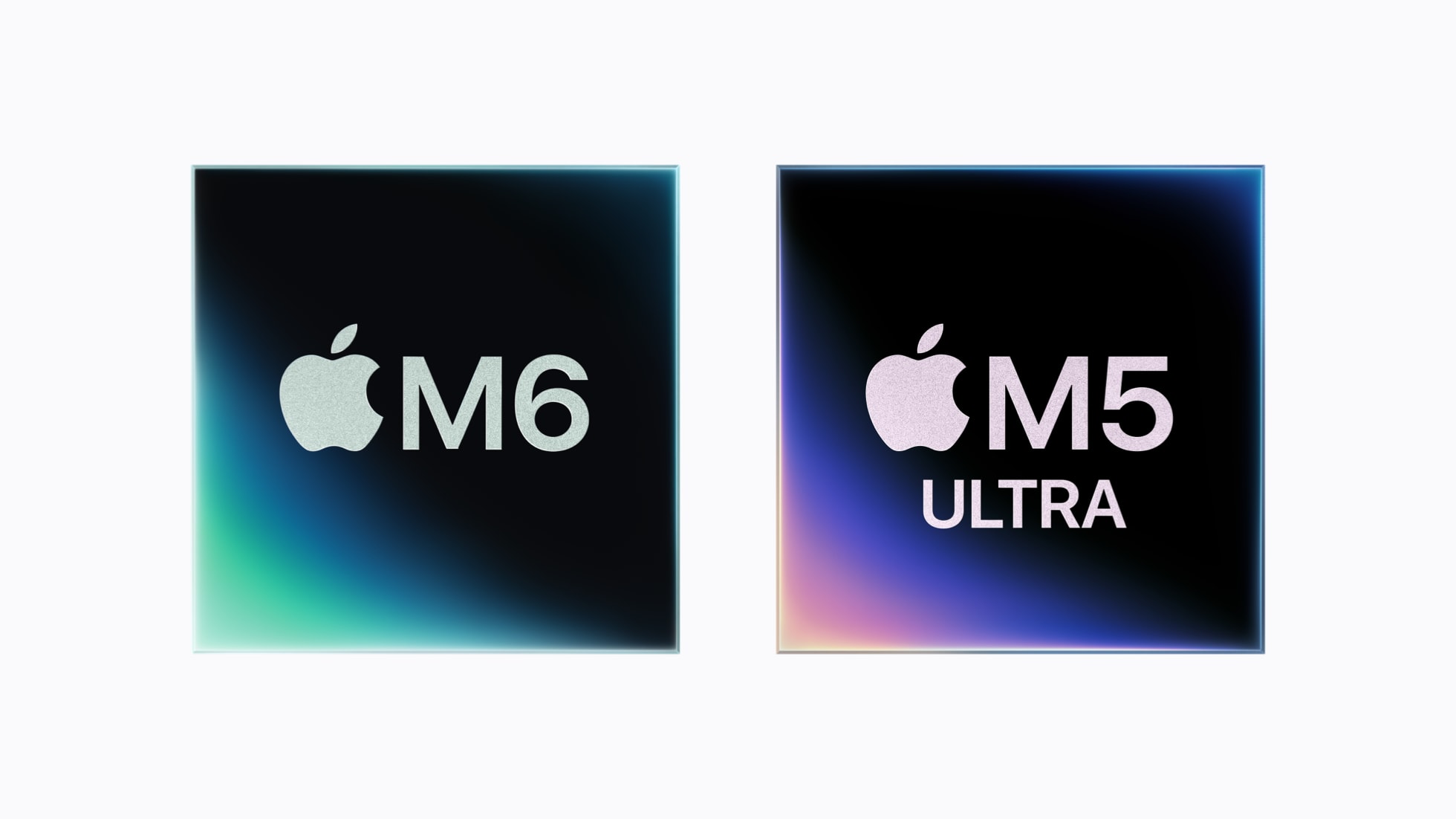
Apple announced two new desktop-class chips on August 25: the M6 and the M5 Ultra. The M6 is the company's first chip built on a 2-nanometer process and debuts in the new Mac mini. The M5 Ultra combines four dies into a single processor, making it the most powerful chip Apple has ever built, and it powers the new Mac Studio. Both are clearly designed around running AI workloads on the device[1].
The M6 Is Apple's First 2nm Chip
The biggest change in the M6 is the manufacturing process. For the first time, Apple is using a leading-edge 2-nanometer process, packing transistors more densely onto a smaller die to improve both performance and power efficiency[1].
The CPU is now a 12-core complex: two super cores, four performance cores, and six efficiency cores, two more cores than the M5. Heavy single-threaded work goes to the super cores, the performance cores join in on multithreaded loads at lower power, and the efficiency cores handle background chores. Multithreaded performance is up to 1.2x faster than the M5 and up to 2.4x faster than the M1[1].
The GPU also grows to 12 cores, each with a Neural Accelerator built in. Peak GPU compute for AI is nearly 30 percent higher than the M5 and more than 8x higher than the M1, which Apple says translates into noticeably faster prompt processing when working with on-device LLMs. On the graphics side, the M6 adds an updated shader core architecture, Dynamic Caching, and hardware-accelerated ray tracing, along with a 50 percent higher geometry rate for complex scenes[1].
A Dual 16-Core Neural Engine
The most notable structural change in the M6 is the dual Neural Engine: two 16-core engines instead of one. Peak compute is up to 2x that of the previous generation, and because system frameworks automatically use both engines at once, apps run models faster without needing to be rewritten[1].
Memory tops out at 32GB of unified memory with up to 170GB/s of bandwidth, 10 percent more than the M5 and 2.5x more than the M1. When running an LLM locally, memory bandwidth matters as much as raw compute, so steadily raising this number is a sensible priority[1].
The M5 Ultra Is Apple's First Quad-Die Design
The M5 Ultra uses next-generation UltraFusion to link two dual-die M5 Max chips, forming the first quad-die architecture in the M series. Die-to-die bandwidth exceeds 4.4TB/s and connection density is more than 6x higher, and that ultra-low-latency interconnect lets all four dies behave as one unified processor[1].
The CPU scales to 36 cores (12 super cores and 24 performance cores) and the GPU to 80 cores. Compared with the M3 Ultra, single-threaded performance is up to 1.25x faster, multithreaded up to 1.3x faster, peak GPU compute for AI up to 4.5x higher, and graphics performance up to 40 percent faster. Against the M1 Ultra, AI compute is more than 6x higher[1].
The memory figures scale up as well: up to 512GB of unified memory with 1.2TB/s of bandwidth, 50 percent faster than the M3 Ultra. Apple's claim that you can run LLMs with hundreds of billions of parameters entirely on device only holds up because of that capacity and bandwidth[1].
Media handling is stronger too, with dedicated hardware for H.264 and HEVC, four ProRes encode and decode engines, and hardware-accelerated AV1 decode. The Neural Engine has 32 cores[1].
Sri Santhanam, Apple's vice president of Silicon Engineering Group, highlighted the M6's new CPU complex, dual 16-core Neural Engine, and larger memory bandwidth, and described the M5 Ultra as a chip that pushes the limits of what is possible on the desktop[1].
Pricing and Availability
The M6 ships in the new Mac mini and the M5 Ultra in the new Mac Studio. In Japan, pre-orders opened on August 25 and both machines go on sale September 22[2].
Entry configurations at the Apple Store are priced as follows[2]:
| Product | Configuration | Price (tax included) |
|---|---|---|
| Mac mini | M6 | 149,800 yen |
| Mac mini | M5 Pro | 299,800 yen |
| Mac Studio | M5 Max | 419,800 yen |
| Mac Studio | M5 Ultra | 949,800 yen |
The 512GB memory configuration of the Mac Studio is the exception, with shipping scheduled for late October[2].
What Developers Get
Apple's developer frameworks and tools, including Core AI, Core ML, Metal, and Xcode, have direct access to the hardware in both chips. The frameworks optimize automatically across CPU, GPU, and Neural Engine, so developers can tap Apple Intelligence features through Apple Foundation Models and App Intents, or run their own models entirely on device[1].
The picture Apple is painting is one where even fine-tuning a large model can happen on a Mac. The M5 Ultra's 512GB of unified memory gives that claim enough headroom to be taken at face value. Apple Intelligence itself is currently available for testing through the Apple Beta Software Program, and reaches supported devices this fall with macOS 27[1].
Summary
On August 25, Apple announced the M6, its first 2-nanometer chip, and the M5 Ultra, its first quad-die design. The M6 pairs a 12-core CPU and 12-core GPU with a dual 16-core Neural Engine, while the M5 Ultra combines up to a 36-core CPU and 80-core GPU with up to 512GB of unified memory at 1.2TB/s. They ship in the Mac mini and Mac Studio, both available in Japan on September 22, starting at 149,800 yen and 419,800 yen respectively. The numbers make it clear that running LLMs on the device has become the design premise rather than a side benefit.
Source: https://www.itmedia.co.jp/pcuser/articles/2608/25/news100.html