AMD is preparing to ship Helios, its first rack-scale system built for AI workloads, with customer deliveries expected before the end of the year. On July 20, Microsoft said it will deploy Helios across Azure data centers, joining Meta, OpenAI and Oracle. For the first time, NVIDIA faces a serious rival in the rack-scale AI market it has effectively owned.
From Selling Parts to Selling a Whole Rack
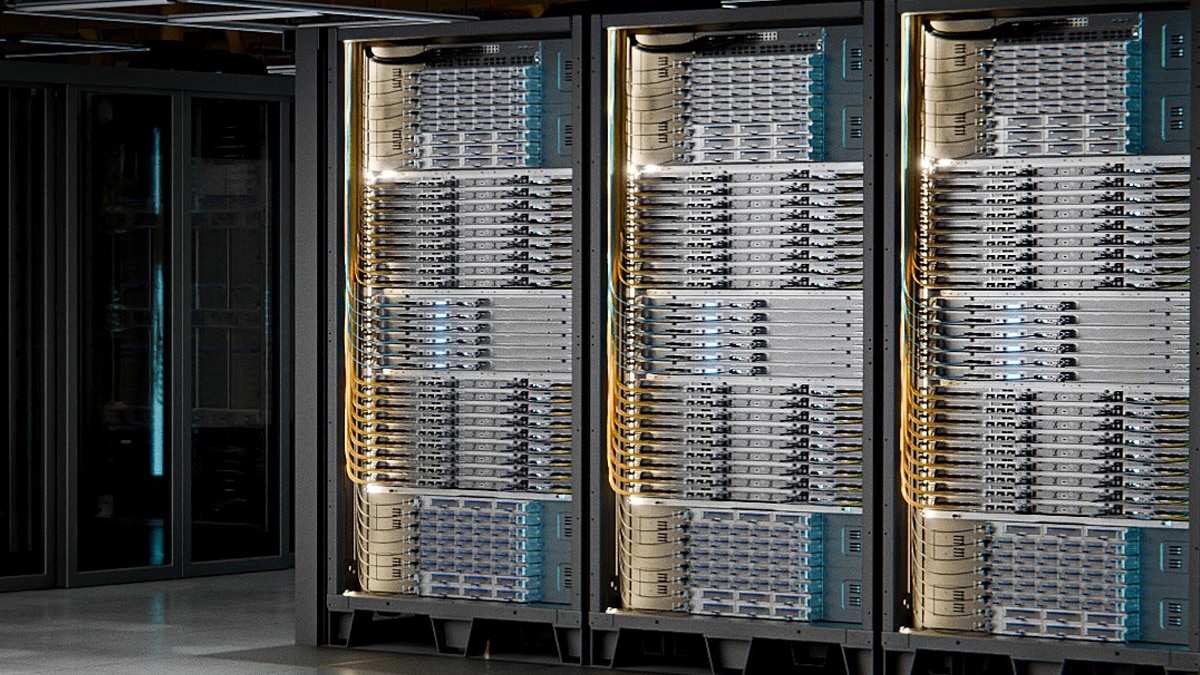
AI silicon has largely been sold as separate pieces: GPUs, CPUs, networking chips and software stacks. Helios takes a different route. AMD supplies all four in-house and designs them into a single rack, power and cooling included.
Inside are 18 compute trays. Each tray carries four Instinct MI455X accelerators and one sixth-generation EPYC processor, codenamed Venice, for a total of 72 GPUs per rack. A tray also holds up to 12 networking chips based on technology AMD picked up when it acquired Pensando in 2022. On the software side, ROCm serves as AMD's open answer to NVIDIA's CUDA.
The name comes from the Greek god who drives the sun across the sky with four horses. The four pillars here are GPUs, CPUs, networking and software.
Bigger, Heavier and More Expensive
Compared with Vera Rubin, NVIDIA's second-generation rack, Helios is both wider and heavier. It weighs up to 7,000 pounds, north of 3 metric tons, enough that floor loading becomes a real planning question for operators.
AMD has not disclosed pricing, but research firm Futurum Group estimates 5 million to 5.5 million USD per rack (about 810 million to 890 million yen). Futurum puts Vera Rubin at 3.5 million to 4 million USD (about 570 million to 650 million yen), so AMD is the pricier option on day one.
1 USD = 162 JPY (as of July 20, 2026)
What AMD emphasizes instead is cost per token and total cost of ownership. Forrest Norrod, who leads the data center business, said the company is focused squarely on that metric and that customers report AMD is delivering on it. Back in May, CEO Lisa Su argued Helios holds meaningful advantages in inference and in memory bandwidth and capacity.
Why Azure Signed On, and What Comes Next
Microsoft plans to use Helios to power frontier model inference for itself and its AI customers, and to support Azure AI services. It is also adding two compute instances built on Venice-generation EPYC processors, one aimed at agentic AI and data pipelines, the other at semiconductor design. Customer instances are expected in late 2026 or early 2027.
The two companies go back a long way. AMD silicon has powered Surface PCs and Xbox consoles for years, and Microsoft was the first to adopt the MI300X in 2023. Microsoft also runs its own Maia chips in production, which suggests this is less a switch away from NVIDIA than a deliberate move to keep more than one option open.
Adoption is spreading quickly. AMD says eight of the top 10 AI companies run workloads on Instinct GPUs. In February, Meta outlined plans to use up to 6 gigawatts of AMD GPUs over time, starting with 1 gigawatt on Helios racks this year. Tata Consultancy Services, India's largest IT firm, has also committed.
Futurum Group puts NVIDIA above 95 percent of the data center GPU market, with AMD holding roughly 4.5 percent. Even so, Futurum analyst Daniel Newman sees a credible path for AMD to reach 20 to 25 percent, a swing he frames as hundreds of billions of dollars in revenue.
AMD's own outlook is bullish. The company expects to book tens of billions of dollars in data center AI revenue beginning in 2027, with the majority coming from Helios. Data centers already accounted for most of AMD's revenue in the first quarter of 2026, up 57 percent year over year.
Skepticism remains. Neil Shah, an analyst at Counterpoint Research, calls AMD's chips on par with NVIDIA's but says the deciding factor is software and optimization, where CUDA still leads on ecosystem breadth. Newman raises a related question: is AMD winning on technical merit, or simply because capacity is so constrained that anything built will sell?
The real test is whether AMD can carry over the server CPU credibility it rebuilt with EPYC. Intel still leads in data center CPUs, but AMD has taken ground steadily. Repeating that on the GPU side starts with how these first Helios deployments perform.
Summary
AMD will ship Helios, its first rack-scale AI system, this year, and Microsoft is deploying it at scale on Azure. Each rack integrates 72 Instinct MI455X accelerators, Venice-generation EPYC CPUs, Pensando networking and ROCm. Pricing appears to run above NVIDIA's Vera Rubin, though AMD argues it wins on cost per token. AMD holds only about 4.5 percent of the data center GPU market, but with Microsoft joining Meta, OpenAI and Oracle, whether NVIDIA's dominance loosens becomes the story to watch through 2027.