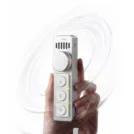
Ulanzi is bringing the AU05 Vibe Key to Japan, a desktop device that puts talking to AI and confirming its output onto physical keys. Crowdfunding opens on GREEN FUNDING on September 25, and units will be on display at Futako Tamagawa Tsutaya Electrics from September 19. The idea is simple: prompt an AI agent without lifting your hands off the desk, then accept or reject the result with a keypress.
Press, speak, done
The core interaction is a single motion. Hold the voice key, speak, and your words land in whatever input field is active. Nothing about writing code or drafting text has to stop while you formulate a prompt.
The omnidirectional microphone is tuned for quiet speech, down to a whisper. That is aimed squarely at shared offices and late-night sessions where talking to a machine at normal volume is not an option.
It is worth being clear about what the device is not. Vibe Key does no speech recognition of its own. It is a hardware controller meant to pair with agents such as ChatGPT, Claude and Codex, or with voice input software like Typeless, which handle the actual transcription.
Approve and reject without leaving the keypad
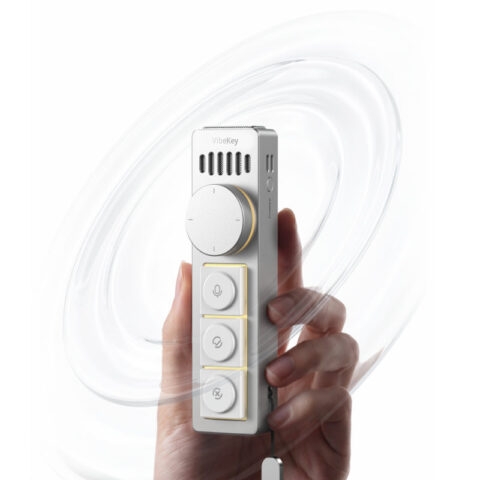
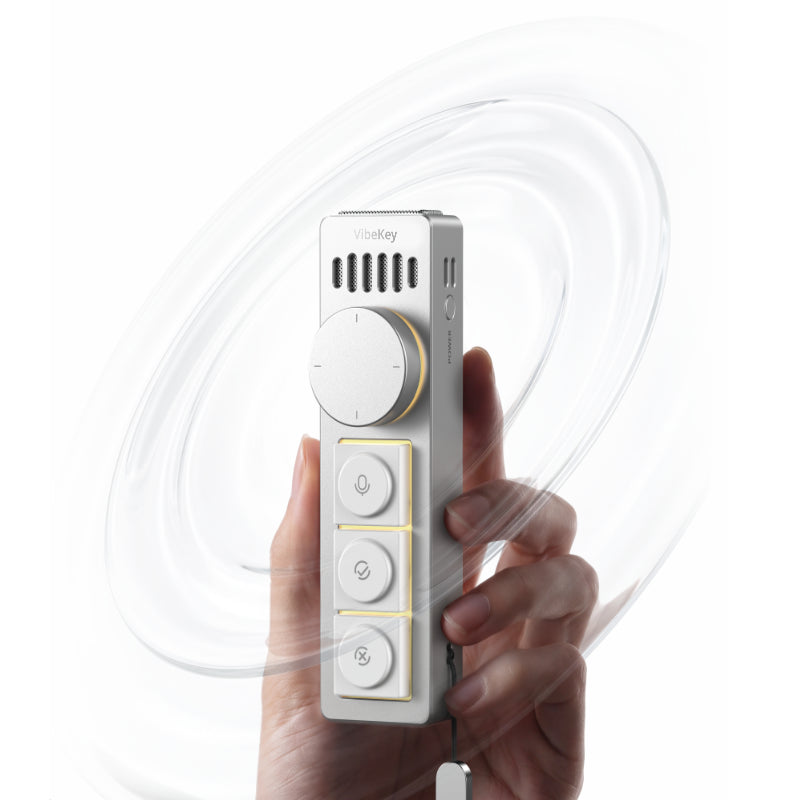
The actions that pile up during an AI session are mapped to physical keys and a multifunction knob: voice input, confirm, reject, start a new session, open the sidebar. Turning the knob scrolls or switches between sessions. The point is to cut down on the constant hop between keyboard and mouse.
Everything is remappable in the companion app, Ulanzi Studio, and layouts can be saved as presets. Users can keep one profile for AI work and another for everyday tasks, and shortcuts keep working offline using the last synced preset after the app is closed.
The lighting is the more interesting touch. Three modes are available, Work Mode, All-On Mode and Power-Saving Mode, and when paired with Codex or Claude Code hooks the lights signal when an AI task is waiting on approval. You can tell a task needs you without watching the screen.
84 grams of machined aluminum
The body is CNC-machined aluminum alloy, weighing roughly 84 grams and measuring 11.2 by 3 by 2.8 cm. It mounts magnetically to a desk setup or hangs from the included lanyard.
Power comes from a 300mAh battery (3.7V, 1.1Wh), rated for up to 5 days when used 3 hours a day in Work Mode. Charging is over USB-C and takes about 4 hours. The connection is via USB dongle, and supported systems are Windows 10 or later and macOS 12.0 or later on both Apple Silicon and Intel Macs. Configuration requires Ulanzi Studio V3.2.0 or later.
Gateron low-profile switches are hot-swappable, and cross-stem keycaps fit, so both the feel and the look can be changed. The box contains the device with lanyard, a receiver, a charging cable and a manual.
Ulanzi's own online store currently lists the unit at 11,100 yen, marked down to 9,800 yen. How that maps to crowdfunding pledge tiers will not be clear until the campaign opens.
Hands-on starts September 19
The showcase is Gadget Exhibition 2026 Autumn Supported by Ulanzi, held at Futako Tamagawa Tsutaya Electrics on September 19 and 20. It runs in the second-floor E-room 1 and 2 and the area in front of the escalator, from 10:00 to 20:00, closing at 19:00 on the final day. Admission is free.
A separate crowdfunding display booth on the first floor, at Tsutaya Electrics Plus, is scheduled to stay up for roughly a month starting September 19, so the hardware remains viewable after the campaign begins.
Other new products share the floor: the MT-44M 2-in-1 magnetic selfie stick with legs, the CW15 wireless charger with Qi2 at up to 15W, the D100H Dial clip assistant for editing, the JOBY BM06 Beamo xenon flash for smartphones, and the TC002 Smart Pixel Clock II with its 16 by 52 pixel display. Desk gear dominates this round.
Summary
The AU05 Vibe Key proposes a dedicated input surface for people whose day now runs through AI tools. Speech recognition stays with whatever software you already use, and only the press, speak, confirm and reject loop moves into hardware. That narrow scope is what makes it legible, and anyone running Claude Code or Codex daily is the obvious audience. Units on display are pre-production and the final spec may differ, so the September 19 preview is the place to judge how it actually feels in hand.