
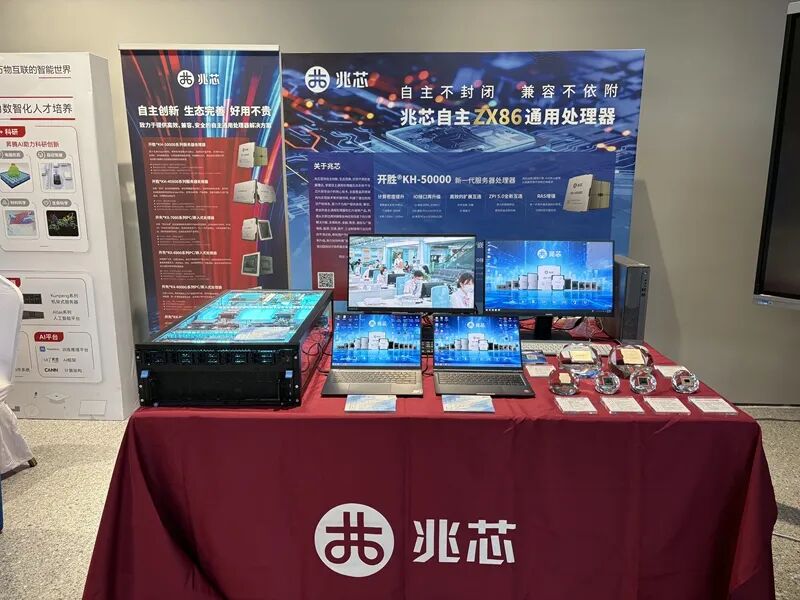
Zhaoxin, the Chinese x86-compatible CPU maker, has disclosed how far its chips have moved into the education sector. Cumulative shipments of terminals, servers and large interactive displays built on the company's own ZX86 instruction set have passed 1 million units, and in Hainan province the company says it won 100 percent of a school infrastructure tender covering more than 34,000 units[1]. The numbers show how far domestic CPU substitution has progressed in China's school market.
ZX86 deployment record presented at a Shanghai conference
Zhaoxin disclosed the figures at the third Shanghai Education Sector IT Application Innovation and IPv6 Application Academic Conference, held at the Shanghai University Exchange and Exhibition Center. The company gave a presentation on ZX86 compute chip technology and its education deployments, and exhibited ZX86-based servers and classroom terminals[1].
Zhaoxin is based in Shanghai and designs general-purpose CPUs. It holds the core technology for its processors and platform chips in house, and has built an intellectual property framework around the ZX86 instruction set under the slogan independent but not closed, compatible but not dependent[1]. The idea is to keep x86 compatibility while retaining the freedom to iterate on its own.
KH-50000 for servers, KX-7000 for endpoints
The ZX86 lineup splits into two families: KaiXian for PCs and embedded systems, and KaiSheng for servers. The division of labor inside a school is straightforward. The new-generation KaiSheng KH-50000 server processor handles campus cloud, AI training environments and large-scale data storage, while KaiXian parts such as the KX-7000 cover multimedia lessons, AI classrooms, everyday teaching and staff office work[1].
Detailed specifications for the KH-50000 were published in September 2025. It uses Chiplet packaging, which integrates multiple small dies into a single package, and can hold up to 12 CPU dies, offered in 96-core and 72-core versions. Base clocks are 2.2GHz for the 96-core part and 2.6GHz for the 72-core part, with a maximum operating frequency of 3.0GHz and up to 384MB of L3 cache. Memory support covers 12 channels of DDR5-5200 ECC up to 3TB, and external connectivity includes 128 lanes of PCIe 5.0 (with CXL and Zhaoxin's own ZPI interconnect) plus 16 lanes of PCIe 4.0. A single server can host up to 4 of these processors for a 384-core configuration[2]. The previous-generation KH-40000 topped out at 32 cores per socket, so compute density has risen sharply.
On the software side, Zhaoxin continues joint validation with major Chinese OS vendors including Kylinsoft, UnionTech and NFS China, and says it has completed more than 240,000 product compatibility and performance optimization projects with over 6,000 partners[1]. Shipping a CPU alone does not get it into a school, so this groundwork is the precondition for adoption.
Three flagship school projects
Zhaoxin points to 3 deployments designed as templates other schools can copy[1].
At Shanghai University, the company built a teaching and training lab assembled entirely from domestic components: machines running ZX86 processors, an NFS China operating system and Kingsoft Office. The lab supports regular classes, academic competitions and specialist training, and is already in continuous use.
At Beijing No. 20 Middle School, Zhaoxin worked with KaiTian, Lenovo's domestic-technology brand, to build what it describes as China's first fully domestic AI training classroom for primary and secondary education. The setup combines ZX86 compute, integrated cloud desktops and a general AI curriculum, supporting lessons in AI-assisted creative work and autonomous agent development.
At ShanghaiTech University, ZX86 platform servers running Kylin OS and ZStack's domestic cloud stack form the virtualization base for the entire campus. Migration from the existing VMware environment has proceeded in stages, and teaching, research and administrative workloads now run on the same foundation. Given that VMware licensing changes have driven migrations worldwide, this case may hold some interest for operators outside China as well.
1 million units cumulative, a full sweep in Hainan
Zhaoxin says the result of this groundwork is cumulative shipments of more than 1 million ZX86-based terminals, servers and smart large displays, spread across teaching and administration, smart classrooms, campus management, examinations and training, and remote education[1].
The Hainan case stands out. In the province's smart education infrastructure program for primary and secondary schools, more than 34,000 ZX86 machines and smart displays were awarded at a 100 percent win rate. The scope covers IT classrooms, student PC labs, teacher lesson-preparation terminals and interactive large displays in one sweep[1]. Supplying an entire province's basic education infrastructure with a single domestic CPU vendor suggests the market has moved beyond partial adoption.
Partner hardware was also on display at the conference: the AS13000G7-460 storage server with 2 KH-50000 processors, Lenovo KaiTian's M75Z desktop and N8 Pro and X5z laptops built on KaiXian parts, and Seewo's Huateng D50sz G1e education terminal running a KX-7000[1].
Summary
Built around the ZX86 instruction set, Zhaoxin now covers everything from school infrastructure to classroom endpoints with the KH-50000 on the server side and the KX-7000 on the client side. Cumulative shipments of 1 million units and the 34,000-unit sweep in Hainan indicate that domestic CPU substitution in China's education market has reached the implementation stage. That said, all of this information comes from the company's own announcement, and third-party performance validation and operational assessments would need to be checked separately.
Source[1]: https://www.zhaoxin.com/news_view.aspx?nid=2&typeid=289&id=2060
Source[2]: https://www.zhaoxin.com/news_view.aspx?nid=2&typeid=283&id=1898