
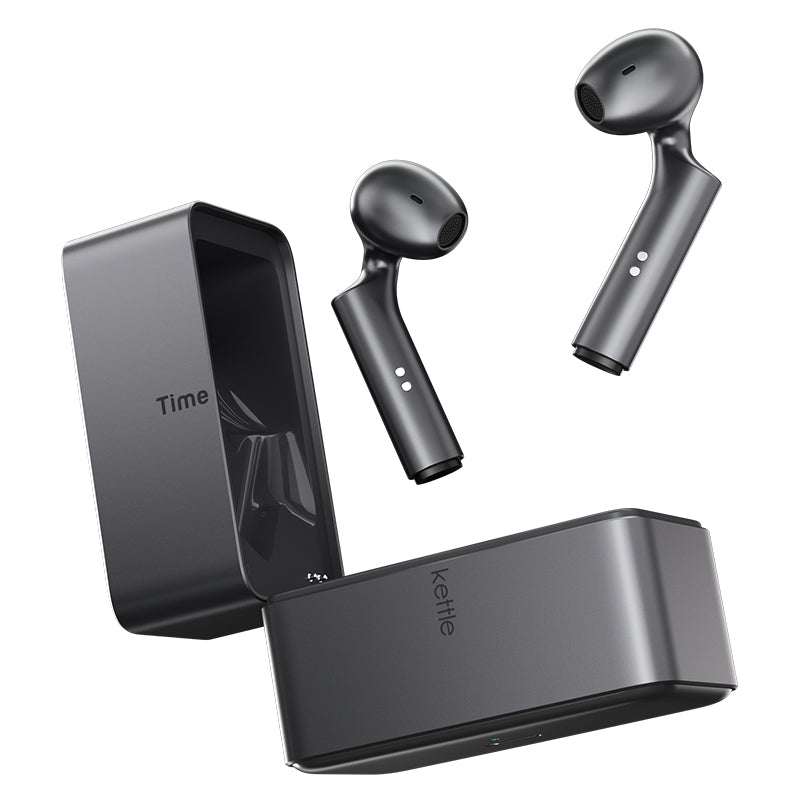
Timekettle, a maker of translation devices, released its new AI interpreter earbuds, the W4 Plus, in the United States on September 6. The product handles not only face-to-face conversation but also phone calls and the audio of video content. Two versions are offered: a 299 USD (about 47,000 yen) model paired with a monthly plan, and a 379 USD (about 59,000 yen) model that unlocks every feature with no recurring fee.
Conversation, Calls and Media in a Single Pair
The W4 Plus organizes its work into four modes. Two-Person Conversation has each side wear one earbud for face-to-face exchanges. On-Site Listening uses both earbuds for one-way interpretation of lectures or guided tours. Call Translation covers phone calls and online meetings in both directions. Media Translation layers subtitles and translated audio over video and audio content.
For the last two, the practical point is that the other party has to prepare nothing. No second pair of earbuds is required, and the arrangement works with only one person wearing the device. Supported apps include regular phone calls plus WeChat, Zoom, Microsoft Teams, DingTalk and WhatsApp, while media translation handles audio from streaming services such as YouTube, Netflix and Amazon Prime Video.
During call translation, the volume of the original audio and the translated audio can be adjusted separately. After a firmware update, users can also turn off the option that lets the other party hear their original voice, delivering only the translated version.
A New Translation Engine: Babel OS 3.0
The biggest internal change is Babel OS 3.0, Timekettle's in-house translation platform. It covers the full path from speech recognition to output, and the company places a large language model at the center of the translation reasoning, claiming an accuracy gain of 30 percent or more over the previous generation. Long sentences full of restarts and casual phrasing are refined into natural expressions rather than left as word-for-word output.
The W4 Plus also lets users switch between speed and accuracy with a single tap on screen. The fast mode suits short exchanges such as ordering food or asking for directions, while the accurate mode waits for a complete sentence and translates it with context, which fits negotiations and meetings. Because the switch does not interrupt the conversation, users can simply tap again when the situation changes.
Bone Conduction and VoiceFocus for Quiet Voices
The pickup side is equally notable. The W4 Plus combines one bone-conduction voiceprint sensor with two air-conduction microphones, extracting the speaker's voice from skull vibration. On top of that sits a noise reduction algorithm called VoiceFocus, which separates the user's voice from the surrounding environment.
According to measurements from Timekettle's own lab, the error rate drops by 32 to 47 percent in quiet settings or when the user speaks softly. The company also cites a 25 percent improvement in recognition accuracy over the W3 generation and 92 percent accuracy for Chinese-English translation. The design targets noisy places such as trade show floors and restaurants, where raising your voice should not be necessary.
Bone-conduction pickup activates only in translation modes; it does not run during ordinary calls or music playback.
Three AI Features, Including Industry Terminology
Three AI capabilities have been added. AI Specialized Translation lets users pick a field such as Tech and Internet, Manufacturing and Industry, New Energy and Green Tech, or Biotech and Pharma, and adjusts the translation to that domain's terminology. AI Conversation Memory keeps terms, proper names and phrasing consistent across a long discussion, although the context is retained only within the ongoing session and is not carried over once the conversation ends. AI Live Summary extracts key points from the translated conversation and shapes them into meeting notes.
These AI features come at no extra cost with the 379 USD one-time purchase version. The 299 USD version includes a 7-day free trial, after which a 14.99 USD (about 2,300 yen) monthly plan unlocks them. Even without a subscription, Two-Person Conversation and On-Site Listening remain unlimited.
Thirteen Offline Pairs, Japanese Included
For places without connectivity, 13 language pairs run offline. Built around Chinese and English, the pairs cover Japanese, Korean, French, German, Spanish and Russian, and every pack is free to download. For Japanese speakers, the practical benefit is that exchanges with English and Chinese work without a network.
Offline use is limited to Two-Person Conversation and On-Site Listening. Call Translation, Media Translation and the three AI features all require cloud processing. Online coverage spans 52 languages and 106 accents, distinguishing 14 regional variants for English, 20 for Spanish and 15 for Arabic.
On privacy, Timekettle states compliance with GDPR and FERPA, and says conversations are neither stored nor used for training.
Battery and Portability
Continuous translation runs for more than 3 hours at 50 percent volume, and music playback lasts 6 hours. With the charging case, that extends to 12 hours of translation and 18 hours of music. The earbuds charge fully in about 50 minutes and the case in roughly 1.5 hours over Type-C, with standby time reaching about 6 months.
Each earbud weighs 5.7 grams, and the total with the case is 116.5 grams. Colors are Space Black, Midnight Blue and Sandy Gold.
Summary
The W4 Plus pairs a single set of earbuds that handle face-to-face talk, calls and media audio with Babel OS 3.0 and bone-conduction pickup. Its coverage spans 52 languages and 106 accents online plus 13 offline pairs, joined by AI features for domain terminology and meeting summaries. Splitting the lineup at 299 USD and 379 USD around a monthly plan is easy to grasp, though the one-time purchase clearly favors heavy long-term use. Sales have started in the United States through Timekettle's official site and Amazon, and no separate announcement has been made about availability in Japan.
※1 USD = 156 JPY (as of September 6, 2026)