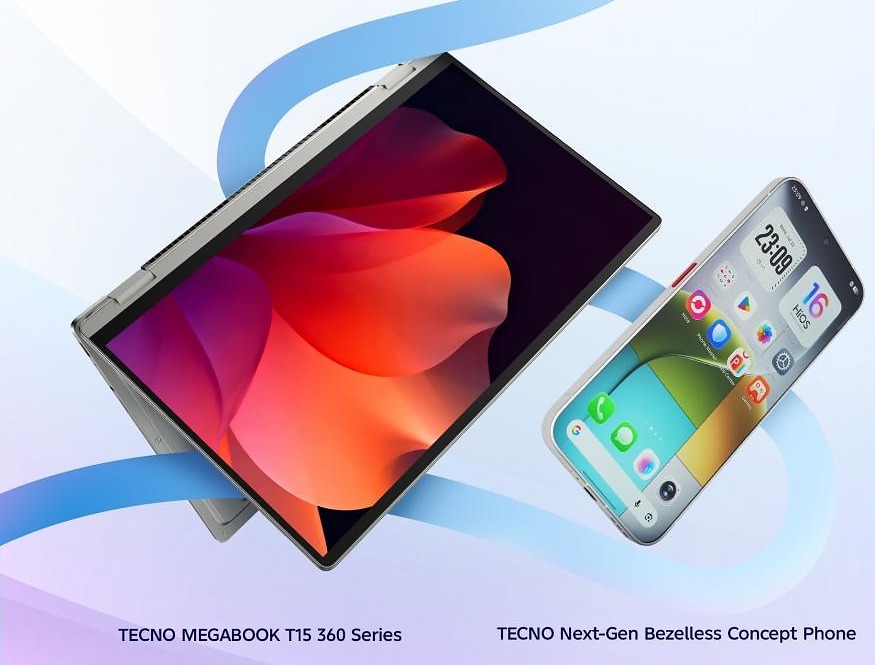
Chinese smartphone brand TECNO has put its Next-Gen Bezelless Concept Phone, a device with no black border left around the screen at all, in front of the public for the first time, timed with the opening of IFA 2026 in Berlin. The concept was previewed only in images at the end of July. TECNO says it has shrunk the 1 to 2 mm black border that normally sits between the active display and the frame down to 0 mm. There is no release date, but the phone stands out for its two-layer cover glass and for a display that is installed from the rear, the opposite of how smartphones are usually built.
TECNO first revealed the concept on July 31, 2026. At that point only a handful of official images were released, and a shot placing the device next to an iPhone 17 Pro to compare bezel width drew most of the attention. The technical explanation was kept short: advanced internal stacking, structural re-engineering, and a new screen packaging method.
The physical unit appeared at ShowStoppers, a press event held at Messe Berlin on the evening of September 3, the day before IFA proper opened. TECNO showed it alongside the MEGABOOK T15 360 Pro, a 15.6-inch touch laptop with a 360-degree hinge, and its lineup of Tonino Lamborghini collaboration products. IFA 2026 runs from September 4 to 8, and for TECNO this follows the ultra-thin modular concept it presented at MWC 2026.
Why the Border Disappears: Two Layers of Glass and Reversed Assembly
Even on today's flagships, a black band of 1 to 2 mm remains between the OLED's light-emitting area and the metal frame. Wiring, assembly tolerances, and the parts that support the panel all gather there, which makes it hard to trim away. TECNO says it removed the band by combining three elements.
The first is a two-layer cover glass. A second sheet of glass sits beneath the top one and extends out under the frame, so the panel's inactive area and the mounting parts are hidden inside the frame. The second is reversed assembly: instead of fitting the display module from the front, it is inserted from the rear-cover side toward the front. The third is front-side bonding. A custom hot-melt adhesive is applied between the edge of the extended second glass layer and the mid-frame, fixing the glass from the front.
In other words, the border was not so much eliminated as relocated directly under the frame and covered with clear glass. Reports from overseas media that handled the unit at the show say there is almost no visible black line around the screen, while the metal frame itself feels wider than on a typical smartphone.
Hands-On Impressions and the Rough Edges of a Concept
The display is a 6.78-inch flexible OLED with 1.5K resolution and a 144Hz refresh rate. The front camera still sits in a punch hole, so TECNO's 0 mm claim applies strictly to the outer border. Several outlets said they wished the camera hole had gone too.
On usability, the most common observation is that apps and UI elements stretch to the very edge, so content looks slightly enlarged compared with a phone of the same size. The iPhone 17 Pro Max, the usual comparison point, has bezels of about 1.36 mm, and the difference is obvious side by side. On the other hand, some reviewers noticed a sliver of black remaining at the lower corners of the screen, and a very thin edge could be seen when peering in from an angle. That is fair to accept as the finish level of a concept unit.
Internally, the phone borrows the design and components of the CAMON Slim, a thin model TECNO announced recently. The SoC is MediaTek's Dimensity 7300e, the battery is 6,000mAh, and the OS is Android 16. The back is white with a subtle three-dimensional floral pattern, and the body includes a configurable physical One-Tap Button. These are only the base for demonstrating the 0 mm bezel, though, not a configuration meant to compete on performance.
What to Do With a Screen That Leaves Nowhere to Rest a Finger
A screen with no edge creates problems that never needed attention before. Wherever a finger touches while holding the phone is now part of the display, so TECNO says it reworked touch sensitivity and the placement of UI elements. How well accidental touches are suppressed is hard to judge in a short hands-on, and there are no evaluations yet from everyday use.
TECNO describes the design as something it will carry into future flagships, so although there is no launch plan, it does not appear to be treating this as a one-off experiment. The bezel race had settled in recent years into shaving fractions off a border of just over 1 mm, but Apple is also reported to be preparing a glass-centric, bezel-free design for its 20th anniversary model in 2027. With TECNO the first to show 0 mm on a working device, attention now turns to how the other manufacturers respond.
Summary
TECNO exhibited a working concept smartphone with no black border around the screen at ShowStoppers during IFA 2026. Three elements, a two-layer cover glass, a display inserted from the rear, and front-side hot-melt bonding, tuck the usual 1 to 2 mm border under the frame. The screen is a 6.78-inch 1.5K 144Hz OLED, and the internals are based on the CAMON Slim. The somewhat wider-feeling frame and the trace of black at the lower corners remain open issues, but even as a concept with no release date, it is a device that concretely shows what lies beyond the bezel.