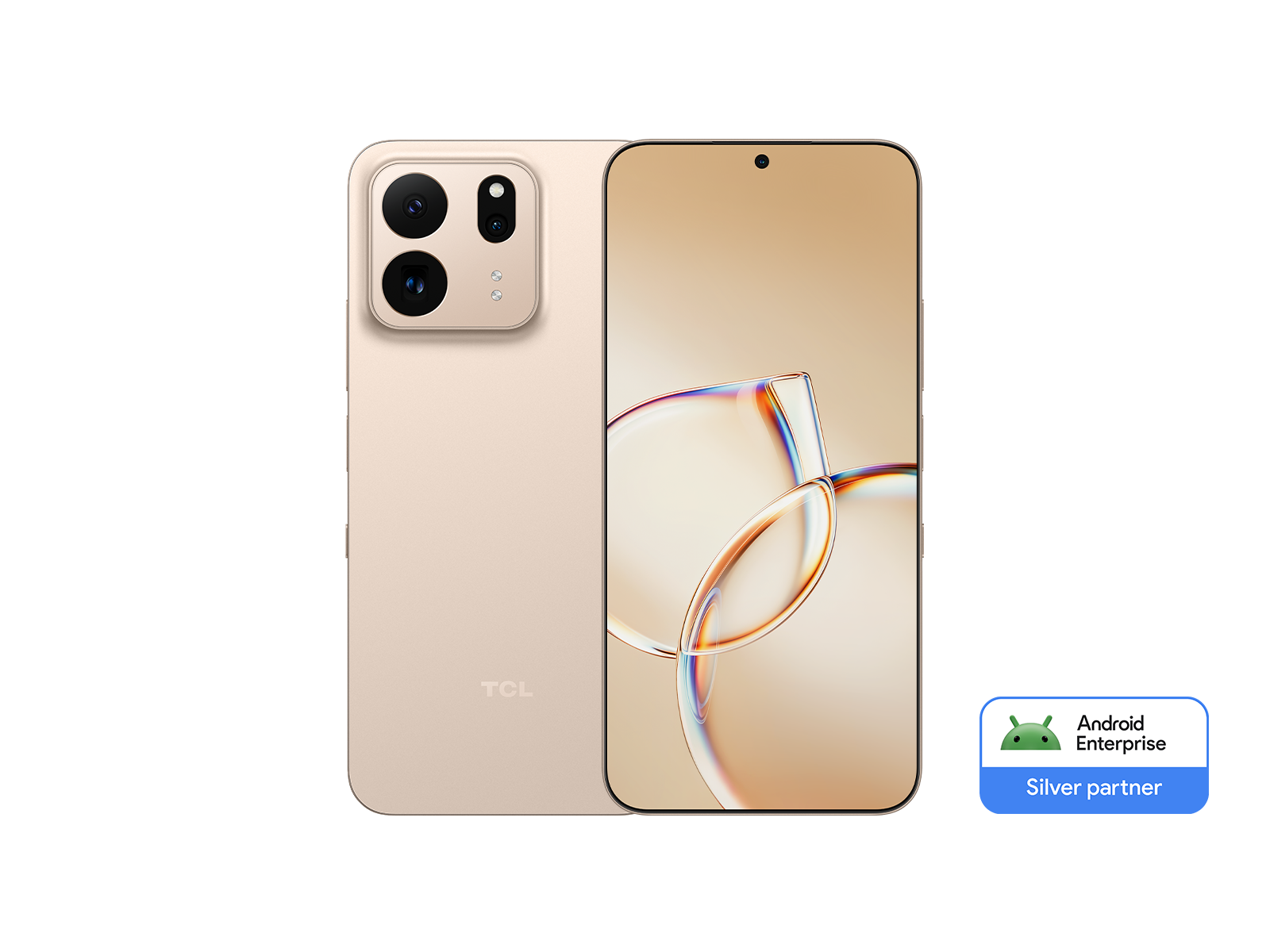
TCL has introduced a new smartphone line, the P80 Series, alongside IFA 2026 in Berlin. For the first time, the company pairs NXTPAPER, the eye-friendly display technology it has developed over several years, with an AMOLED panel on the two higher-end models. The flagship P80 Ultra adds a telephoto camera with 3x optical zoom, and it is already on sale in Europe from 549 euros.
A technology built on LCD finally moves to AMOLED
NXTPAPER is TCL's display technology for cutting glare and blue light so a screen reads more like paper. Until now it was designed around LCD panels, but the P80 Ultra and P80 Pro place it on top of an OLED panel instead. The idea is to keep the deep blacks and color response of AMOLED while killing reflections at the surface.
The panel itself is shared across all three models: a 6.83-inch 1.5K display (2772 x 1280), a 120Hz refresh rate, and peak brightness of 3200 nits. The standard P80 uses a conventional AMOLED screen, while the Pro and Ultra add the NXTPAPER layer. Both of those models also get a physical key on the side of the chassis for switching display modes, so moving between the normal view and the paper-like view takes one press.
TCL went further on the Ultra, which uses Nano Crystal Shield Glass to suppress reflections. Its polarizing filter is circular rather than linear, so the screen stays readable through polarized sunglasses. The company says harmful blue light is reduced to as little as 2.9 percent.
Only the Ultra gets a telephoto lens
The clearest difference across the series is the camera. The P80 Ultra carries three rear cameras: a 50MP main camera with a 1/1.56-inch sensor, a 50MP telephoto camera with optical image stabilization, and an 8MP ultra-wide camera with autofocus. The telephoto offers 3x optical zoom and reaches 6x without losing detail.
The P80 Pro shares the main and ultra-wide cameras with the Ultra but drops the telephoto, leaving a dual setup. The standard P80 uses the same two cameras and is positioned around a slim body and everyday use. All three models share a 32MP front camera.
Inside, the Ultra runs on MediaTek's Dimensity 7400 Elite. It is paired with 8GB of LPDDR5 memory and either 256GB or 512GB of UFS 3.1 storage. The battery is rated at 5,800mAh with 45W wired charging. The phone carries an IP68 rating for dust and water resistance and has also passed MIL-STD 810H durability testing.
Max Ink mode lasts up to 7 days, and an assistant watches your posture
Switching to the paper-like view is not the only change; Max Ink mode also changes how the battery behaves. In this mode, notifications other than calls and messages are suppressed and background apps are put to sleep. TCL says the phone can run for up to 7 days in this state. In practice it means one device can serve as a reading tool on some days and a normal smartphone on others.
There is reading material to go with it. The Ultra ships with more than 500 books preloaded, and an AI feature converts book content into audiobooks or podcast-style audio, giving you a way to rest your eyes and listen instead.
The other notable addition is an assistant that watches how you use your eyes. It warns you when your face is too close to the screen, when your posture slips, when the brightness is too high or too low, and when it is time for a break. Rather than relying on display hardware alone, TCL is also stepping into how the device is used.
The software commitment has been spelled out as well: 4 major OS upgrades and 7 years of security updates, which is on the long side for this price bracket.
Pricing and availability
The P80 Ultra comes in Midnight Blue, Burgundy, and Sunlit Gold. The 256GB model is priced at 549 euros (about 99,000 yen) and the 512GB model at 599 euros (about 108,000 yen), and both are already on sale in Europe. Depending on the market, a matching case and a charger are included in the box.
1 EUR = 181 JPY (as of September 5, 2026)
Connectivity covers Wi-Fi 6, Bluetooth 5.4, and eSIM, and the stereo speakers support DTS surround processing. Availability in Japan has not been announced as of this writing. TCL notes that configurations, colors, pricing, and availability vary by market and sales channel.
Summary
The core of the P80 Series is moving a glare-reducing display technology onto OLED. Being able to switch a single panel between 3200 nits of brightness and a calm, paper-like reading view is an easy value to grasp, and it sits on a different axis from the usual spec race. Given a 549 euro starting price, the telephoto-equipped Ultra lands in a realistic spot within the mid-range. What remains is to see, on real hardware, how far AMOLED color and a paper-like finish can genuinely coexist.