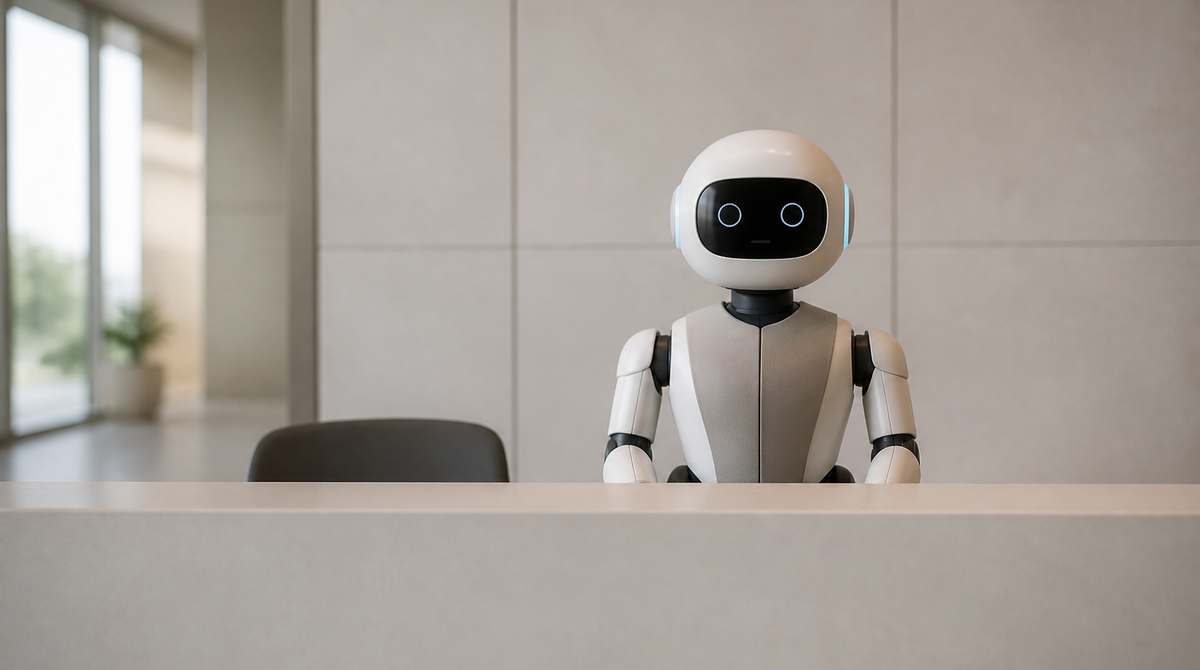
The more AI moves into customer service, the more people shift toward a way of speaking that machines can parse easily. A research team led by the University of Birmingham has named the result robotoid humanness, a state in which humans pick up machine-like behaviour through mutual imitation, and has raised the issue in the journal AI & SOCIETY.
People Learn the Way of Speaking That Works on AI
When humans interact, they unconsciously trace each other's expressions and speech patterns, a phenomenon known as mirroring. What caught the researchers' attention is that this instinct fires even when the counterpart is a robot.
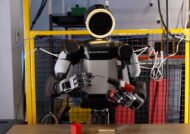
Customer service robots in retail, hospitality, tourism and healthcare are designed to imitate gestures, speech and emotional cues in a human-like way. The goal is to build trust and keep the conversation going. But users exposed to that human likeness return the robot's phrasing through the same instinct.
There is also a difference from a flesh-and-blood counterpart: AI responses are clear and consistent. Adapting to them is far easier than adapting to unpredictable human feedback. Once someone learns which phrasing gets the intent across, they start choosing the wording that draws the best response from the AI. Dr Inci Toral-Manson, Associate Professor of Marketing at Birmingham Business School, explains that dealing with anthropomorphised robots creates a bidirectional influence in which robots become more like people and people become more like robots.
The Framework Called Robotoid Humanness
What the team put forward is a framework for organising how human-robot interaction affects self-perception. Its elements are the service setting, the expectations the user brings, the robot's appearance and speech, and the commitments made by both the user and the robot.
That last element, the space between one party's action and the other's, is where the argument centres. Dr Selcen Ozturkcan, Associate Professor of Business Administration at Linnaeus University, notes that the consumer acts, the robot responds, and with repetition the consumer internalises the exchange. Machine learning adjusts robot behaviour based on user input, so the mimicry grows more precise and the loop turns more easily.
Self-Image May Be Rewritten Too
What the study warns about is that this imitation does not stop at word choice. Repeated exchanges shape user identity, and continued exposure to algorithmically driven feedback can produce distortions such as confirmation bias.
The effect varies by individual, depending on technological readiness, cultural background and personality traits. The sharpest concern is the case where someone outsources validation of their own worth to a robot. Repeated positive reinforcement can raise confidence, while a run of negative cues erodes self-esteem. Given that the counterpart is a system designed for commercial purposes, that asymmetry is hard to ignore.
A Design Problem for Companies
The paper was published open access in AI & SOCIETY on August 19, 2026, with authors based at the University of Birmingham, Aarhus University in Denmark and Linnaeus University in Sweden. It is written from a marketing and business administration perspective, which makes it less a critique for its own sake than a prompt aimed at the practice of service design.
Dr Jean-Paul Jde Cros Peronard, Associate Professor at Aarhus University, concludes that now robots and AI are commonplace in customer service, companies need to understand how people interact with them in order to use the technology effectively while staying ethical. Put another way, watching only satisfaction scores and resolution rates will never surface this kind of effect in the metrics.
I noticed the same thing in myself: with a chatbot I have developed a habit of cutting sentences short and stripping out anything decorative. Efficient, no doubt. But if that is bleeding into conversations with people, the story changes somewhat.
Summary
Dialogue with AI is not one-directional; it acts on the way people speak and on how they see themselves. The research team calls this robotoid humanness and argues that the imitation loop can reach as far as user identity and self-esteem. For companies weighing a customer service AI deployment, it reads as a reminder that some territory lies beyond what service quality metrics can capture.