NVIDIA and LG Group have announced that they are building an AI factory together to accelerate LG's next wave of AI-driven businesses, spanning robotics, autonomous driving, data centers and GPU cloud services[1]. By combining NVIDIA's full-stack AI factory platform with LG's global strengths in home appliances, robots and automotive components, the two companies are connecting everything from AI model development to physical AI data generation, robot simulation and edge deployment into a single workflow[1].
The "AI Factory" at the Center of the Collaboration
At the heart of this collaboration is the "AI factory"[1]. It refers to the high-performance accelerated computing infrastructure used to train, simulate, validate and deploy AI-powered applications[1]. NVIDIA says it will integrate AI model development, data generation for physical AI, robot simulation and training, edge deployment, and factory-scale digital twins (technology that recreates the real world in a virtual space) into one continuous workflow[1]. LG brings a broad range of businesses — home appliances, robots, mobility components, smart spaces and data center technologies — with the aim of bringing AI to each of these front lines[1].
Expanding into Physical AI and Robotics
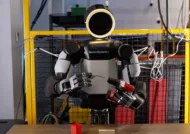
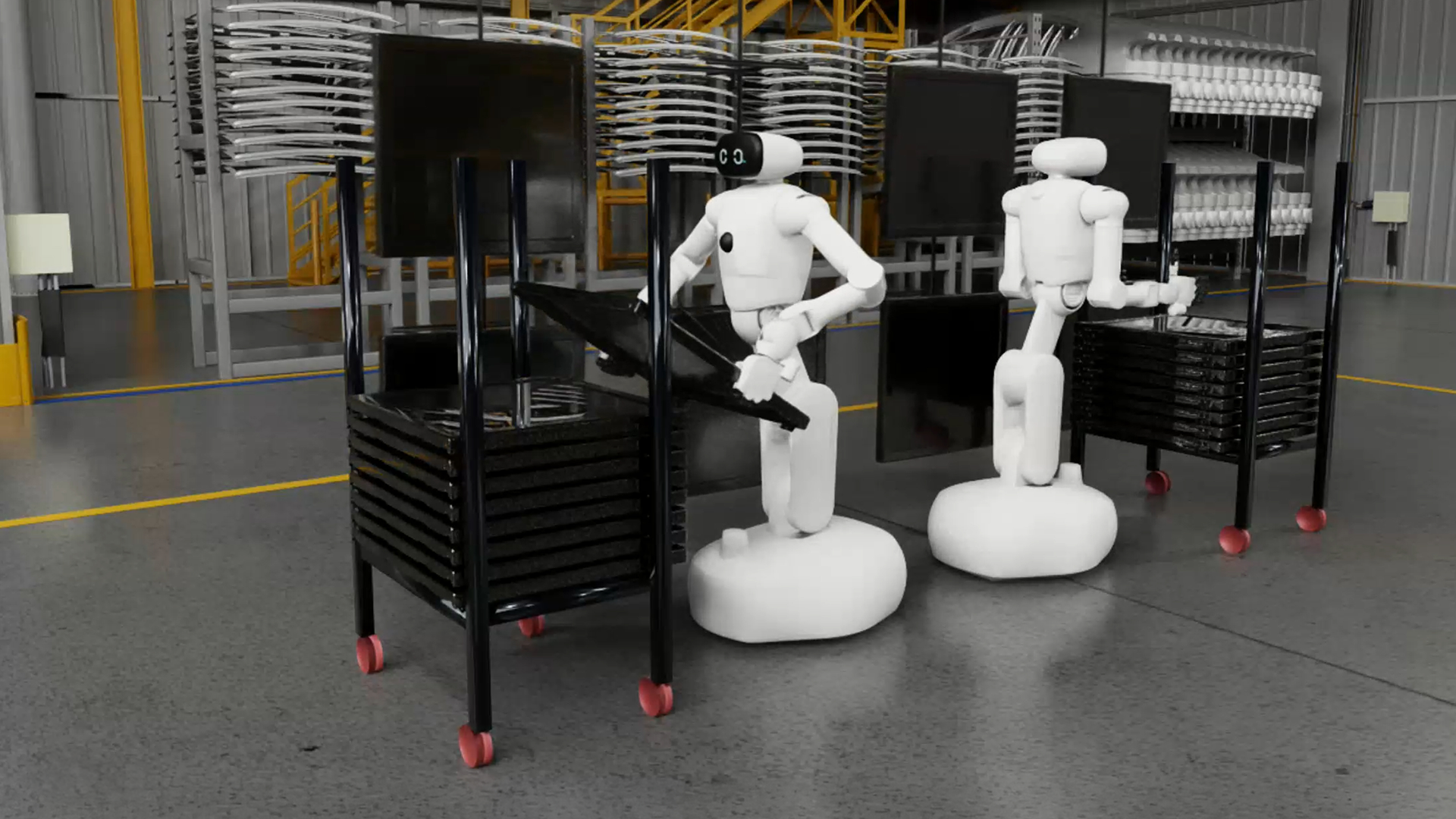
LG Electronics is developing home robots such as CLoiD, designed to help with a wide range of indoor household tasks[1]. By adopting NVIDIA's robot development frameworks Isaac Sim and Isaac Lab, the company can simulate, train and validate household collaborative robots (cobots) in physically accurate virtual environments before deployment[1]. It is also exploring the use of Isaac GR00T, a reasoning vision-language-action model, to give its robots humanlike reasoning and the ability to carry out complex tasks[1]. The two companies plan to jointly develop reference robots and position LG's robots within the Isaac GR00T ecosystem[1].
They are also tackling the shortage of training data that has long been a barrier to robot development[1]. LG Electronics is building a "physical AI data factory" that turns computing power into data, supplying high-quality training data for robotics and industrial AI[1]. Here it uses NVIDIA's Cosmos world foundation models to generate and augment synthetic data[1]. LG Innotek, drawing on its strength in optical technology, plans to provide robot components including sensing solutions, optimized for NVIDIA's development environments and GPU architecture[1]. LG CNS is building a framework that lets anyone adopt AI robots on manufacturing and logistics floors, incorporating the Isaac frameworks, the open Cosmos world models and Isaac GR00T into its PhysicalWorks industrial robot platform[1].
Smart Factories and Next-Generation AI Infrastructure
AI in manufacturing is another pillar[1]. By combining the manufacturing data LG has accumulated at production sites worldwide with NVIDIA's AI infrastructure and digital twin technologies, the companies aim to build an autonomous manufacturing ecosystem that connects everything from raw material procurement to production, logistics and delivery to customers in real time through data and AI[1]. They want to establish this as a new global smart factory standard[1].
Work on the foundations of the AI factory itself is also moving forward[1]. LG Electronics has been pursuing certification cooperation with NVIDIA on cooling distribution units (CDUs) and cold plates that manage heat in AI factories, and is now moving into prefabricated modular design technologies[1]. By aligning with NVIDIA's AI factory platform "NVIDIA DSX," it aims to rapidly deploy scalable, high-performance infrastructure[1]. LG Uplus, the group's telecommunications arm, is teaming up with LG Electronics and LG Energy Solution to build power-efficient AI factories based on NVIDIA DSX and large-scale AI data centers that can house the latest GPUs[1]. LG Energy Solution will work with NVIDIA on 800-volt direct-current power delivery for data centers to support next-generation GPUs[1].
Autonomous Driving and Mobility AI
In mobility, LG Electronics will align its advanced driver-assistance systems (ADAS) and in-vehicle AI with NVIDIA's automotive platform "NVIDIA DRIVE"[1]. By aligning its sensor, compute and software configurations with the "DRIVE Hyperion" architecture, it will support a roadmap toward autonomous driving, ADAS and software-defined vehicles (SDVs)[1]. For future mobility applications, it plans to adopt the in-vehicle compute platform "NVIDIA DRIVE AGX" for AI-powered cockpits and edge AI processing[1]. LG Innotek will also cooperate on next-generation components designed specifically for NVIDIA architecture, centered on its core sensing, connectivity and lighting parts[1].
Strengthening the Sovereign AI "EXAONE"
NVIDIA and LG AI Research are also collaborating to strengthen EXAONE, one of Korea's leading sovereign AI (AI developed and operated domestically) models[1]. EXAONE is an open model family available to developers, enterprises and researchers[1]. LG AI Research says it used NVIDIA's Blackwell-generation GPUs, the NeMo framework and the open Nemotron datasets for model development, and TensorRT-LLM to build optimized inference engines[1]. Through services such as ChatEXAONE, an in-house chatbot built on EXAONE, LG Group is working to expand the adoption of EXAONE and agentic AI across its various businesses[1].
Summary
This announcement marks a push to spread AI across LG Group's wide-ranging businesses — home appliances, robots, mobility, energy and materials — with NVIDIA's AI infrastructure at its core. What stands out is how it advances AI that acts on the physical world all at once, from familiar areas such as home robots and autonomous driving to foundational layers such as smart factories and data centers. Together with the strengthening of Korea's sovereign AI "EXAONE," the way well-known companies are tying AI to concrete products makes this worth watching as physical AI moves further toward practical use.
Source: https://blogs.nvidia.com/blog/nvidia-and-lg-group-ai-factory/