NVIDIA has laid out its case for moving AI factory power delivery to 800 volts direct current (800 VDC)[1]. The company argues the bottleneck is not raw wattage but the path electricity takes from the grid to the GPU. An MGX-compatible power rack that drops into existing AC facilities arrives in the second half of 2026, followed by a staged roadmap that scales to the row and then the whole facility[1].
Multiple AC Conversions Are Eating Into Available Power
In traditional power delivery, electricity arrives from the grid as alternating current (AC) and is converted several times before it reaches the rack. Every conversion adds overhead and complexity, and that penalty grows as racks get denser[1]. At the power levels next-generation AI compute demands, even small inefficiencies compound quickly[1].
800 VDC shortens that path. Distributing power at higher voltage as direct current leaves fewer conversion stages between the grid and the accelerator, so more of the available power actually reaches the compute[1]. NVIDIA says the approach substantially cuts current, copper usage and cable bulk compared with rack-level 54 VDC systems and facility-level 480 volts alternating current (480 VAC)[2]. Switchgear, distribution boards and busways also become more compact, reducing both floor space and complexity[2].
The migration path itself is handled by NVIDIA DSX reference designs, which map the route from today's AC infrastructure through hybrid architectures and into fully native 800 VDC facilities[1].
No Changes to the Building's Electrical System
Most AI factories running today were designed around AC distribution[1]. The bridge is the MGX-compatible 800 VDC power rack arriving in the second half of 2026[1].
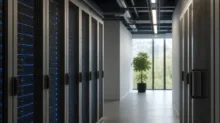
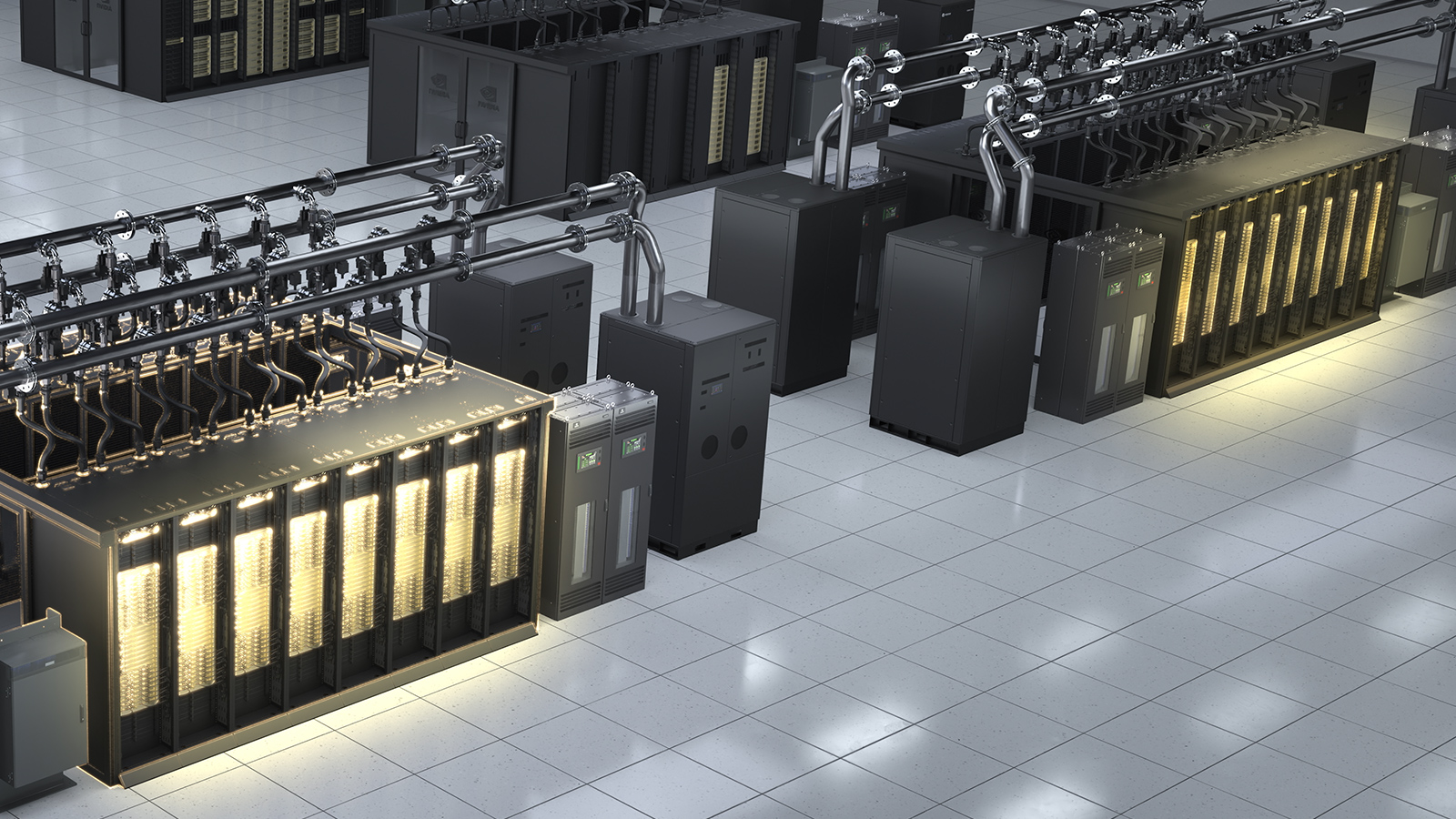
The rack is designed to slot into existing AC infrastructure and deliver 800 VDC to compute racks within the same row, with no changes required to the building's electrical system[1]. In practice, that means next-generation rack-scale performance can be retrofitted into facilities that are already built and operational.
Vladimir Troy, vice president of data center infrastructure at NVIDIA, said 800 VDC unlocks the compute performance and power density required for AI at scale, and that NVIDIA is working through OCP with more than 80 ecosystem companies to give AI factories a practical path forward rather than a future vision[1].
For site owners, the point is that prior investment does not become stranded. Land, power rights and building infrastructure are all preserved while compute density goes up[1].
Power Rack, Row Power Center, DC Power Block
800 VDC offers on-ramps at every stage of growth[1].
Most operators will start with the power rack, a near-term option compatible with hybrid architectures and a first step toward higher density[1].
For operators building dedicated AI factory environments, the row power center is a centralized power station serving a full rack row. It uses an overhead 800 VDC busway to scale distribution across multiple rack rows and supports up to 2 megawatts per row, with availability expected in 2027[1].
For new facilities being designed, the DC power block is a facility-scale unit that converts grid power directly to 800 VDC in a single step, enabling direct medium-voltage conversion at massive scale. NVIDIA positions it as the architecture for AI infrastructure being planned for the decade ahead[1].
An Open Standard Built a Supply Chain of 80-Plus Companies
The 800 VDC specification was not written by NVIDIA alone. NVIDIA, Google and Microsoft developed it jointly through the Open Compute Project (OCP), publishing a joint white paper in March 2026 and the LVDC Solid-State Transformer Specification v0.3 in July 2026[1].
The specifications define common interfaces so power hardware from different vendors can operate together inside the same 800 VDC facility[1]. More than 80 equipment manufacturers and infrastructure companies are already building to those specifications, and a supply chain is forming around the open standard[1]. NVIDIA lists partners including ABB, Eaton, Schneider Electric, Siemens, Hitachi Energy, Vertiv, Delta, Infineon Technologies, Texas Instruments, Renesas, ROHM and Mitsubishi Electric, spanning power semiconductors through substation equipment[2].
These building blocks are captured in NVIDIA DSX reference designs, a system-level blueprint connecting power architecture, rack-scale computing and facility infrastructure[1].
The investment backdrop is large. Wood Mackenzie projects 9 trillion USD (about 1,420 trillion yen) in global AI and data infrastructure investment through 2040[1]. NVIDIA's view is that the facilities able to absorb that investment will be the ones that resolved their power architecture before compute demand outran what their infrastructure could deliver[1].
※1 USD = 158 JPY (as of August 2026)
Summary
NVIDIA is moving AI factory power delivery toward 800 VDC, starting with an MGX-compatible power rack that slots into existing AC facilities in the second half of 2026. A row power center supporting up to 2 megawatts per row follows in 2027, with the facility-scale DC power block after that. The specification is an open standard developed with Google and Microsoft through OCP, and more than 80 manufacturers are building compatible products. For sites already in operation, the ability to raise density without touching the building's electrical system is the practical draw.
Source [1]: https://blogs.nvidia.com/blog/800-vdc-power-architecture-ai-factory/
Source [2]: https://www.nvidia.com/en-us/data-center/technologies/800-vdc-architecture/