
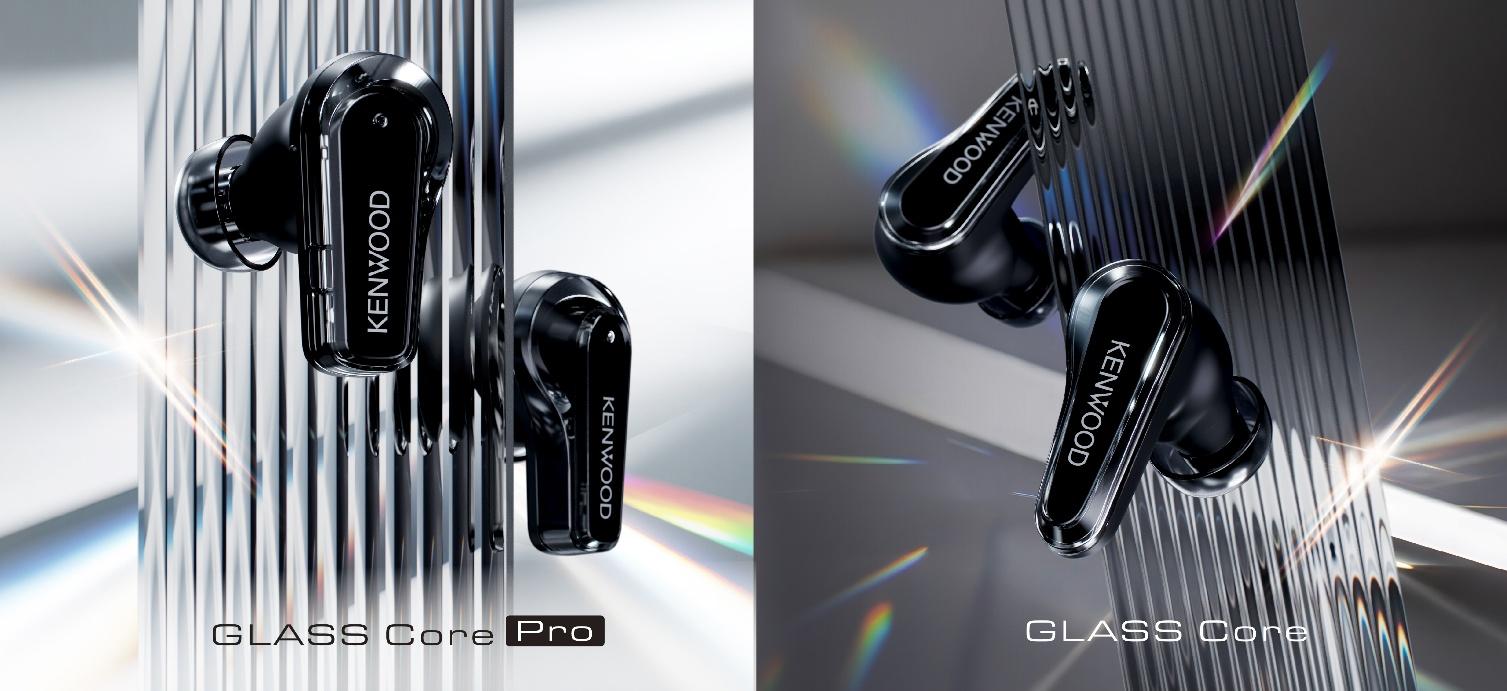
JVCKENWOOD will release two KENWOOD-brand true wireless earbuds, the GLASS Core Pro and the GLASS Core, in late June. Their defining feature is a glass diaphragm — an industry first for true wireless earbuds — and the pair serves as the first models in an anniversary lineup marking a KENWOOD brand milestone. The higher-end Pro pairs a 10 mm glass diaphragm with a MEMS driver and sells for around 49,900 yen, while the standard GLASS Core comes in at around 27,800 yen. Here is how the two models differ and what they offer.
An industry first: glass at the point where sound is made
Earbud sound is created by a thin membrane, the diaphragm, that vibrates the air. The GLASS Core series is the first true wireless earbud lineup to use glass for this diaphragm. Glass is hard and resists unwanted internal resonance, so the membrane itself stays free of extra vibration. That helps keep the outline of the sound crisp and convey detail faithfully from the low end to the high end.
The series name, GLASS Core, reflects how this choice of material sits at the very heart of the product. The design shows off translucent glass panels, signaling the technology inside through the way the earbuds look.
The flagship GLASS Core Pro is tuned with a two-way setup
The GLASS Core Pro (model KH-CRZ100T) combines a 10 mm glass diaphragm with a MEMS driver (an ultra-compact speaker made using semiconductor manufacturing techniques) to handle the highs, forming a two-way configuration. Each driver is powered by its own amplifier in a bi-amp design, aiming for fine detail and a spacious soundstage.
Its noise cancelling (a function that cancels out surrounding noise) is billed as world-class, making it easy to focus on music even where train or street noise is loud. The Pro also adds two Pro-only features: Exofield, which recreates the sense of space of listening to speakers in a room, and K2 Technology, which restores and extends high frequencies that tend to be lost through compression. Playback time totals 49 hours with the charging case. The price is around 49,900 yen.

Amazon.co.jp でチェック
JVCケンウッド KENWOOD GLASS Core Pro ワイヤレスイヤホン Bluetooth Ver.6.0 ノイズキャンセリング マイク付き ハイレゾ マルチポイント アプリ対応 低遅延 LDAC対応 合計49時間再生
The standard GLASS Core covers the essentials
The GLASS Core inherits the series' core glass diaphragm while keeping the price down as the standard model. It includes noise cancelling and supports LDAC (a codec that helps preserve high sound quality over a wireless connection) to deliver high-resolution-class detail. Playback time totals 44 hours with the charging case, leaving plenty of headroom and coming close to the Pro.
At around 27,800 yen, it suits anyone who wants an affordable first taste of the glass-diaphragm sound. For listeners who do not need the Pro's two-way setup or world-class noise cancelling but still want the series' signature, it lands as a well-judged option.

Amazon.co.jp でチェック
JVCケンウッド KENWOOD GLASS Core ワイヤレスイヤホン Bluetooth Ver.6.0 ノイズキャンセリング マイク付き ハイレゾ マルチポイント アプリ対応 低遅延 LDAC対応 合計44時間再生
Both models support the latest Bluetooth 6.0 standard. Multipoint lets you connect to two devices at once, such as a smartphone and a PC, and switch between them; a low-latency mode reduces audio lag in video and games; and a dedicated app handles fine adjustments — covering everyday usability across the board. Both models also share LDAC support, so you can enjoy detail-rich sound even over a wireless connection.
The GLASS Core series is part of the anniversary activities JVCKENWOOD is running under the "JVCKENWOOD Anniversary" banner, positioned as the first models marking the 80th anniversary of the KENWOOD brand. The glossy bodies paired with glass panels give the series a fittingly symbolic look for the milestone.
Summary
KENWOOD's GLASS Core Pro and GLASS Core are anniversary models and the first true wireless earbuds to adopt a glass diaphragm. The flagship Pro adds world-class noise cancelling, Exofield, and K2 Technology to a two-way setup of a 10 mm glass diaphragm and a MEMS driver for around 49,900 yen, while the standard GLASS Core covers the essentials for around 27,800 yen — letting you choose based on the balance between sound ambition and price. Both go on sale in late June, and the question now is just how far that distinctive glass sound will carry.