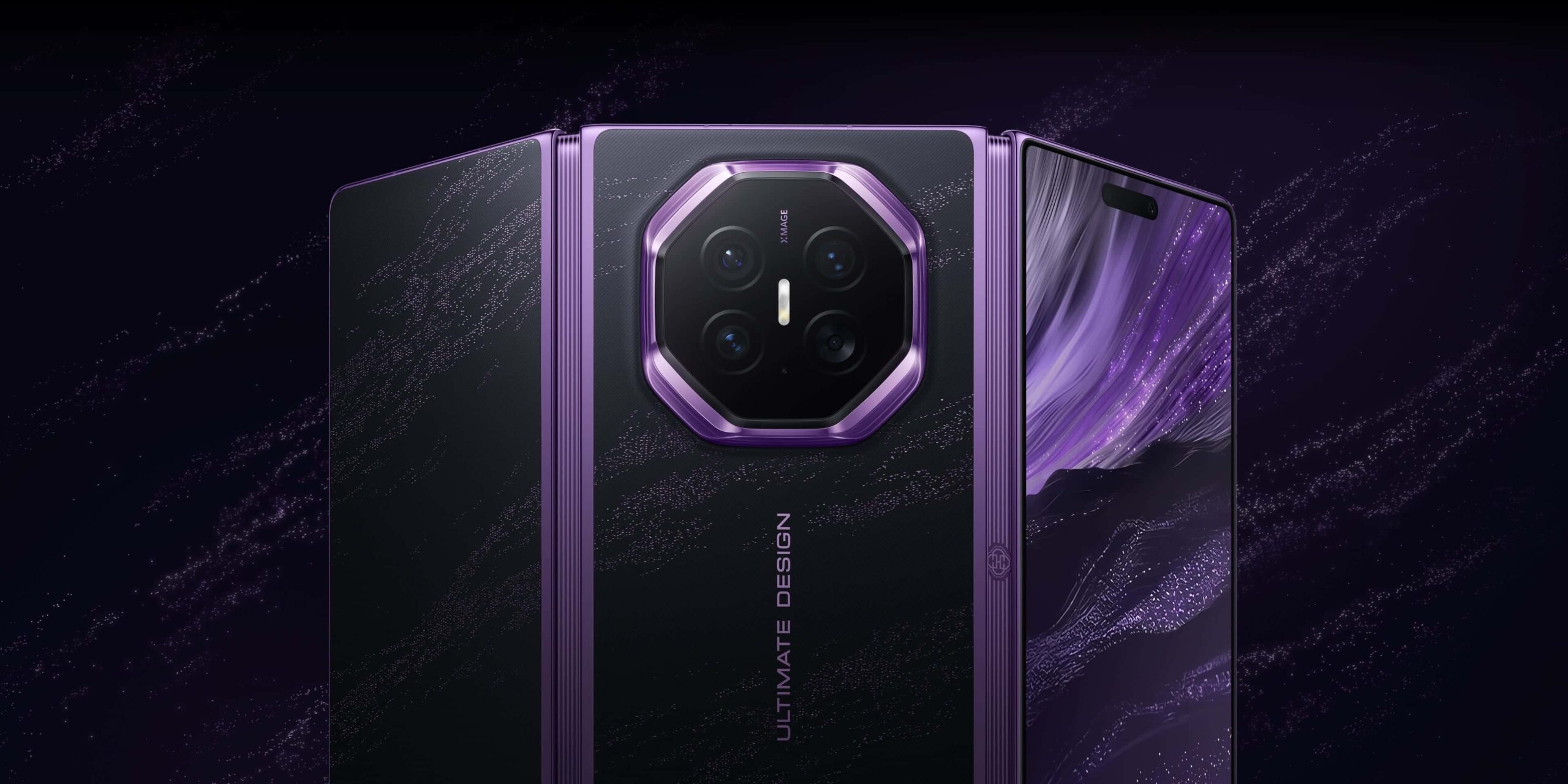
Huawei has announced the HUAWEI Mate XT 2 Ultimate Design, the second generation of its tri-fold smartphone. The folding mechanism now tucks the flexible panel inside the body, and the inner display carries a hardware-level system for blocking prying eyes. Chinese pricing starts at 19,999 yuan (about 470,000 yen), with sales beginning on September 12 at 10:08 a.m.
A New Wing-Spread Structure That Folds Inward
The original Mate XT left one of its three panels facing outward when closed. The Mate XT 2 adopts what Huawei calls a wing-spread structure, so the entire flexible panel sits on the inside of the body when folded. Keeping the fragile inner screen out of contact with the world while the phone is in a pocket is a straightforward improvement.
The body measures 157.2 mm long. Width is 77 mm folded and 219.2 mm when opened into three panels. Thickness is 12.3 mm folded, thinning to 3.5 mm in the area without cameras when fully opened. Weight is about 299 grams including the battery, or about 304 grams counting the screen surface layer.
Durability figures have been reworked as well. The exterior uses Basalt Kunlun Glass, which Huawei says is 30 times more drop resistant than the previous generation. The inner panel uses a multi-layer composite with an ultra-thin high-strength steel buffer layer, raising impact resistance by 200 percent. The second-generation Tiangong hinge uses a gearless linkage mechanism that Huawei says improves impact resistance by 90 percent. The phone carries both IP58 and IP59 dust and water ratings.
The Lingdun Display Blocks Side Viewing at the Pixel Level
The standout feature is the privacy display Huawei calls Lingdun. Rather than applying a film, the panel holds separate wide-angle and narrow-angle pixels, and the narrow-angle set takes over when privacy mode is switched on. Resolution stays identical before and after the switch, so the view from directly in front does not degrade.
Privacy mode can be toggled from the outer display or from the smart control key on the side of the body. Huawei also offers an automatic prompt when you enter an airport or train station, and per-app settings that turn privacy mode on for chosen apps. Huawei notes that the bottom of the phone, on the USB port side, is not covered by the privacy effect.
The display itself measures 6.5 inches folded and 10.2 inches open. Resolution is 2,442 by 1,140 folded and 2,232 by 3,184 open, at 412 ppi outside and 382 ppi inside. The outer panel runs LTPO from 1 to 120 Hz. The inner panel runs 1 to 90 Hz on the standard model and 1 to 120 Hz on the Lingdun version, an unusual arrangement in which the privacy-equipped variant also gets the higher refresh rate.
On the health side, opening the screen and gripping both side frames with each hand records an ECG reading over 30 seconds. The ECG analysis software has been granted a Class II medical device registration certificate by China's National Medical Products Administration, and Huawei's Celia assistant supplies an interpretation and report after each measurement.
Kirin 9050 Pro and the Third-Generation Red Maple Camera
The processor is the Kirin 9050 Pro, making its debut in the Mate XT 2. Huawei claims a 42 percent gain in overall device performance over the previous Mate XTs, with hardware acceleration for real-time ray tracing at a scale of 50 million lines. The operating system is HarmonyOS 7.0, also debuting here.
Every configuration ships with 16 GB of memory. Storage comes in 256 GB, 512 GB and 1 TB, while the Lingdun display model is 1 TB only and the stylus bundle is 2 TB only. The battery is rated at 5,600 mAh typical, with 66 W wired charging, 50 W wireless charging and reverse wireless charging.
The rear camera system has four lenses. The first three are a 50 MP main sensor with a continuously variable aperture from F1.49 to F4.0, a 40 MP ultra-wide, and a 50 MP periscope telephoto. All use RYYB sensors, and optical zoom reaches 3.5x. The fourth is the third-generation Red Maple color camera, debuting here, which filters stray infrared light and improves color reproduction by 95 percent over the previous generation. Huawei also cites an 18 EV dynamic range.
For connectivity, the phone supports Tiantong satellite calling, Beidou satellite messaging and satellite paging for areas beyond terrestrial coverage. Wi-Fi 7, Bluetooth 6.0 and eSIM are also on board.
Pricing and Availability
In China, 16 GB plus 256 GB costs 19,999 yuan (about 470,000 yen), 16 GB plus 512 GB costs 21,999 yuan (about 520,000 yen), and 16 GB plus 1 TB costs 23,999 yuan (about 560,000 yen). The 1 TB model with the Lingdun display is 24,999 yuan (about 590,000 yen), and the 2 TB model bundled with the stylus set is 29,999 yuan (about 700,000 yen).
*1 CNY = 23.5 JPY
Colors are Brocade Purple, Obsidian Black and Bright White. Sales in China begin on September 12 at 10:08 a.m., and no availability outside China, including Japan, has been announced. Given that the original Mate XT also launched in China first, any move abroad looks some way off.
At roughly half a million yen, this is closer to buying a portable 10.2-inch device than a phone. Solving the privacy problem through pixel design rather than software feels specific to a device whose owner will be unfolding a large screen in public.
Summary
The Mate XT 2 is a second-generation tri-fold built around two changes: a wing-spread structure that folds the panel inward, and the Lingdun display that blocks side viewing at the pixel level. It debuts the Kirin 9050 Pro and HarmonyOS 7.0, and adds IP58 and IP59 ratings along with a 5,600 mAh battery. Pricing starts at 19,999 yuan, with Chinese sales beginning September 12.