Flipper Devices, the company behind the Flipper Zero multi-tool popular with hackers and tinkerers, has announced a new productivity gadget called the BUSY Bar. It shows a "busy" status to the people around you on a dot-matrix LED display and helps you stay focused with a Pomodoro timer and the ability to block phone apps. The device costs 249 USD (about 40,000 yen) at retail, with the first 3,000 units offered at 199 USD (about 32,000 yen). Shipping is set to begin on July 14.
After the multi-tool, a focus on focus
Flipper Devices is known for the Flipper Zero, a handheld tool that can work with Bluetooth, RFID, NFC, and sub-1GHz radio signals all in one. The BUSY Bar moves away from that hacker-oriented lineage and instead targets concentration during remote work and desk work. The product was first teased a year ago, and it has now finally moved to an open sale.
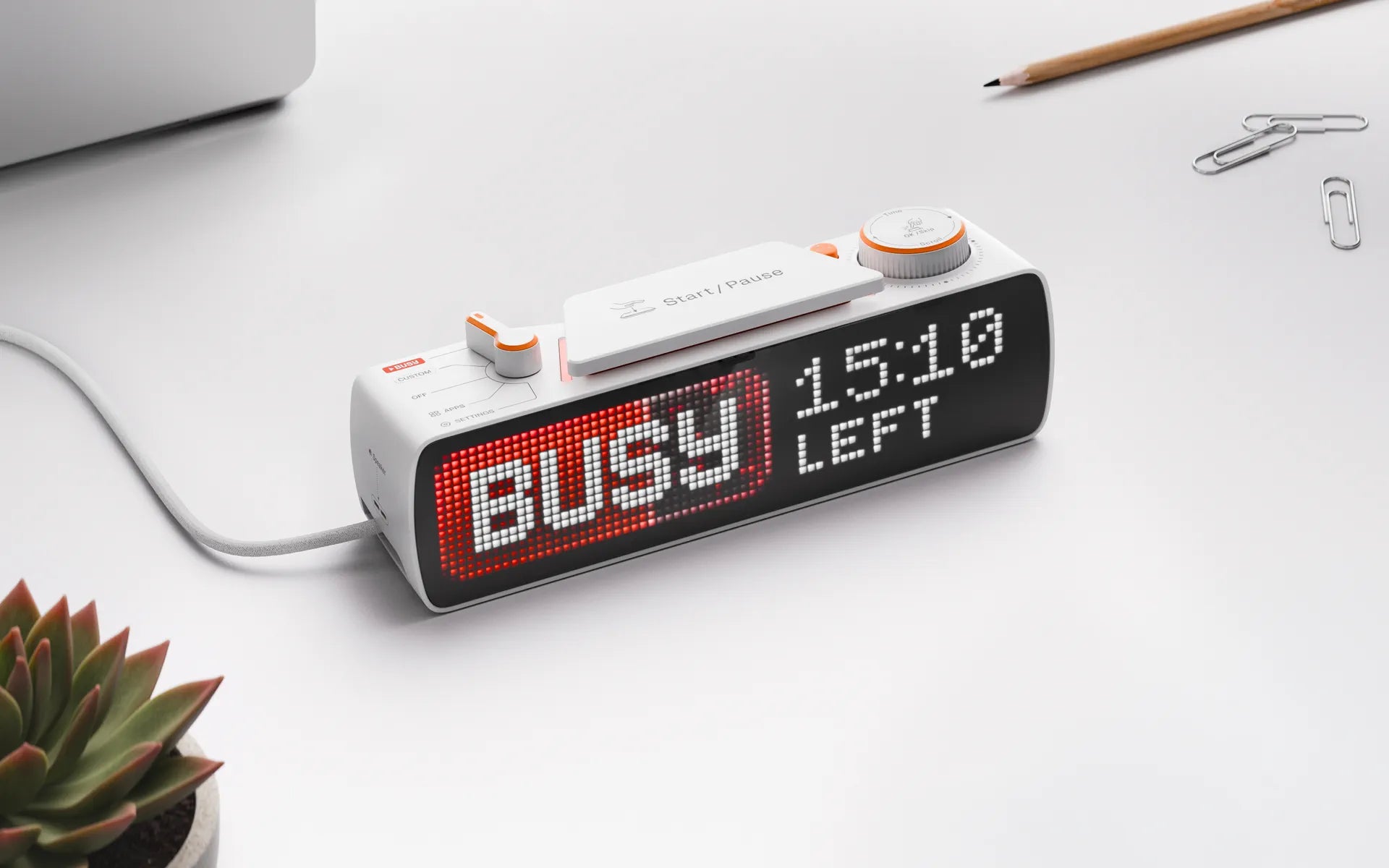
Its shape resembles a wide desk clock lined with knobs and buttons. The company has concentrated the display and controls on the unit itself, emphasizing that it can be used on its own without connecting to a PC or smartphone.
The front carries a 72×16 RGB LED matrix (a panel that forms text and images out of fine dots). It can show 16 million colors at up to 400 nits, and a built-in light sensor automatically adjusts the brightness to the surroundings so the display stays readable in both bright and dim rooms.
The back has a 160×80 monochrome OLED that mirrors what is shown on the front. This lets you check the status and operate the device from your side even when the main display is facing away from you. A small speaker on the side plays notification sounds.
Operation centers on physical parts. There is a start/stop button, a selector for switching among four working modes, a scroll wheel for setting time and navigating menus, and a back button, all sized so you can use them without looking. For connectivity it supports Wi-Fi 6 and Bluetooth Low Energy 5.4, and it uses USB Type-C for charging and PC connection. The 3,250mAh battery is rated for up to 8 hours of active status or up to 2 weeks on standby, and a 15W charger fills it in about an hour.
Pomodoro and a way to shut out distractions
At the heart of the BUSY Bar is its time-management feature. It includes a timer based on the Pomodoro technique, which repeats 25 minutes of work and 5 minutes of rest, so you can commit to a set block of focused time. The front LED can display a "busy" message and the remaining time, letting those around you know when you will be free again. That helps reduce interruptions even when family members or housemates are present during remote work.
A standout feature is its ability to suppress distracting notifications and apps. When paired with a free smartphone app, it can automatically mute notifications on your phone and PC during focus mode and prevent you from opening apps you have chosen in advance. It is designed to block time-sapping apps like Instagram and TikTok, and there is even a "hardcore mode" that fully locks apps until the session ends. In this mode you cannot unlock the apps until the focus time is over, and the only way to get out early is to reset the device, a fairly drastic design choice.
The PC integration is detailed as well. When your microphone becomes active, it automatically switches to an "on call" display, and when you launch streaming software such as OBS, a streaming indicator lights up. Windows and macOS are supported, and a Linux version is in the works.
Smart home links and a developer-friendly design
The BUSY Bar supports Matter, the common smart home standard developed mainly by Apple, Google, Amazon, and Samsung to connect devices across brands. Through it, the gadget can work with Apple Home and Google Home, so entering a focus state can trigger automations such as pausing music or changing the lighting. It can also connect with the open-source smart home platform Home Assistant via its HTTP API.
The developer-facing design is fitting for the company that created the Flipper Zero. The firmware is open source, and there are an HTTP API, MQTT support, and libraries for Python, JavaScript, and Go. With these, you can display your own widgets or show the status of an internal system on the LED. It supports connections over USB, LAN, and the cloud, and the company stresses a design free of vendor lock-in. Built-in apps include a clock, weather, and statistics for YouTube, Instagram, and TikTok, and third-party apps are supported too.
Price and availability
The BUSY Bar costs 249 USD (about 40,000 yen) at retail, while the first 3,000 people who sign up through the waitlist can buy it for 199 USD (about 32,000 yen). Shipping and sales start on July 14, with the United States, the European Union (EU), the United Kingdom, and Canada listed as the launch regions. The box includes the device and a 2-meter USB-C cable, and accessories such as a wall mount are planned to be sold separately.
One thing to note is that Japan is not among the launch regions announced so far. A waitlist sign-up on the official site is required to purchase, and the timing and price for a Japanese release have not been disclosed. It is not cheap for a single-purpose desk gadget, so opinions may differ depending on how far you want to physically cut off your distractions.
* Converted at 1 USD = 162 JPY (as of June 30, 2026)
Summary
The BUSY Bar is a desk gadget from Flipper Devices, known for the Flipper Zero, built around the themes of focus and desk work. Its dot-matrix LED tells the people around you that you are busy, while a Pomodoro timer and app blocking support deep concentration. It also offers smart home integration through Matter and developer-friendly extensibility through open APIs and libraries, carrying on the freewheeling, customizable spirit of the Flipper Zero. At the same time, the retail price of 249 USD is hard to call cheap, and with Japan absent from the initial launch regions, it will likely be a while before it is within reach here.