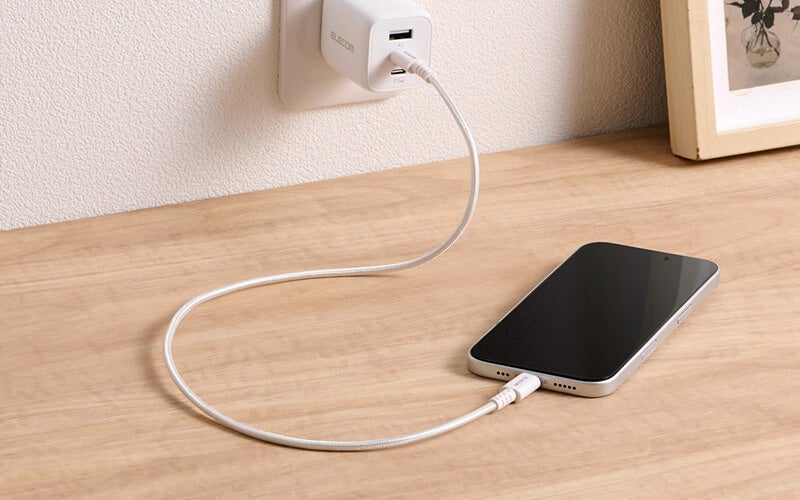
ELECOM will release two series of high-durability USB Type-C cables, eight items in total, from mid-July 2026[1]. One series supports up to 240W, the other up to 60W, and both carry official USB-IF certification. The focus is on the way cables actually fail: breakage near the plug, addressed here through both materials and structure[1][2].
Three structures aimed at the weakest point
What these cables sell is neither speed nor wattage, but endurance. ELECOM cites three structural measures against breakage[1][2].
The first is a high-density wiring structure. Increasing the density of the internal wiring strengthens resistance to repeated bending. The second is a nylon mesh outer jacket, which protects the cable surface from the scratches that come from bags and desk edges. The third is a long bush structure. The bush is the protective section joining the plug to the jacket, and making it longer than usual distributes the stress that tends to concentrate at the base of the plug[2].
When a cable dies, it is usually because the area right at the plug has been bent repeatedly until the internal wires fatigue. All three measures point at that single failure mode. The jacket also uses flame-retardant material, and the terminals use gold-plated pins to limit signal degradation[2].
Two series, eight items, split by power
The lineup divides by power delivery[1][2].
The higher-end MPA-CCPESCxxWH series supports USB Power Delivery EPR and delivers up to 240W (48V/5A). It carries a built-in eMarker that automatically adjusts voltage to the connected device. It has also passed the TDR compliance test defined in the USB specification, which ELECOM says keeps communication stable in noisy environments (measured and evaluated in-house)[2]. The 240W figure targets charging for high-performance laptops.
The standard MPA-CCSCxxWH series supports USB Power Delivery at up to 60W (20V/3A), enough for smartphones, tablets, and lower-power laptops.
Both series come in four lengths, roughly 0.5m, 1m, 1.5m, and 2m, in white only, for eight items in total[2]. Cable diameter runs from about 3.8mm to 4.4mm on the 240W series and about 3.5mm to 3.8mm on the 60W series, so the higher-end cable is slightly thicker. The connectors are printed with the supported wattage and transfer speed, which makes it harder to mix up several similar-looking cables[1][2].
Certification, and what the specification gives up
Both series are officially certified products under Certified Hi-Speed USB (USB2.0)[2]. USB-IF certification means a third party has verified that the cable is designed and built to specification, which serves as a guard against the overheating and unstable power delivery often seen in uncertified budget cables. For a product handling 240W, that verification carries weight.
The specification is deliberately limited elsewhere. Data transfer tops out at USB2.0 speeds of 480Mbps (theoretical), and DisplayPort Alternate Mode video output is not supported[2][3]. These cables are not for high-speed external SSDs or for driving a monitor over a single cable. They put charging first, with photo and video transfer as a secondary use.
On the environmental side, they are certified under ELECOM's own THINK ECOLOGY standard. Packaging consists only of paper, cardboard, and poly bags, and plastic weight has been cut by at least 20 percent versus the company's internal reference products. They also comply with the EU RoHS directive on restricted hazardous substances across 10 substances[2].
Pricing starts at 880 yen, scaled by length
Street prices run from 880 yen for the 0.5m 60W MPA-CCSCxxWH up to 1,180 yen for the 2m model, and from 1,280 yen for the 0.5m 240W MPA-CCPESCxxWH up to 1,880 yen for the 2m model[1]. Each additional 50cm adds roughly 100 to 200 yen, a straightforward structure. ELECOM's product pages separately list a standard price, quoted at 2,398 yen including tax for the 1.5m 240W model[3]. The warranty period is one year[3].
The gap between the 240W and 60W series is roughly 400 to 700 yen at the same length. If your charger and laptop do not support EPR, the 60W series is sufficient; if you expect to use higher-output equipment later, the upper series is the safer buy. At launch, Biccamera.com is carrying the roughly 1m model from both series[1].
Summary
ELECOM's new USB Type-C cables give up transfer speed and video output outright, and lean instead on resistance to breakage and on certification. The three measures, high-density wiring, nylon mesh, and a long bush, all target the place where cables actually break. Eight items across 240W and 60W in four lengths, priced from 880 to 1,880 yen. For anyone who keeps replacing the charging cable they plug in every day, this is a straightforward option.
出典:https://prtimes.jp/main/html/rd/p/000001470.000026881.html