Anthropic, the company behind the Claude AI models, is reportedly in early-stage talks with Samsung to manufacture its own dedicated AI chip. If it moves ahead, the chip could be built on Samsung's 2nm (nanometer, a measure of how fine the circuitry is) process, though its purpose and performance have not been settled yet. This article walks through what has been reported and the broader reasons AI companies are moving toward custom silicon.
What Was Reported: Still an Early-Stage Discussion
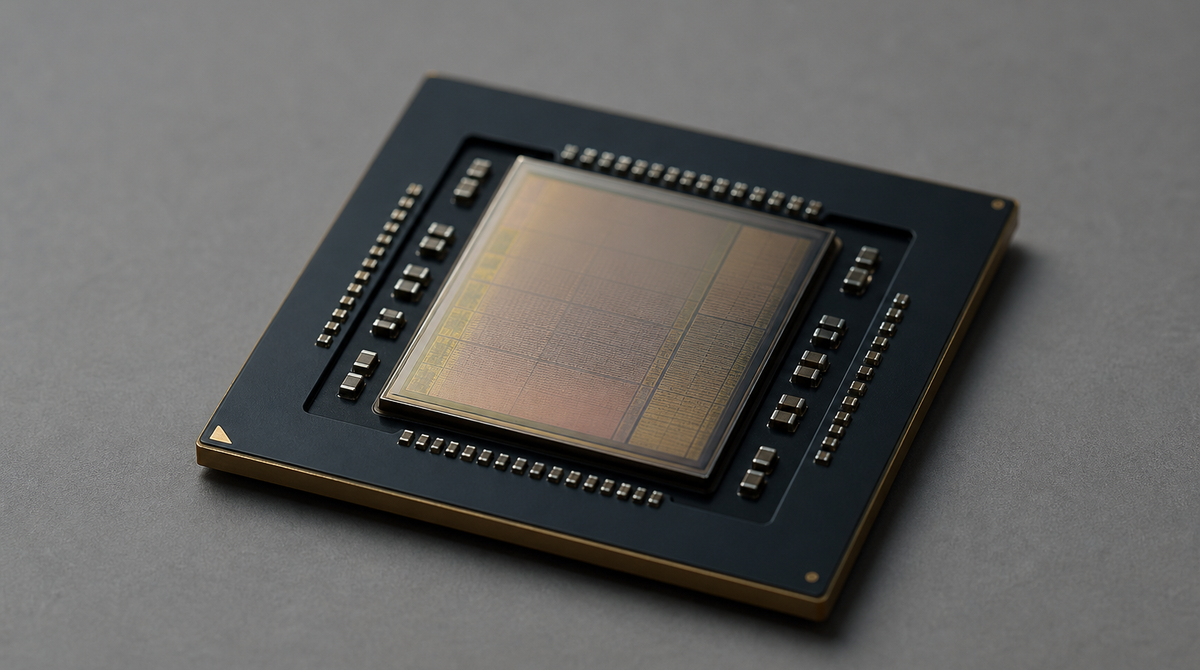
According to multiple reports, Anthropic is in talks with Samsung as a manufacturing partner for a chip of its own design. At this point, though, even the basics are said to be undecided: what the chip would be used for, how powerful it would be, and how it would fit inside a server. The project has reportedly not yet moved into detailed design, prototyping, or mass production.
Anthropic itself has been careful not to say much. In response to inquiries, the company noted only that a diverse hardware stack combining chips from Google, Amazon, and NVIDIA will remain important to its compute foundation, and that it had nothing further to add about any partnership with Samsung. In other words, a custom chip appears to be just one option rather than a plan to replace its existing suppliers.
The Technical Aim: 2nm and Advanced Packaging
The reports focus on Samsung's 2nm process and its advanced packaging technology. Packaging refers to the step of sealing and connecting the processor, memory, and other components into a single unit. Advanced packaging that places the processor and memory physically closer together can speed up the data exchange between them and reduce processing bottlenecks. Because generative AI workloads require moving enormous amounts of data back and forth at high speed, this "closeness" has a large effect on real-world performance.
For Samsung, 2nm represents its most advanced manufacturing technology. Landing a major AI company as a foundry customer would be a valuable chance to build a track record at cutting-edge process nodes.
Following OpenAI, Amazon, and Google Into Custom Silicon
Anthropic would not be the first AI company to pursue its own chip. The main motivations are owning hardware optimized for specific compute tasks, and easing dependence on NVIDIA, which retains an overwhelming presence in the chip market.
Rival OpenAI recently teamed up with Broadcom to unveil its own inference processor, called "Jalapeño," which OpenAI says outperforms competing chips in performance per watt (power efficiency). Amazon and Google have likewise offered their own in-house TPUs (chips specialized for AI processing) as part of their cloud services. Anthropic's move suggests it is now looking to join this trend in earnest.
A Curious Twist: Samsung, NVIDIA's Close Ally
What makes this interesting is that Samsung is already a major manufacturing partner for NVIDIA. While Samsung supplies the chips NVIDIA needs to train and run its AI models, it also uses NVIDIA's software in its own manufacturing process, and the two are cooperating on an AI chip factory in South Korea. Samsung has also been linked to potential chip-making collaboration with Google.
If a Samsung so deeply tied to NVIDIA ends up building Anthropic's custom chip, the relationships across the supply chain become intricately intertwined. It would be a very AI-industry-like pairing: an AI company that wants to reduce its reliance on NVIDIA joining hands with a foundry that also manufactures for NVIDIA.
Summary
The report that Anthropic is in talks with Samsung over manufacturing a custom AI chip again highlights how AI companies are moving to secure not just the "models" but also the semiconductors that underpin them. The purpose and performance are still to be worked out, and Anthropic has signaled that it will keep NVIDIA at the center of its setup for now. Even so, the very fact that it is seriously weighing a chip of its own is likely to draw attention as a new move in the competition over AI infrastructure.