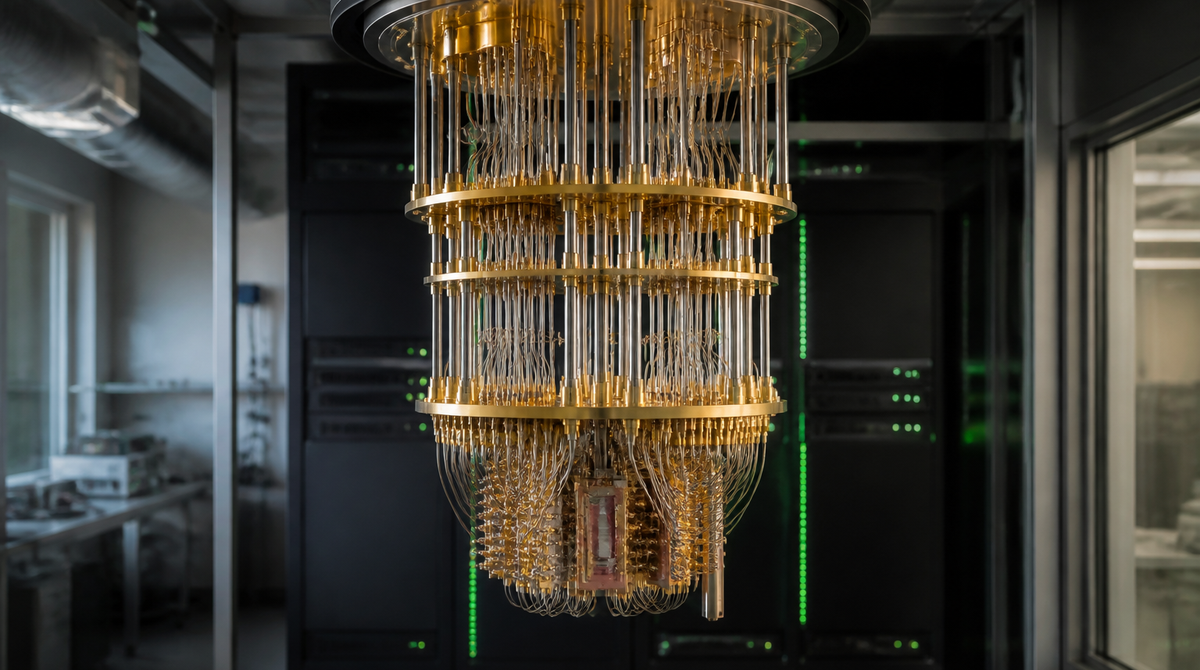
On September 14 (local time), NVIDIA announced that its open-source quantum computing platform CUDA-Q now includes a new layer for fault-tolerant quantum computers called CUDA-Q Logical. The announcement was timed with IEEE Quantum Week 2026, the international quantum computing conference held in Toronto, Canada. The new layer lets researchers combine algorithms, error-correction codes and hardware configurations in a single workflow, and Fermi National Accelerator Laboratory (Fermilab) in the United States reports that its design cycle shrank from five months to three weeks. CUDA-Q Logical is already available on GitHub.
A Foundation for the Era of Logical Qubits
Physical qubits, the basic unit of a quantum computer, are highly sensitive to noise, and errors pile up over the course of a computation if they are used as is. The approach widely considered essential for practical-scale quantum computing is to bundle several physical qubits together, detect and correct errors among them, and treat the group as a single reliable "logical qubit." Large workloads such as drug discovery, financial modeling and materials development all presuppose this kind of fault tolerance.
Developing applications for fault-tolerant quantum computers, however, is a slow and painstaking job. Tweak the algorithm, swap in a different error-correction code, or revisit the hardware layout, and any one of those changes can dramatically alter the number of physical qubits and the runtime required. Because the pieces all affect one another, the optimal combination cannot be found unless they are designed together (co-designed).
CUDA-Q Logical is the layer that takes on exactly this task. Researchers can design and integrate every component an application built on logical qubits needs in one place, switch between options, and search for the configuration that delivers the best performance. Timothy Costa, who leads NVIDIA's quantum business, explained that quantum computing is maturing into an era of logical qubits and that researchers need an open, customizable platform capable of representing every aspect of a fault-tolerant system. He stressed that the platform lets teams explore fully integrated, co-optimized systems regardless of qubit type or architecture.
It Works Much Like a Compiler
According to a technical paper published by NVIDIA's research team, CUDA-Q Logical sits directly above the physical execution layer and progressively lowers hardware-independent quantum programs through an abstract machine model called a virtual logical machine. Along the way it generates error-correction microcode, pulse schedules for manipulating physical qubits, and real-time control plans, effectively serving as a compiler stack dedicated to fault-tolerant quantum computing.
What I find particularly interesting is that resource estimates are derived directly from the artifacts the compiler actually produces rather than from theoretical formulas. Until now, teams have tended to rely on rough estimates such as "a computation of this size should need roughly this many physical qubits." Because the actual configuration can now be counted as is, the estimates become far more trustworthy.
7x Faster at Fermilab, One-Tenth the Qubits for Silicon
Several early results have been shared. Fermilab's researchers used CUDA-Q Logical to validate prior results and evaluate resource requirements such as physical qubit counts and runtimes across different error-correction approaches and quantum hardware. By turning complicated fault-tolerant system designs into a repeatable and verifiable computational workflow, they accelerated algorithm development from five months to three weeks, a 7x speedup. Anna Grassellino, chief technology officer at Fermilab and director of the Superconducting Quantum Materials and Systems Center, said that work that would have typically required about five months of building specialized infrastructure was completed in just three weeks.
Another eye-catching example comes from Iceberg Quantum and Diraq, both based in Australia. Iceberg Quantum used CUDA-Q Logical to model a fault-tolerant architecture for Diraq's silicon spin qubits. The result showed that 1,000 logical qubits can be built from 150,000 physical qubits, roughly one-tenth of Diraq's previous estimate. It is a telling example of how far clever design can push back against the conventional wisdom that error correction demands enormous numbers of physical qubits.
Beyond these, neutral-atom company Infleqtion, superconducting-qubit maker IQM Quantum Computers, silicon-qubit developer Quantum Motion, simulation platform provider QCDesign and Sandia National Laboratories in the United States have all begun using CUDA-Q Logical. The fact that companies and labs working on different qubit modalities share the same foundation is precisely why NVIDIA keeps repeating that the platform is modality-agnostic.
Sandia's New QUOPS Benchmark Is Included Too
The announcement also covers QUOPS, a new benchmark developed by Sandia National Laboratories that is now included in CUDA-Q as a reference implementation. QUOPS is a hardware-agnostic, open metric for measuring how far quantum computing systems have progressed toward utility-scale applications.
Until now, progress in quantum computing has mostly been described in terms of improvements on the physical-qubit side: increasing qubit counts, raising fidelity and extending coherence times. QUOPS looks ahead to the next stage, fault tolerance, and aims to let vendors compare their progress with a common yardstick. Ahead of IEEE Quantum Week, Sandia posted a preprint reporting initial benchmark results for quantum processors from Google, IBM and Quantinuum. Timothy Proctor, co-director of Sandia's Quantum Performance Laboratory, described the benchmark's purpose as giving the whole industry a way to track and forecast the growth of quantum computers' capabilities.
A Growing Ecosystem Linking GPUs and Quantum Processors
The announcement also highlighted adoption of NVIDIA's other quantum technologies beyond CUDA-Q Logical. Diraq is using NVIDIA Ising, a family of open models for building and deploying AI for quantum computing, to calibrate its silicon quantum processor. With NVQLink, the open system architecture for tightly coupling quantum processors with GPU supercomputers, Anyon Computing developed a new quantum control system, and French photonic quantum computing company Quandela built an architecture combining quantum processors with GPUs. Quantum Machines ran a demonstration integrating supercomputing resources with qubits at the Israeli Quantum Computing Center.
On the application side, IonQ reported progress on DQAOA-GPT, a quantum generative AI framework, using NVIDIA accelerated computing, and Phasecraft used NVIDIA cuQuantum to build a molecular database from large-scale emulations of quantum chemistry calculations (the variational quantum eigensolver), among other examples of GPUs serving as tools for quantum research. Qedma Quantum Computing, which provides error-correction and error-mitigation software, and QCentroid, which offers a hybrid quantum application platform for enterprises, have each integrated their technology with CUDA-Q as well.
Summary
NVIDIA has added CUDA-Q Logical, a design and integration layer for fault-tolerant quantum computers, to its open-source quantum computing platform CUDA-Q. Its key strength is letting researchers design everything from algorithms and error-correction codes to hardware configurations together while estimating required resources from actual compiler output. Fermilab cut its design cycle from five months to three weeks, and in the Iceberg Quantum and Diraq case the number of physical qubits required fell to roughly one-tenth of the previous estimate. Sandia National Laboratories' QUOPS benchmark is included as a reference implementation. As the yardstick for quantum computers shifts from "how many qubits" to "how cheaply can reliable logical qubits be built," this announcement makes clear NVIDIA's intent to control that design process from the GPU side.
※The thumbnail image is AI-generated and for illustrative purposes.